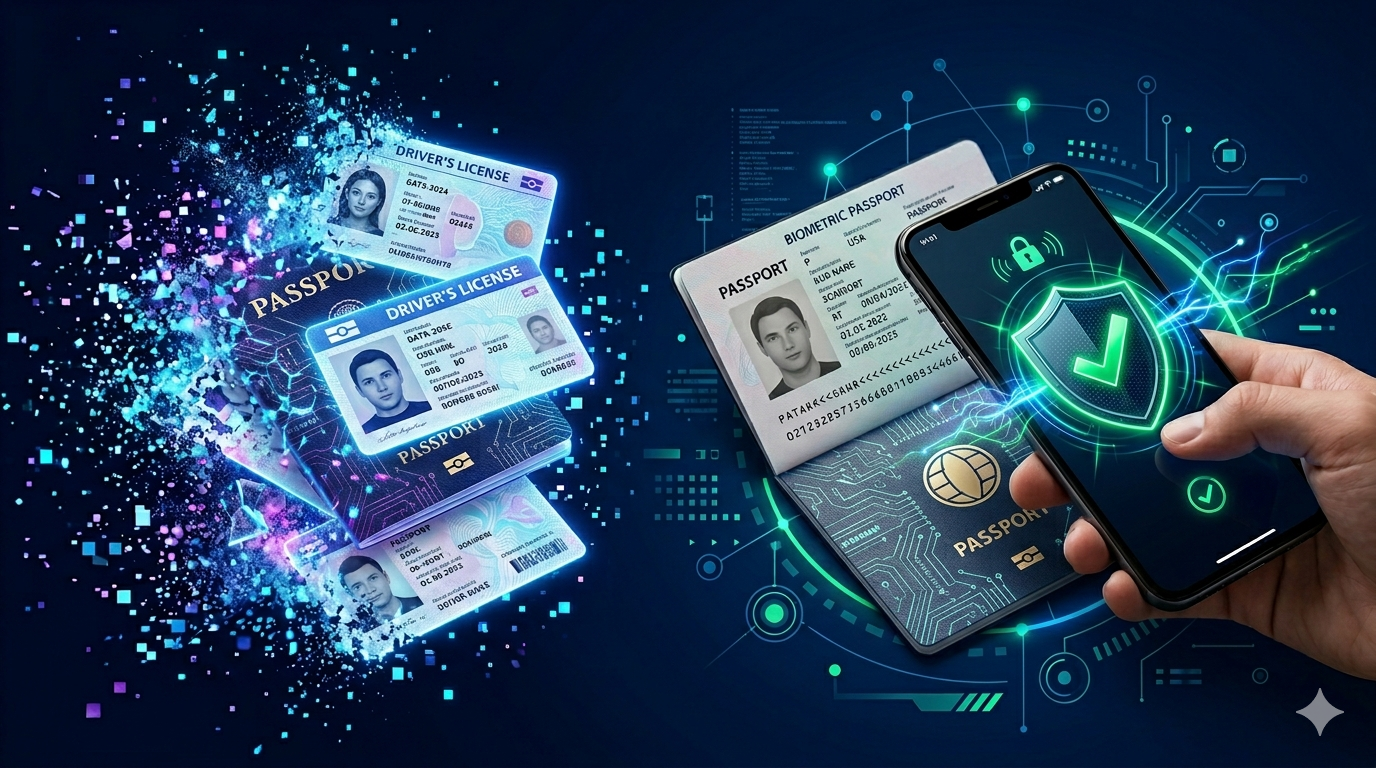
For about $15, anyone with a browser can generate a forensically convincing fake government ID — front, back, hologram, MRZ that parses correctly, photograph that matches a face the operator chooses. Independent red-team tests run by buyers in Q1 2026 are showing pass rates of 60 to 90 percent against the document-upload-plus-selfie verification stacks that still dominate the market. In one widely circulated test, a single off-the-shelf generator pushed thirty-seven different “verified” identities through a major US KYC provider over a weekend, undetected, before the issuing fingerprint was finally flagged.
This is no longer a future problem. The synthetic ID economy is in production. And the architectural assumption that has powered identity verification for the last decade — that you can establish trust by inspecting pixels — is no longer defensible as the primary verification path.
This post is about how we got here, why the standard mitigations are losing the arms race, and what the replacement stack looks like in practice.
How the Synthetic ID Economy Got to $15
Three things had to happen at the same time for synthetic IDs to become commodity infrastructure for fraud.
First, open-weight image models reached the quality threshold where a single prompt can produce a near-photographic ID document, including realistic surface texture, ink-bleed, and font kerning. The 2023 generation of these tools needed expert prompt engineering and produced obvious tells. By late 2025, fine-tuned variants trained on leaked and scraped ID corpora produce documents that survive the kind of inspection a junior reviewer or a basic computer-vision pipeline can perform.
Second, public templates leaked. Multiple US state DMV vendor breaches between 2023 and 2025 put structural templates — the exact pixel layouts, security pattern positions, and barcode encoding schemas for several major jurisdictions — into the hands of anyone with a torrent client. Combined with publicly documented MRZ specifications and ICAO 9303 chip layout standards, the inputs to a competent forgery pipeline are no longer secret.
Third, the supply side professionalized. What started as one-off services on dark-web forums turned into web-accessible API products with documentation, throughput SLAs, and customer support. Pricing collapsed from low hundreds of dollars per ID in 2023 to single-digit dollars in 2026. Throughput went from hours per document to seconds per document. The same pipelines that generate documents now generate matching selfies, including injection-ready video clips for liveness checks.
The result is a fraud economy where the unit cost of a verification attempt is lower than the unit cost of detecting it. That ratio is the actual problem.
Why Photo-of-ID-Plus-Selfie Verification Broke
The dominant verification flow has been stable for years: a user uploads images of the front and back of an ID document, takes a selfie or a short liveness video, and a vendor returns a pass/fail signal. Inside that vendor, a pipeline runs document classification, MRZ parsing, basic security-feature heuristics (font shape, expected hologram positions, color profile), and face matching against the document photo.
Every step in that pipeline assumes the input is a faithful capture of a physical artifact. That assumption is what synthetic ID generators target.
Document AI does not actually verify a document. It scores how well the input matches the patterns it has been trained to associate with authentic documents. Synthetic generators are trained against the same public benchmarks vendors use to validate their detectors. The training objective is, almost literally, “produce outputs that score above the threshold.” This is why the arms race favors the attacker: the attacker’s loss function is the defender’s pass criterion.
Hologram and security-feature checks done from a 2D camera capture are largely theatrical. A hologram is, by design, a feature whose authenticity depends on viewing angle and lighting — properties a static image cannot capture. Vendors that claim to verify holograms from a single uploaded photo are inferring from indirect cues that a generator can readily reproduce.
Then there is the injection-attack dimension. The pixels reaching the verification server are not the pixels coming off a physical camera. Virtual camera drivers, browser extension exploits, mobile emulators, and modified app builds can replace the camera input with arbitrary content before any liveness or capture-quality check runs. An attacker who can inject a generated selfie does not need to defeat the model — they need to defeat the camera abstraction, and that abstraction was never designed as a security boundary.
Manual review is not the safety net it used to be. Human reviewers under throughput pressure routinely approve documents that current-generation generators produce. Multiple internal benchmarks at large verification vendors show human reviewer accuracy on synthetic IDs sitting in the same range as automated detectors — somewhere between 50 and 80 percent, depending on the document class and the time the reviewer has per case. When you are reviewing one document every twelve seconds, you do not catch a forgery whose only tell is a barely-perceptible edge artifact.
The Detection Patterns That Still Work — and Their Limits
There are real defenses against synthetic IDs, and a serious vendor stacks several of them. None of them is sufficient on its own.
Forensic image analysis — PRNU (sensor noise fingerprinting), error level analysis, and quantization-table inspection — can flag images that have been resaved or composited. These techniques work against a meaningful slice of low-effort synthetic submissions. They do not work against generators that simulate camera pipelines end-to-end, which is the direction the better generators are moving. Forensic analysis is a useful filter, not a verification step.
Behavioral and device signals — fingerprinting the browser or mobile environment, looking for known emulator artifacts, checking for virtual cameras, scoring submission velocity against known fraud rings — catch attackers who reuse infrastructure. They are essentially useless against a sophisticated attacker willing to rotate devices and residential proxies. They reduce noise; they do not raise the floor.
Liveness detection has evolved meaningfully, with passive liveness and challenge-response approaches both seeing real improvements. The current best-in-class systems detect a substantial majority of presentation attacks (printed photos, video replays) and a smaller-but-growing share of injection attacks. The fundamental issue is that liveness only verifies that the captured face is a live person — it cannot verify that the live person is the person on the (potentially synthetic) document.
The “use AI to detect AI” framing — train a discriminator on known synthetic outputs and call it a defense — is the worst of the bunch. Discriminators trained on a generator’s output are, at best, useful for as long as the generator does not change. The next checkpoint of the same model defeats them. Vendors who claim “deepfake detection” as a primary control are selling a moving target whose half-life is shorter than your procurement cycle.
The honest summary: detection helps at the margins, but no detection-based architecture is going to outrun a fraud economy whose marginal cost approaches zero. The exit from the arms race is to stop verifying pixels and start verifying cryptographic attestations.
The Stack That Replaces Document Upload
The replacement architecture is not a single technology. It is a layered stack that prioritizes verifications which a generator cannot synthesize, with high-friction fallbacks reserved for cases where the cryptographic path is unavailable.
NFC chip reads of e-passports and modern e-IDs. A smartphone with NFC reads the chip embedded in compliant identity documents — passports issued in compliance with ICAO 9303, and the growing share of national e-IDs that follow the same standard. The chip returns a cryptographically signed data object. The signature is from the issuing authority’s trust anchor. There is nothing to forge: a valid signature requires the issuer’s private key, which an attacker does not have. This is the closest thing to a binary verification result that exists in identity. For a deeper look at the protocol details, see our NFC chip verification deep-dive.
Mobile driver’s licenses and EUDI wallet credentials. Mobile driver’s licenses (mDLs) issued under ISO/IEC 18013-5, and EU Digital Identity Wallet credentials issued under eIDAS 2.0, are signed attestations issued by government authorities and held in the user’s wallet. Selective disclosure means a verifier asks only for the attribute it needs — “is this person over 18” — and receives a cryptographic answer without ever seeing the underlying identity data. Twenty-one US states now issue mDLs; all 27 EU member states will support the EUDI wallet by year-end. This is the destination architecture for most consumer verification flows.
Issuer authority verification, where it exists. Some jurisdictions and document classes support direct online verification against the issuing authority’s database. US DMV verification through AAMVA’s S2S service, NHS number verification in the UK, India’s Aadhaar e-KYC, several EU national PEPS services. Where these channels are available, they reduce the verification problem to a question against a trusted source.
On-device liveness and age estimation. When biometric checks are needed — and they are still needed for some flows — they should run on-device. The video stream never leaves the user’s phone; only a binary outcome and a signed attestation does. This eliminates the centralized biometric template that has powered most of the recent breach catastrophes, and it makes injection attacks harder because the model the attacker has to defeat is running inside the phone’s secure enclave rather than against an unknown remote endpoint. We covered the architectural argument in detail in our piece on on-device age estimation.
Passkeys and reusable credentials. Once a user is verified through a high-assurance path, the result should be bound to a passkey or a reusable credential rather than re-collected on every return visit. This solves the conversion problem — re-verification friction is the dominant reason users abandon — and it eliminates the temptation to store biometric templates “just in case.” The user proves the same identity again by satisfying the passkey challenge, not by re-uploading their face. See our analysis of the passkey tipping point for the broader implications.
A vendor who cannot offer at least the first three of these is selling a 2018 architecture in a 2026 threat environment.
Hybrid Flows That Don’t Kill Conversion
The legitimate concern with a cryptographic-first stack is coverage. Not every user has an NFC-capable phone, an mDL, or a passport. The answer is not to default to document upload — it is to design tiered routing that tries the highest-assurance method first and falls back deliberately.
A pragmatic decision tree for a consumer flow:
- Detect device capabilities. If the device is NFC-capable and the user is in a jurisdiction where mDLs are widely issued, present the wallet flow first. Selective disclosure is one tap; conversion is near-vertical when this works.
- Offer NFC chip read of e-passport as the next option. For users without an mDL but with an e-passport, this is still a cryptographic verification and takes thirty seconds.
- Issuer-authority verification where supported. A direct check against AAMVA, NHS, Aadhaar, or equivalent yields a high-confidence result without document inspection.
- Document upload + on-device liveness — only as a fallback. When no cryptographic path is available, fall back to the legacy flow, but route it through risk scoring. Submissions from high-risk fingerprints, anomalous device profiles, or known fraud signatures get additional friction (reviewer escalation, KBA challenge, NFC re-prompt). Submissions from low-risk profiles complete the legacy flow with the understanding that this path carries elevated false-acceptance risk.
- Reusable credential or passkey for return visits. Bind the verification result to a credential the user can present on subsequent visits without re-running any of the above.
This is not a flow chart we invented. It is roughly the architecture every regulator currently writing standards is converging on, including the UK Ofcom highly-effective standard, the France ARCOM double-anonymity standard, and the Australian eSafety age assurance trial. The consistent regulatory direction is: prefer methods that don’t expose the verifier to forgeable inputs.
What Regulators Are Starting to Require
Synthetic ID fraud has been the open secret of the verification industry for over a year, and regulators have started to write it into standards.
The amended COPPA Rule, effective April 22, 2026. The FTC’s amended rule expands the list of approved verifiable parental consent methods, and notably emphasizes that the operator must use methods “reasonably calculated, in light of available technology, to ensure” the consenting party is the parent. The phrase “available technology” is the wedge. As cryptographic methods become commercially available, “we used document upload and a checkbox” becomes a harder defense. We walked through the operational implications in our COPPA compliance checklist.
UK Ofcom’s “highly effective” age assurance standard. Ofcom’s guidance under the Online Safety Act explicitly identifies open-loop ID document submission as insufficient for high-risk content, requiring methods with documented resistance to spoofing and circumvention. The guidance is technology-neutral on its face but maps directly to NFC, mDL, and issuer-authority verification in practice.
EU eIDAS 2.0 and the Digital Identity Wallet mandate. The EU is not just allowing the EUDI wallet; it is mandating that “very large online platforms” accept it and that public services issue compatible credentials. By year-end 2026, the wallet is the legal default for cross-border identity in the EU. Document upload becomes the fallback, not the primary.
France ARCOM double anonymity standard. ARCOM’s age verification framework requires a separation between the entity verifying age and the entity providing the service, paired with cryptographic attestations rather than raw identity data. This effectively forecloses the photo-upload-to-the-platform model that has dominated US adult-content verification.
State-level laws in the US. Texas HB 18, Florida HB 3, Idaho HB 542, Nebraska LB 383, and the wave of state social media age laws that followed the Supreme Court’s decision in Free Speech Coalition v. Paxton increasingly use language like “commercially reasonable” or “demonstrably effective.” Plaintiffs and AGs will read those phrases, in litigation, against the state of the art at the time of compliance. The state of the art in 2026 is no longer photo upload.
The regulatory direction is unambiguous. Vendors and operators who continue to treat photo upload as a primary verification path are accumulating compliance debt that will be expensive to retire under enforcement.
How to Evaluate a Verification Vendor in the Synthetic-ID Era
A practical buyer’s checklist for procurement teams evaluating verification vendors in 2026:
- Does the vendor support NFC chip read of e-passports and compliant national e-IDs? If no, this is a 2018 stack with a 2026 marketing page.
- Does the vendor support mDL / EUDI wallet credentials, including selective disclosure? Coverage of US state-issued mDLs and the EUDI wallet should be specific and current.
- Where is biometric data stored? A vendor that retains face templates server-side is a breach surface. On-device-only architectures eliminate this exposure entirely.
- What independent benchmarks have they published or participated in? The Australian eSafety age assurance trial, NIST FATE/FRVT submissions, and similar third-party evaluations are the only credible accuracy signals. Vendor-reported numbers without independent reproduction are marketing.
- What is their documented FAR/FRR against synthetic ID benchmarks specifically? Generic accuracy numbers are not enough. Ask for results against current-generation generative ID corpora, not against the 2022 spoofing dataset everyone has memorized.
- What does the fallback flow look like, and what is its failure mode? A clean cryptographic path with a cleanly-scoped fallback is defensible. A “throw everything at document upload if anything fails” architecture is the legacy stack with extra steps.
- Reusable-credential support and passkey binding? Re-verification is where conversion goes to die and where most of the temptation to store sensitive data lives. A vendor with no story here will quietly push you back into the upload-and-selfie loop on every return visit.
The vendor answers to these questions reliably separate the architectures that will be defensible in 2027 from the architectures that will be in the news.
The Bottom Line
Document upload plus selfie verification is on the same trajectory as SMS-based two-factor authentication: still ubiquitous, still in product flows, still good enough for the residual case where nothing else works — but no longer defensible as the primary verification path for any product where the cost of false acceptance is meaningful. The synthetic ID economy has flipped the cost asymmetry permanently, and no amount of detection investment is going to flip it back.
The platforms that will be in compliance, out of the breach headlines, and not paying eight-figure regulatory settlements by 2027 are the ones building cryptographic-credential-first verification today. NFC, mDL, EUDI, on-device liveness, passkey-bound reuse — that’s the stack. The market is already pricing it; the regulators are starting to require it; the fraud economy has already routed around everything else.
If you’re still uploading IDs and selfies as your primary verification path, the question is not whether you will be replaced. It is how expensive the replacement event will be, and whether it happens because you chose it or because an AG made you.
If you’d like to see what a cryptographic-first verification flow looks like in production, book a technical walkthrough or read our 5-minute integration guide.