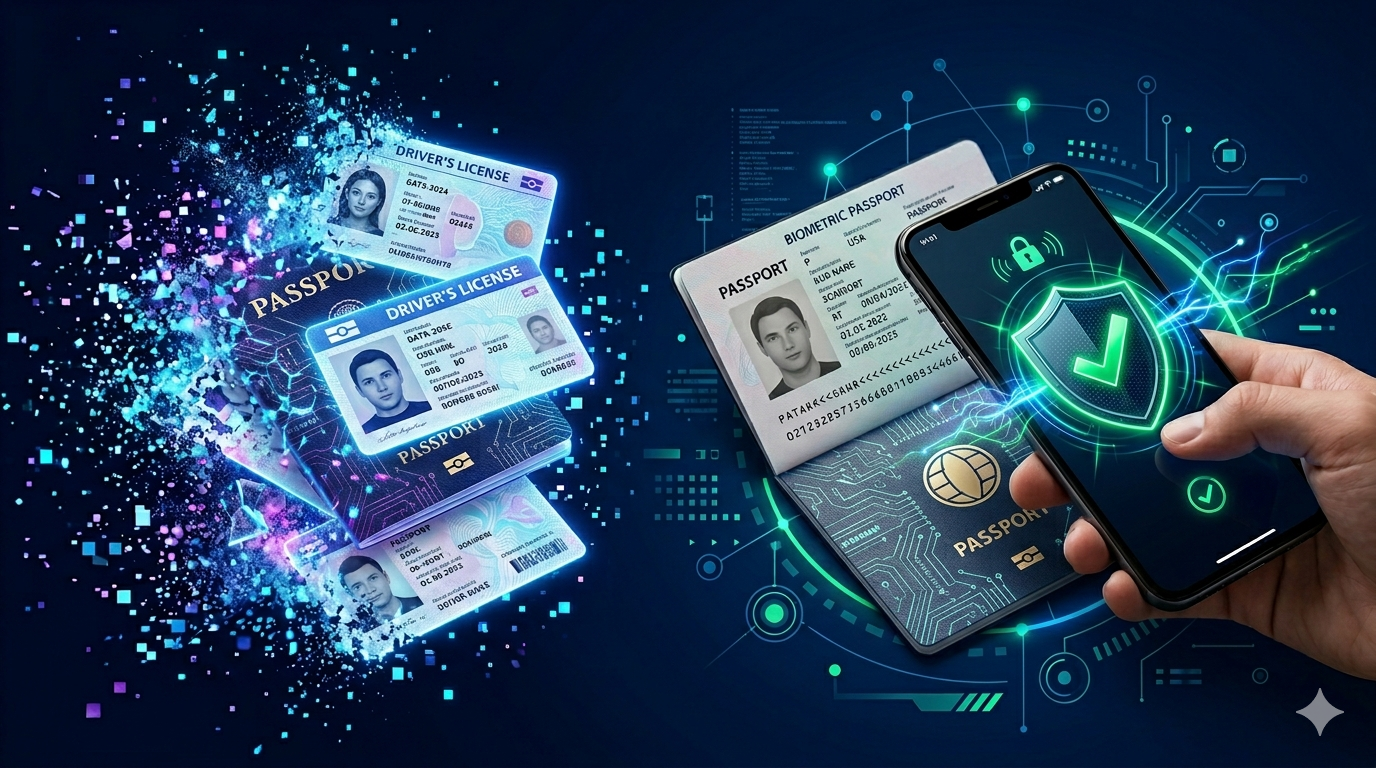
Every identity verification flow built on document photos has the same structural weakness: the camera. Whether a user uploads a passport scan or takes a selfie, the verification pipeline starts with an image — and images can be fabricated, injected, or manipulated. Deepfake attacks exploit exactly this, producing synthetic media that bypasses liveness detection before the server even gets involved.
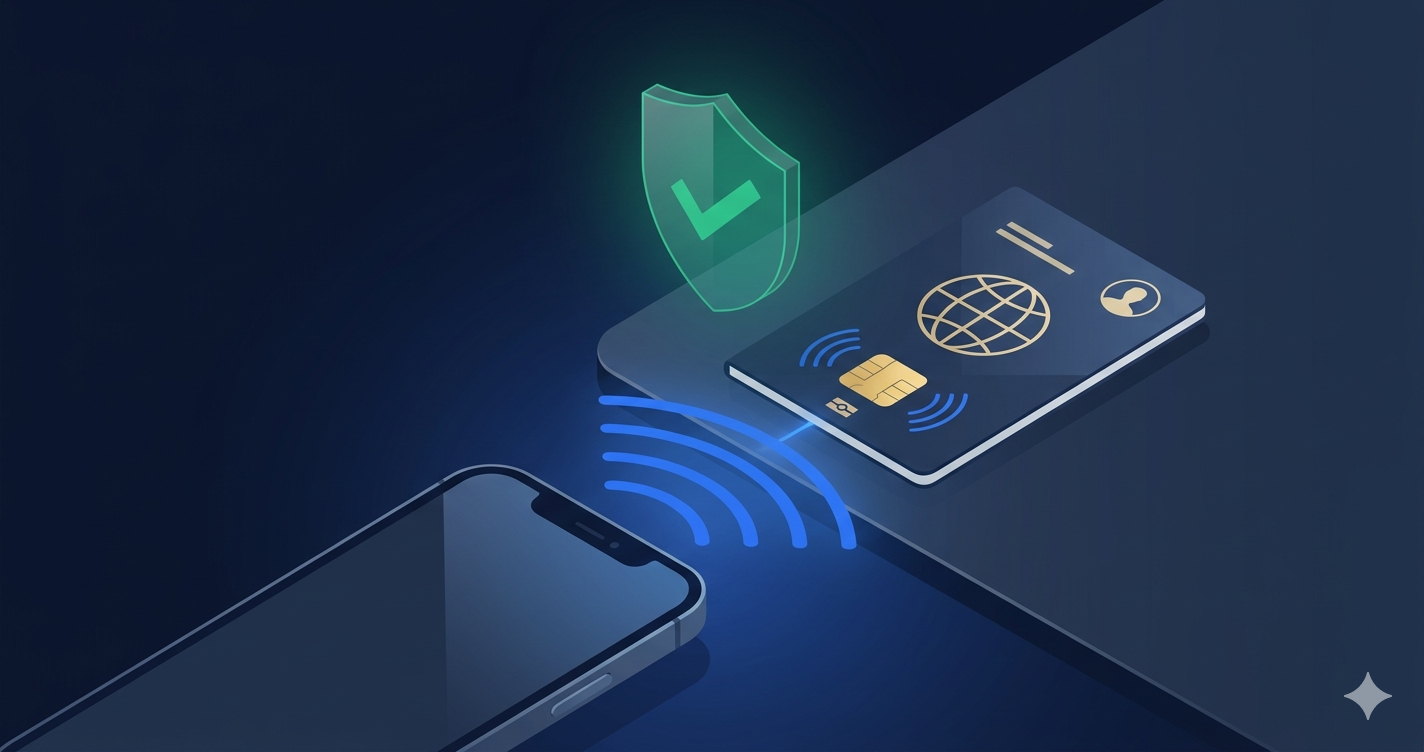
NFC chip verification sidesteps the problem entirely. Instead of analyzing a photo of a document, it reads the cryptographically signed data stored on the chip embedded in modern passports and national ID cards. That data cannot be cloned, cannot be injected, and cannot be generated by an AI model. It’s a fundamentally different trust model — one that doesn’t depend on visual inspection at all.
With over 140 countries now issuing NFC-enabled travel documents, 650 million people projected to use mobile driver’s licenses by end of 2026, and regulators increasingly demanding high-assurance verification methods, NFC chip reading is shifting from “nice to have” to the default first step in any serious identity verification flow.
How NFC Chip Verification Actually Works
An NFC-enabled identity document — a biometric passport (marked with the standard ICAO logo), a national ID card, or an increasingly common mobile driver’s license — contains an embedded contactless chip. That chip stores a standardized data set defined by ICAO Doc 9303:
- MRZ data: Name, nationality, date of birth, document number, expiration date.
- Facial image: A high-resolution photo stored in a standardized biometric format.
- Fingerprints (where applicable): Stored as compressed biometric templates.
- Digital signature: A cryptographic signature from the issuing country’s Certificate Authority, binding the data to the document.
When a user taps their document against a smartphone’s NFC reader, the verification flow proceeds through several cryptographic protocols:
1. Access Control
Before the chip releases any data, the reader must authenticate itself. Two protocols handle this:
Basic Access Control (BAC) derives an encryption key from the Machine Readable Zone (MRZ) — the two lines of text at the bottom of the document’s data page. The user either scans the MRZ optically or enters their document number, date of birth, and expiry date. This proves the reader has physical access to the document.
Password Authenticated Connection Establishment (PACE) is BAC’s modern replacement, offering stronger encryption and resistance to eavesdropping. PACE uses a Card Access Number (CAN) printed on the document, establishing a secure session without exposing key material.
2. Passive Authentication
Once the secure channel is open, the reader downloads the chip’s data groups and their associated digital signatures. Passive Authentication verifies that the data was written by the issuing state’s certificate authority and has not been modified since issuance.
This is the critical step. The chip’s digital signature is chained to a Country Signing Certificate Authority (CSCA), maintained by each issuing state and distributed through ICAO’s Public Key Directory. If a single byte of chip data has been altered — a name changed, a date of birth modified, a photo swapped — the signature check fails.
3. Active Authentication / Chip Authentication
Passive Authentication proves the data is genuine, but it doesn’t prove the chip itself is the original. Active Authentication solves this by challenging the chip to sign a random nonce with a private key that never leaves the chip. If the chip produces a valid signature, it’s confirmed as the original — not a clone.
Chip Authentication is the newer variant, offering the same clone-detection guarantee while also establishing a stronger encrypted session for data transfer.
4. Data Extraction and Matching
With the chip authenticated and data integrity confirmed, the verification system extracts the biometric photo and personal data. This data can then be used for:
- Face matching: Comparing the chip’s stored photo against a live selfie. Since the chip photo is the issuing authority’s original enrollment image, it’s a far stronger reference than a photo-of-a-photo captured by a phone camera.
- Age verification: Extracting the date of birth directly from cryptographically signed data — no OCR errors, no photo manipulation risk.
- Identity binding: Linking the verified identity to an account, session, or credential.
The entire flow completes in seconds on a modern smartphone.
Why NFC Verification Changes the Security Model
The security advantages of NFC chip verification aren’t incremental improvements over photo-based methods. They represent a categorically different trust model.
Deepfakes Become Irrelevant
Photo-based verification pipelines are vulnerable because they rely on visual analysis of transmitted images. Deepfakes, face swaps, and injection attacks all target this surface. NFC chip verification doesn’t analyze images transmitted from the user’s device in the traditional sense — it reads cryptographically signed data from a physical chip. There’s no camera feed to intercept, no image to synthesize, no liveness check to fool.
An attacker would need to compromise the issuing state’s PKI infrastructure or physically clone a secure chip element — both of which are orders of magnitude harder than generating a deepfake video.
Document Forgery Becomes Detectable
Physical document forgeries — altered photos, changed dates, fake holograms — are increasingly sophisticated. Visual inspection, even aided by ML models trained on document templates, has a ceiling. NFC chip verification bypasses visual inspection entirely. If the cryptographic signature doesn’t validate against the issuing state’s certificate chain, the document is rejected regardless of how convincing it looks.
OCR Errors Disappear
Optical Character Recognition on document photos is a consistent source of verification failures. Poor lighting, glare, camera angles, low-resolution captures — all introduce errors that require manual review or cause false rejections. NFC chip reading extracts data digitally, exactly as the issuing authority stored it. Zero OCR. Zero ambiguity.
Verification Speed Drops to Seconds
A typical photo-based verification flow — capture document, capture selfie, upload, process, return result — takes 30 to 90 seconds under ideal conditions and significantly longer with retries. NFC chip reading completes in 2 to 5 seconds. For high-volume platforms processing millions of verifications, this difference compounds into significant operational cost savings and dramatically lower drop-off rates.
The Regulatory Push
Regulators are increasingly specifying NFC chip verification — or “chip-first” verification — as the expected standard for high-assurance use cases.
eIDAS 2.0 and EU Digital Identity Wallets: The EU’s revised electronic identification regulation mandates that all member states offer at least one EU Digital Identity Wallet to citizens by end of 2026. These wallets will be loaded with verified credentials, and the initial identity proofing step for wallet enrollment is expected to use NFC chip reading from national ID documents as the primary high-assurance method.
NIST SP 800-63-4: The updated NIST digital identity guidelines raise the bar for Identity Assurance Level 2 (IAL2), which now effectively requires evidence verification methods stronger than photo capture. NFC chip reading satisfies IAL2 requirements cleanly.
UK Age Assurance: Ofcom’s guidance under the Online Safety Act encourages “highly effective” age verification methods. NFC-based document verification, combined with face matching, represents the highest assurance tier available — well above self-declaration or AI-based age estimation.
76% of organizations surveyed in 2026 report increased regulatory requirements for stronger identity checks, with chip verification emerging as the primary method for meeting those requirements.
Where NFC Fits in a Modern Verification Stack
NFC chip verification isn’t a replacement for your entire identity stack — it’s the high-assurance anchor that other methods build on.
A practical architecture looks like this:
Tier 1 — NFC Chip Verification (highest assurance): Used for initial identity proofing, wallet enrollment, regulated use cases (financial services, age-restricted content with legal mandates), and any scenario where the cost of a false positive is high.
Tier 2 — Document Photo + Biometric Matching: Used when the user’s document doesn’t have an NFC chip (older documents, some national IDs) or when the device doesn’t support NFC reading. This remains the fallback for broad coverage.
Tier 3 — AI Age Estimation: Used for low-friction age gating where the compliance requirement allows probabilistic methods — social media age gates, content recommendations, parental controls.
Tier 4 — Reusable Credentials: Once a user has been verified at Tier 1 or Tier 2, issue a cryptographic credential (an age token, a verified identity credential) that can be re-presented without repeating the verification. This is where NFC chip verification pays dividends — a single high-assurance check becomes the foundation for frictionless re-verification across platforms.
The key insight: NFC chip verification at enrollment time dramatically increases the trustworthiness of every downstream credential and session. A reusable age token anchored to an NFC-verified identity is fundamentally more trustworthy than one anchored to a photo-based check.
Device Coverage and Practical Considerations
The most common objection to NFC chip verification is device coverage. Here’s the current reality:
Android: NFC reading of identity documents has been supported since Android 6.0 (2015). All modern Android devices ship with NFC hardware. The Android Identity Credential API and the newer OpenID4VP stack provide standardized interfaces for document reading.
iOS: Apple opened NFC tag reading in iOS 11 (2017) and expanded capabilities with Core NFC. As of iOS 17+, full MRTD (Machine Readable Travel Document) reading is available through the PassKit and Identity frameworks. Apple’s integration with EU Digital Identity Wallets further cements NFC as a first-class identity primitive on iOS.
Document coverage: Over 140 countries issue NFC-enabled passports. EU member states universally issue NFC-enabled national ID cards. The percentage of the population carrying an NFC-enabled document approaches universal coverage in developed markets.
User experience: The “tap your document on your phone” interaction is intuitive — far more so than positioning a document in a camera frame, ensuring lighting conditions, and waiting for OCR processing. User testing consistently shows higher completion rates for NFC flows versus photo capture flows.
The remaining gap is users with older documents that lack NFC chips. A robust verification system handles this gracefully by falling back to photo-based verification for these cases while routing NFC-eligible documents through the chip-first path.
What This Means for Your Platform
If your platform performs identity verification or age verification today, here’s the practical takeaway:
If you’re building new verification flows, make NFC chip reading the default path. Treat photo-based verification as the fallback, not the primary method. The security differential is large enough that this isn’t a marginal optimization — it’s a fundamental architectural decision.
If you have existing photo-based flows, add NFC chip reading as a parallel path. Route users with NFC-enabled documents and capable devices through the chip-first flow automatically. You’ll see immediate improvements in verification accuracy, speed, and resistance to fraud — without disrupting existing users on older devices.
If you’re issuing reusable credentials or age tokens, anchor them to NFC-verified identities wherever possible. The trust level of a reusable credential is only as high as the trust level of the initial verification. An NFC-anchored credential is meaningfully more defensible to regulators and auditors.
If you’re operating in regulated markets (financial services, age-restricted content, healthcare), NFC chip verification is rapidly becoming the expected standard rather than a premium feature. Building it in now avoids re-architecture when regulations mandate it.
How Xident Approaches NFC Verification
Xident’s verification SDK supports NFC chip reading as a first-class verification method alongside document photo capture, face matching, and AI-based age estimation. The SDK handles the full NFC protocol stack — BAC/PACE negotiation, Passive Authentication against the ICAO PKI, Active Authentication for clone detection, and data extraction — abstracting the cryptographic complexity behind a straightforward API.
When NFC chip data is available, Xident uses the chip’s stored facial image as the biometric reference for face matching, producing significantly higher match confidence than document-photo-based references. The extracted date of birth feeds directly into age threshold classification, with zero OCR error surface.
For platforms that issue Xident age tokens for returning users, NFC-verified tokens carry a higher assurance level — reflected in the token metadata — enabling downstream services to make trust decisions based on the strength of the original verification.
The result: a single integration that automatically selects the highest-assurance verification path available for each user’s device and document combination, while maintaining seamless fallback to photo-based methods when NFC isn’t available.
NFC chip verification isn’t new technology. Biometric passports have shipped with NFC chips since 2006. What’s changed is the convergence of regulatory demand, device capability, and threat landscape that makes chip-first verification the obvious default.
The deepfake arms race, the push for privacy-preserving verification, and the regulatory demand for high-assurance methods all point in the same direction: read the chip, verify the signature, trust the cryptography. Everything else is a workaround.