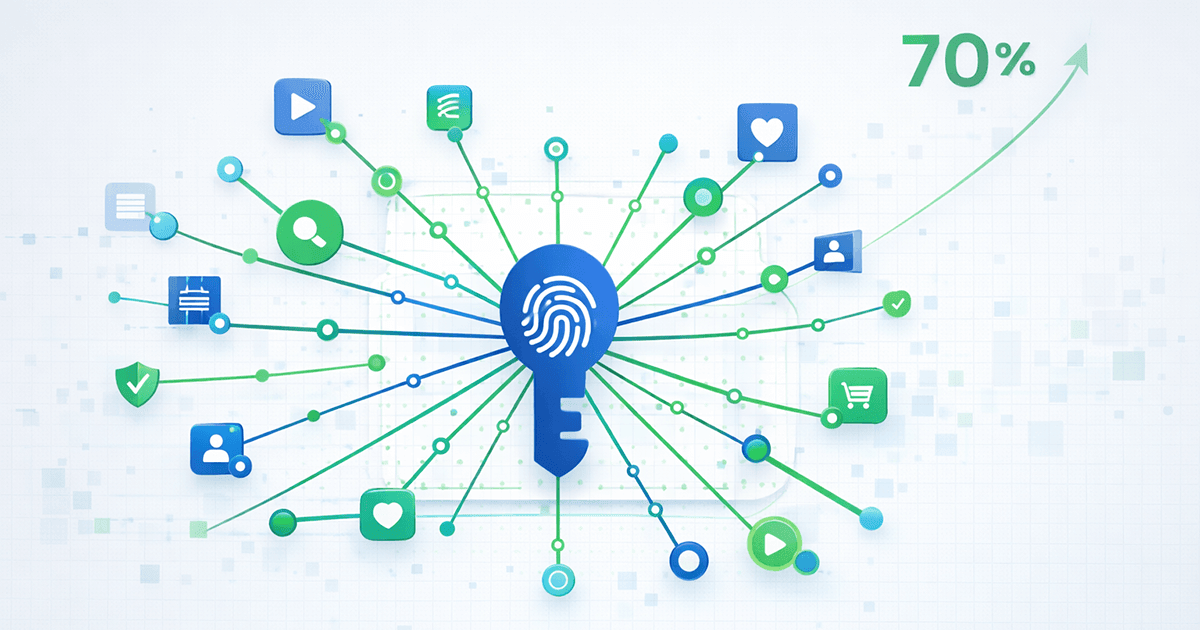
The shift is quietly accelerating. Passkeys — long positioned as the future of authentication — have moved from niche interest to mainstream reality. Today, approximately 70% of users have at least one passkey. Eight of the top 10 websites now support them. The U.S. National Institute of Standards and Technology (NIST) has elevated phishing-resistant multifactor authentication from recommendation to mandate. What was once experimental is now infrastructure.
Yet the identity verification industry hasn’t caught up.
This creates an extraordinary opportunity. While legacy verification providers continue to treat each verification as a standalone transaction, a new architecture is emerging — one built on passkeys and the network effects they enable. For organizations managing identity and access, understanding this shift isn’t academic. It’s a competitive necessity.
What Passkeys Actually Are (And Why It Matters)
For those still encountering the term, let’s be precise: passkeys are cryptographic credentials bound to a user’s device, protected by biometric or PIN verification. They implement the WebAuthn standard and FIDO2 protocol — open specifications designed to eliminate passwords and phishing vulnerabilities.
Here’s what makes them different from passwords:
Device-bound cryptography. A passkey consists of a private key stored securely on your device (phone, laptop, hardware key) and a public key shared with services. The private key never leaves the device. This architecture makes phishing and credential stuffing impossible — an attacker can’t intercept credentials because they’re never transmitted.
Biometric unlock stays local. When you use Face ID, a fingerprint, or a PIN to unlock a passkey, that biometric data is processed entirely on your device. No facial images, fingerprints, or PINs are sent to servers. The verification is purely local.
Cross-device syncing (optional). Modern passkeys can sync across your own devices through iCloud Keychain, Windows Hello, Google Password Manager, and similar services. You remain in control — syncing is an opt-in security choice, not a dependency.
This architecture addresses authentication’s oldest problems: weak passwords, phishing attacks, account takeovers. It’s why NIST, the European Union, and major platforms are aligning behind it.
The Identity Verification Gap
Here’s where the industry faces a genuine problem. Today’s identity verification platforms — Veriff, Jumio, Sumsub, Yoti, IDnow, and others — are built on a fundamentally cloud-centric model. A user verifies their identity on Platform A by uploading documents and submitting to a biometric check. If that same user wants to verify on Platform B two weeks later, they typically must repeat the entire process from scratch.
This is wasteful on multiple fronts:
User friction. Verification is time-consuming: document upload, selfie capture, potential manual review. Asking a verified user to repeat this on each new platform creates abandonment and frustration.
Operational cost. Every verification requires server-side processing, storage, and often manual review. Repeating this for the same user across platforms multiplies costs without adding value.
Privacy exposure. Every repetition means biometric data and identity documents are transmitted, stored, and retained across more servers. More endpoints mean more risk.
No persistent identity. There’s no mechanism for a user to carry their verification across platforms. Each platform maintains its own siloed identity record.
The industry assumes this is how verification works: isolated, document-dependent, repeated for each use case. But this assumption is about to be challenged by the architecture passkeys enable.
Introducing the Fast Lane: Xident’s Approach
At Xident, we’ve designed around the passkey opportunity. Here’s how it works:
First verification (new user). A user encounters an Xident-integrated platform and needs age or identity verification. If they’re new, they follow a standard document-based verification flow — KYC checks, liveness detection, document capture. Here’s where Xident differs: we perform all biometric processing on the client side using ONNX Runtime and WebAssembly. No facial images leave the user’s browser. The verification completes, and the user creates an Xident account.
Subsequent verifications (returning user). The same user arrives at another Xident-integrated platform weeks later and needs verification again. Instead of repeating the document flow, they simply authenticate with their passkey — Face ID, fingerprint, or PIN. In under a second, they receive a verification token valid across the network. No biometric recapture. No document re-upload. No server-side processing of facial data.
Alternatively, returning users can choose social OAuth login (Google, Apple, Microsoft), which issues the token equally fast — but passkey authentication is faster and more private.
This creates a dramatic difference in user experience. The traditional flow takes minutes. The passkey flow takes seconds.
It also creates a dramatic difference in cost structure. Document-based verification is expensive. Authenticating a passkey is essentially free. As more users fall into the “returning user” bucket — the dominant case once the network matures — the cost per verification approaches zero for platforms.
The Network Effect Engine
This is where the opportunity becomes systemic.
Each new platform that integrates Xident creates value for all previous users. If Platform A has 100,000 Xident-verified users, and Platform B integrates Xident, those 100,000 users suddenly have a 1-second verification option on Platform B instead of a 10-minute option. They also help populate Platform B with Xident tokens, making that platform more attractive to other Xident-verified users.
The incentive structure works in both directions:
For platforms: Faster verification means higher conversion, lower abandonment, and dramatically lower verification costs. After the initial verification, each returning user verification costs nearly nothing.
For users: Once you have an Xident account secured by a passkey, verification becomes frictionless. The more Xident-integrated platforms exist, the more valuable your passkey becomes.
For the network: Every platform integration increases the size of the verified user base, which increases the probability that new users already have a Xident account, which increases the percentage of fast-lane verifications, which decreases average cost per verification, which makes the business model more attractive and sustainable.
This is a genuine network effect. The traditional model — isolated verifications repeated on each platform — has no comparable dynamic. A legacy provider’s value to Platform A is independent of its value to Platform B. Xident’s value increases with each new integration.
The Phishing-Resistance Angle
Beyond speed and cost, there’s a security dimension that matters especially for sensitive use cases.
Traditional identity verification systems often rely on email-password combinations for account access. Verification is tied to an account you can access anywhere — and that account remains vulnerable to credential stuffing, password reuse, and phishing. An attacker who compromises your email can access your verification history, potentially even force re-verification.
Passkeys eliminate this entire attack surface. A passkey is physically bound to your device and cryptographically locked by your biometric or PIN. You can’t share it. It can’t be phished. It can’t be reset from a stolen email account. An attacker would need to physically steal your device and defeat your biometric — a dramatically higher bar than stealing a password.
For identity verification — arguably the most sensitive authentication use case — this matters. A passkey-protected verification token is substantially more trustworthy than one backed by traditional credentials.
Regulatory Alignment and the Road Ahead
Xident’s passkey-first approach isn’t just technically sound — it aligns with where regulation is moving.
The European Union’s eIDAS 2.0 Regulation mandates an EUDI Wallet: a device-based, user-controlled digital identity system. The architecture is familiar to anyone using passkeys — device-bound credentials, selective disclosure, biometric unlock on the device, no central storage of sensitive attributes. Regulators are moving toward this model because it solves the privacy and phishing problems that plague centralized identity systems.
NIST’s revised guidance on authentication (SP 800-63B-3) effectively mandates phishing-resistant multifactor authentication for federal systems and recommends it broadly. Passkeys are the primary implementation path for this standard.
The regulatory trend is clear: the future is device-bound, user-controlled, phishing-resistant credentials. Xident’s architecture anticipates this direction. As regulation tightens and liability for data breaches increases, platforms that have moved to passkey-based verification will face substantially lower compliance burden.
The Era of Verify-Once, Authenticate-Everywhere
The old model is “verify every time.” You prove your identity separately to every platform. It’s inconvenient, expensive, and creates privacy risk.
The emerging model is “verify once, authenticate everywhere.” You undergo thorough verification once. Thereafter, you simply authenticate to prove you’re you — a cryptographic operation that costs nothing and reveals no sensitive data.
This shift is not hypothetical. It’s already happening in adjacent spaces. Enterprise SSO has operated on this principle for years: verify user identity once, issue a token, reuse that token across services. Blockchain and distributed identity systems are built on this assumption. Mobile apps with platform-level biometric APIs have normalized device-bound authentication.
Passkeys and standards like WebAuthn make this model feasible for consumer identity verification at scale. Xident is built to realize this model — to make “verify once, authenticate everywhere” the normal path.
Implications for Identity Platforms
For organizations currently evaluating identity verification partners, this shift should inform your thinking.
Legacy providers will continue to optimize for the isolated-verification model. They’ll improve document processing, add liveness detection, streamline the individual verification flow. These are incremental improvements, but they don’t address the structural inefficiency of repeated verifications.
Providers building around passkeys and network effects will offer something fundamentally different: verification that gets faster and cheaper as the network grows, not slower and more expensive. A platform that verifies 100,000 users today will have materially lower cost per verification in six months, as the percentage of passkey-authenticated returning users increases.
For CTOs and product leaders, the question is straightforward: Do you want a verification system that requires user effort and server cost on each use? Or one where returning users verify in under a second, at near-zero marginal cost?
The technology to enable the latter exists today. Passkeys have reached mainstream adoption. Standards are aligned. The infrastructure is in place. The remaining question is adoption by platforms willing to build around this architecture.
Key Takeaways
-
Passkeys are now mainstream: With ~70% of users holding at least one passkey and 8 of the top 10 websites supporting them, passkey-based authentication has moved from emerging technology to standard infrastructure.
-
The verification industry is ripe for disruption: Current providers treat every verification as an isolated transaction, requiring users to re-verify on each platform. A network-based model can serve returning users in under a second, creating cost advantages and network effects that isolated systems cannot match.
-
Passkey-based verification aligns with regulatory direction: eIDAS 2.0 and NIST SP 800-63B-3 both mandate device-bound, phishing-resistant credentials — the exact architecture passkeys implement. Early adopters reduce compliance risk.
-
The future is verify-once, authenticate-everywhere: The architectural shift from isolated verification to network-based authentication isn’t just possible — it’s inevitable. Passkeys are the infrastructure that makes it economically viable at scale.