If you ship a mobile app that’s available in the United States, 2026 is the year your relationship with age verification fundamentally changes. A new category of state legislation — App Store Accountability Acts (ASAAs) — is rewriting the rules for how age is verified, who does the verifying, and what happens when a minor downloads your app.
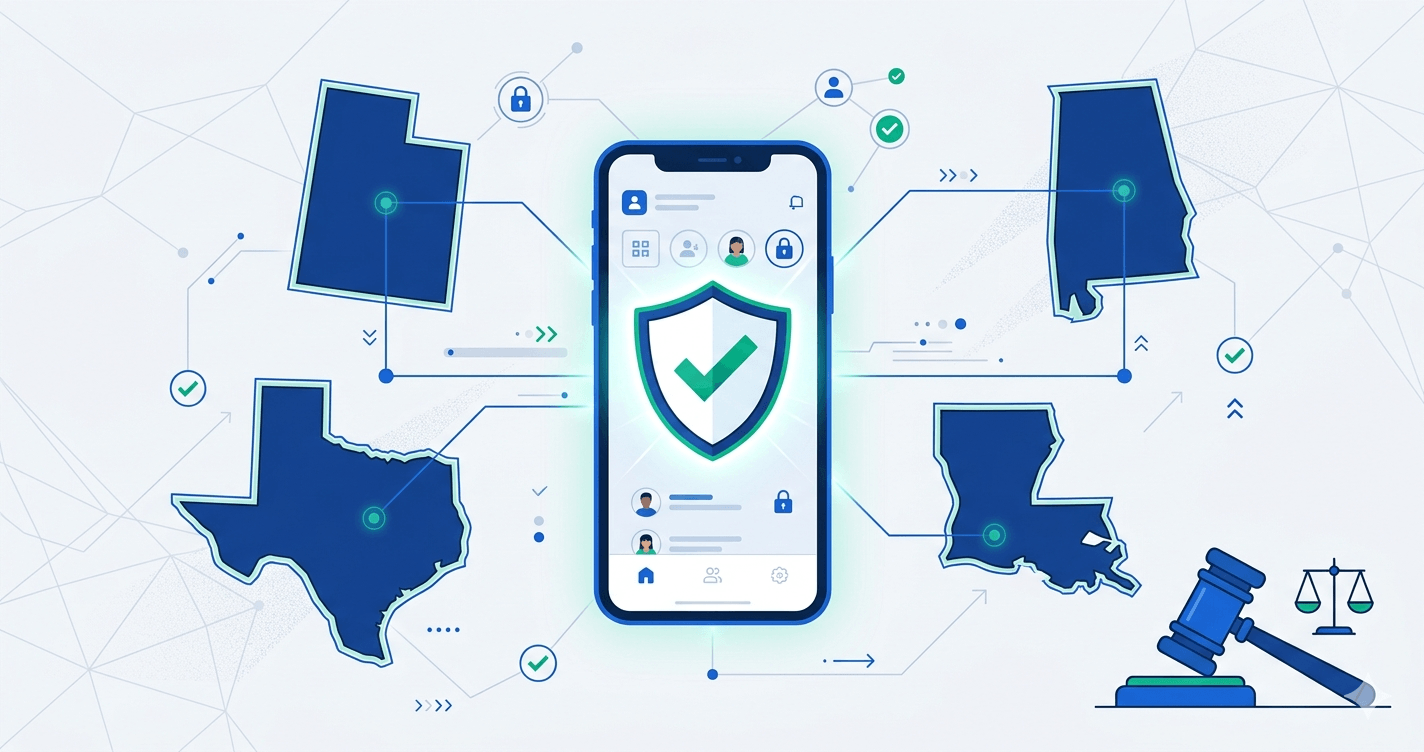
Unlike previous age verification laws that targeted specific content categories (adult sites, social media platforms, gambling apps), ASAAs apply to all apps distributed through app stores to residents of applicable states. If your app is in the App Store or Google Play and a user in Texas, Utah, Louisiana, or Alabama can download it, these laws apply to you.
Here’s what’s changing, what you need to build, and where the traps are.
The Shift: From App-Level to Platform-Level Verification
Previous age verification regulations placed the burden squarely on individual apps and websites. Each platform had to independently determine whether its users were old enough to access its content. This created a fragmented, inconsistent landscape where every app reinvented the wheel — or, more commonly, slapped a birthdate picker on the onboarding flow and called it compliance.
ASAAs fundamentally restructure this model. Instead of each app verifying age independently, the laws require app stores to verify user age at account creation and then share that age category information with developers through platform APIs. The app store becomes the identity layer; the developer becomes the enforcement layer.
This is architecturally elegant in theory. In practice, it introduces a new set of integration requirements, data handling obligations, and compliance risks that most development teams haven’t planned for.
Which States, Which Timelines
Four states have enacted ASAAs as of March 2026, with more bills in committee:
| State | Law | Effective Date | Status |
|---|---|---|---|
| Texas | SB 2420 | January 1, 2026 | Preliminary injunction issued; enforcement blocked pending litigation |
| Utah | HB 311 | May 2026 | On track |
| Louisiana | HB 422 | July 2026 | On track |
| Alabama | HB 161 | Signed March 9, 2026 | Effective date TBD (likely late 2026) |
A federal bill (H.R. 3149 / S. 1586) is also progressing through Congress, which would create a uniform national standard. But as with most federal tech legislation, state laws will likely take effect well before any national framework lands.
The Texas preliminary injunction is worth noting. A federal judge blocked the law on First Amendment grounds, citing concerns about the burden age verification places on adult users’ access to apps. This mirrors the judicial pattern we’ve seen with state-level social media age verification laws. But the injunction is specific to Texas — it doesn’t affect Utah, Louisiana, or Alabama.
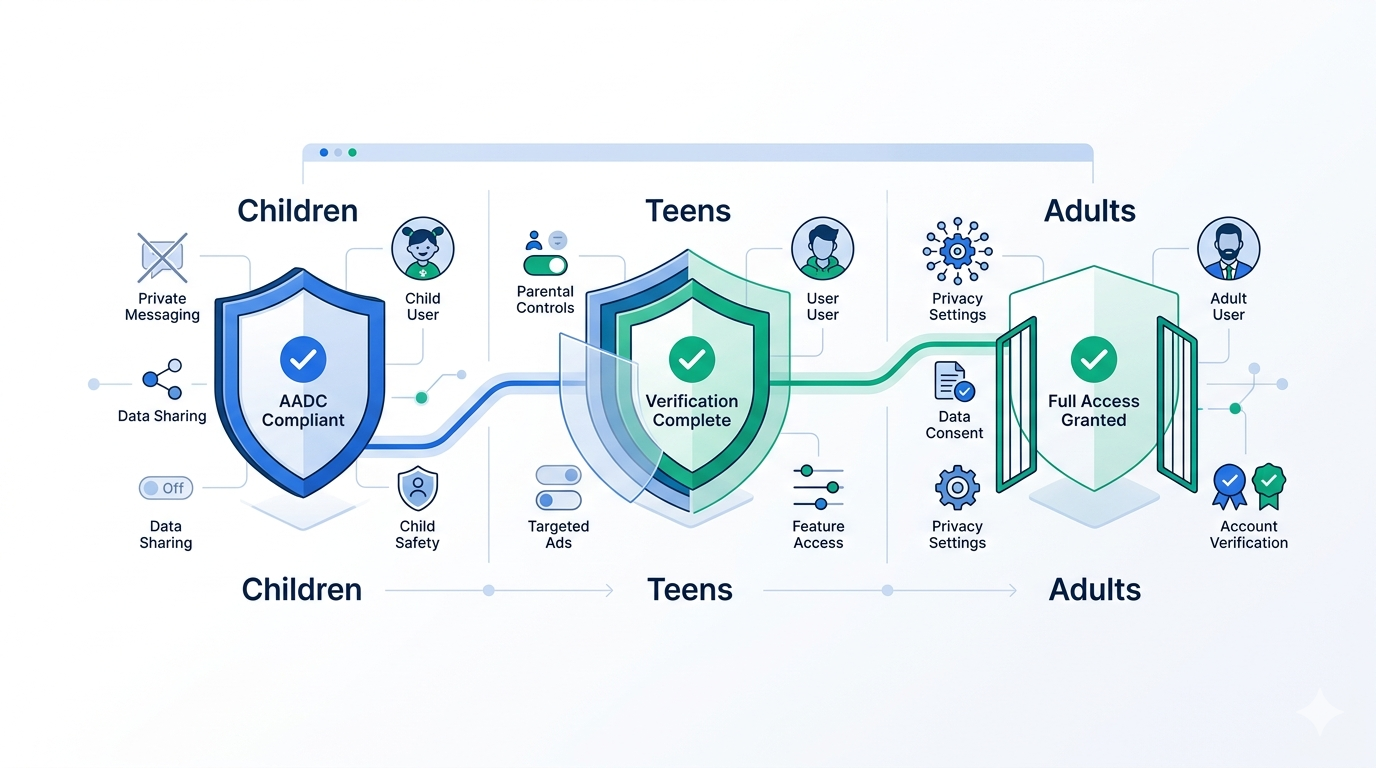
The Four-Tier Age Category System
ASAAs define four age categories that app stores must assign to users:
- Under 13: Full COPPA protections apply. Verifiable parental consent required for essentially everything.
- 13–15: Parental consent required for downloads, purchases, and in-app purchases. Targeted advertising prohibited in most states.
- 16–17: Parental consent may be required depending on the state and app’s age rating. Reduced but non-trivial obligations.
- 18+: No parental consent requirements. Standard terms apply.
This four-tier model aligns well with existing regulatory frameworks (COPPA covers under-13; most state laws define “minors” as under-18), but it creates new operational complexity for developers who previously only had to distinguish “child” from “not child.”
What Developers Must Actually Build
Here’s where it gets concrete. ASAAs impose three categories of developer obligations:
1. Receive and Process Age Signals
App stores will provide age category data through platform APIs. Google has already rolled out the Play Age Signals API for Android developers. Apple is expected to deliver equivalent functionality through the App Store Connect framework.
Your app must:
- Integrate the age signals API to receive the user’s age category at launch or first interaction
- Handle all four age categories with appropriate UX and access controls
- Fail closed if age signals are unavailable — don’t default to full access when you can’t determine age
This isn’t a “nice to have” API integration. If your app is available in an applicable state and doesn’t consume age signals, you’re non-compliant from day one.
2. Enforce Parental Consent
For users in the under-13 and 13–15 categories (and potentially 16–17, depending on your app’s age rating and the state), you must verify that parental consent has been granted before allowing the user to:
- Download the app (handled at the app store level)
- Make purchases or in-app purchases
- Access age-restricted features or content
Critically, several states — notably Texas — require per-transaction parental consent. Blanket or ongoing consent is not sufficient. If a 14-year-old wants to buy a cosmetic item in your game, the parent must approve that specific transaction.
This has significant UX implications. You’ll need to build consent flows that don’t destroy engagement while remaining legally compliant. The temptation to make consent frictionless will be strong; resist it. Regulators are watching for dark patterns that effectively bypass consent requirements.
3. Assign Age Ratings
Texas requires developers to assign age ratings to both the app itself and each in-app purchase, using the four-tier category system. This goes beyond the existing ESRB or App Store content ratings — it’s a legal classification with enforcement consequences.
If you rate your app as suitable for all ages but it contains content that regulators determine is inappropriate for under-13 users, you’ve created a compliance liability. Be conservative in your ratings.
Data Handling Requirements
ASAAs include strict rules about how age-related data must be handled:
Purpose limitation: Age category data received from app stores can only be used for compliance purposes. You cannot use it for ad targeting, analytics segmentation, personalization, or any other commercial purpose. Texas is explicit: age data must be used “solely for compliance with this chapter.”
Encryption: Age category data must be encrypted using industry-standard methods, both in transit and at rest.
Deletion: Texas requires deletion of age verification data after it is no longer needed for compliance. Don’t warehouse age signals indefinitely.
No cross-referencing: You cannot combine age signals with other user data to build richer profiles. The age signal is a compliance input, not a data asset.
These requirements echo the FTC’s COPPA safe harbor conditions, which is likely intentional — legislators are building on the same privacy-by-design principles.
Enforcement: Where the Teeth Are
Enforcement varies significantly by state, and one state has a notable gap in developer protections:
Safe harbor provisions: Texas and Utah include safe harbor language for developers who reasonably rely on age category data provided by app stores. If the app store tells you a user is 18+ and they turn out to be 14, you have a defense — provided you acted on the data in good faith.
Louisiana’s exception: Louisiana explicitly does not include a safe harbor for developers. If a user’s age category is wrong, the developer may still face liability even if they relied on data from the app store. This creates an asymmetric risk: you’re legally required to use app store age signals, but you can’t fully trust them as a defense.
Private right of action: Utah allows private lawsuits. Texas treats violations as deceptive trade practices under the DTPA, which carries statutory damages. Alabama’s enforcement mechanisms will become clear once the effective date is set.
State AG enforcement: All four states empower their Attorneys General to investigate and prosecute violations.
The Architectural Implications
For development teams, ASAAs create a new architectural requirement: your app must have a consent and age enforcement layer that sits between the platform’s age signals and your core application logic.
Here’s a practical architecture:
App Store (Google Play / Apple)
    │
    ▼
Age Signals API
    │
    ▼
┌─────────────────────────────┐
│   Consent & Age Gate Layer  │
│                             │
│  - Receive age category     │
│  - Check consent status     │
│  - Enforce access controls  │
│  - Log compliance events    │
│  - Handle edge cases        │
└─────────────────────────────┘
    │
    ▼
Core Application Logic
This layer needs to handle several edge cases:
- Age signal unavailable: What happens when the API doesn’t return a category? Fail closed.
- Consent revoked mid-session: Parents can revoke consent at any time. Your app must respond to revocation signals.
- Multi-state users: A user who travels from a non-ASAA state to Texas doesn’t suddenly become exempt. You need to handle location-aware compliance.
- Offline access: If your app works offline, how do you enforce age gates without a live API connection?
Where Xident Fits
If you’re building age verification into your app — whether to comply with ASAAs or to go beyond the minimum that app store age signals provide — the question is what happens when platform-level signals aren’t enough.
App store age categories are coarse. They tell you a user is “13–15” but not whether they’re 13 or 15. They rely on the accuracy of the age verification the app store performs at account creation, which may be based on self-declared information in some cases. And Louisiana’s lack of a safe harbor means relying solely on app store signals is a business risk.
Xident provides a complementary verification layer that operates on-device:
- Biometric age estimation runs entirely in the browser or in-app via ONNX Runtime — no biometric data leaves the device
- Configurable thresholds support the four-tier ASAA model (+13, +16, +18) and granular age gates (+12, +15, +21, +25)
- Token-based returning users via passkey-bound credentials eliminate re-verification friction
- Server-side liveness detection (Growth plan and above) protects against spoofing attempts
This gives you a defense-in-depth approach: app store signals for the baseline, Xident for high-confidence verification where it matters — purchases, age-restricted content, or users in states without safe harbor protections.
What to Do Now
If you ship mobile apps to US users, here’s the priority list:
Immediate (Q1 2026): Map your app’s exposure to ASAA states. Determine which features require age-gating and which transactions require per-transaction parental consent. Start integrating Google’s Play Age Signals API if you’re on Android.
Near-term (Q2 2026): Build your consent and age enforcement layer. Test it against all four age categories. Implement logging for compliance audits. Update your privacy policy to reflect new data flows.
Before Utah goes live (May 2026): Complete integration testing. Verify that your consent flows work correctly for all age categories. Ensure your data handling meets encryption and deletion requirements. Consider adding a complementary verification layer for Louisiana exposure.
Ongoing: Monitor the federal bill. Watch for additional state ASAAs — Kansas, Florida, and Virginia have similar bills in progress. Track the Texas litigation for precedent that could affect other states.
The Bigger Picture
ASAAs represent a structural shift in how mobile ecosystems handle age verification. By moving verification to the platform level and making developers responsible for enforcement, these laws create a more consistent user experience — but they also distribute compliance liability across the entire app ecosystem.
For developers who’ve treated age verification as someone else’s problem, that era is over. The app stores will handle the initial verification. But what you do with that signal — how you enforce it, how you protect the data, and how you handle edge cases — is squarely on you.
The good news: if you build the consent and age enforcement layer correctly now, you’ll be positioned for whatever federal legislation eventually arrives. The state laws are leading indicators of where national policy is headed. Build for the strictest requirements, and everything else is a subset.
Xident helps mobile developers add high-confidence age verification that complements app store age signals. Our on-device biometric estimation means no user data leaves the device, and our configurable age thresholds map directly to the ASAA four-tier model. Get started in 5 minutes or explore our pricing.