Somewhere in your codebase there is probably a date-of-birth field and a bit of logic that says “if under 18, block.” Someone shipped it in an afternoon a couple of years ago, and for a while it was enough. That afternoon is the reason build-vs-buy still feels like a close call to a lot of engineering leaders. It isn’t one anymore.
The thing that changed is not the difficulty of writing a form. It’s the definition of what the form has to be. A self-declared birthday is now, in most of the markets that matter, a compliance liability rather than a control. The UK’s Information Commissioner fined Reddit £14.47m in February 2026 in part for leaning on exactly that kind of honor-system gate. Ofcom’s “highly effective age assurance” standard names the methods that pass, and a text box asking for a birth year is not on the list. So the real question is no longer “should we build a form or buy a form.” It’s “should we build and then own, forever, a production identity system, or should we rent one.” Those are very different questions, and most teams are still answering the first while signing up for the second.
Why “just build it” was ever a reasonable answer
For a single product in a single jurisdiction under a self-declaration regime, in-house made sense. The spec fit on an index card: collect a birthdate, gate on it, log the result. No biometrics, no documents, no regulator asking how you know the birthdate is real. If that were still the spec, this article wouldn’t exist and you should absolutely build it yourself.
The spec is not that anymore. As of mid-2026, more than half of US states have some active age-gating mandate, and they do not agree with each other on thresholds, methods, or who is liable. The UK Online Safety Act is in live enforcement with fines attached. The EU has shipped a reference age-verification app and told providers there are no more excuses. Australia’s under-16 rules are in force. Each of these regimes has its own idea of what counts as a good-enough check, and several of them change every few months as guidance lands and cases get decided. The index card became a moving standards document maintained by a dozen regulators who don’t coordinate. Building against a fixed target is an engineering project. Building against that is a standing commitment.
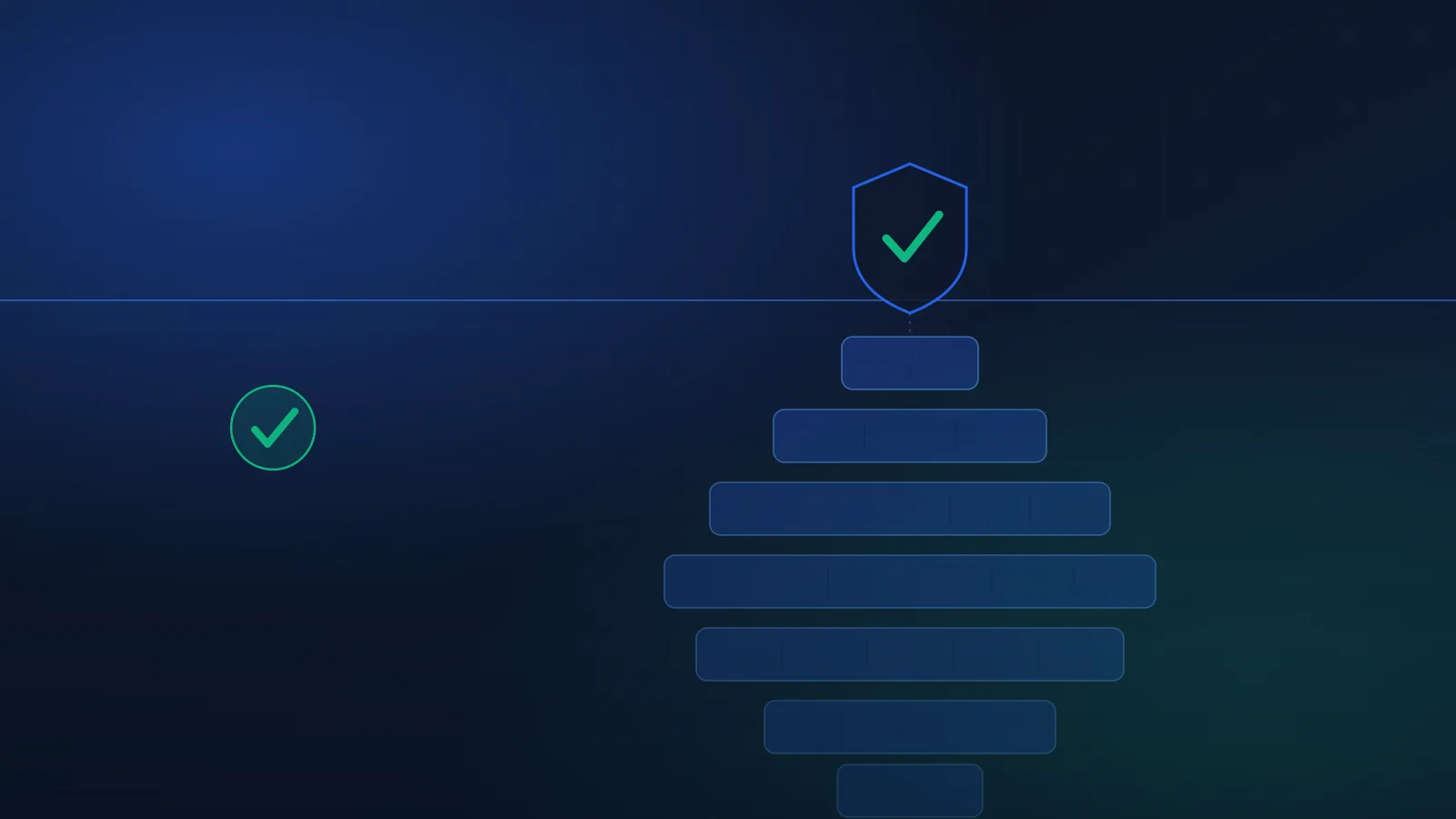
The iceberg under the age gate
The visible part of age verification is the gate: a user hits restricted content, something checks them, they pass or they don’t. That gate is maybe a tenth of what an in-house build actually has to be. Here is the part below the waterline, the part that doesn’t show up in the original ticket.
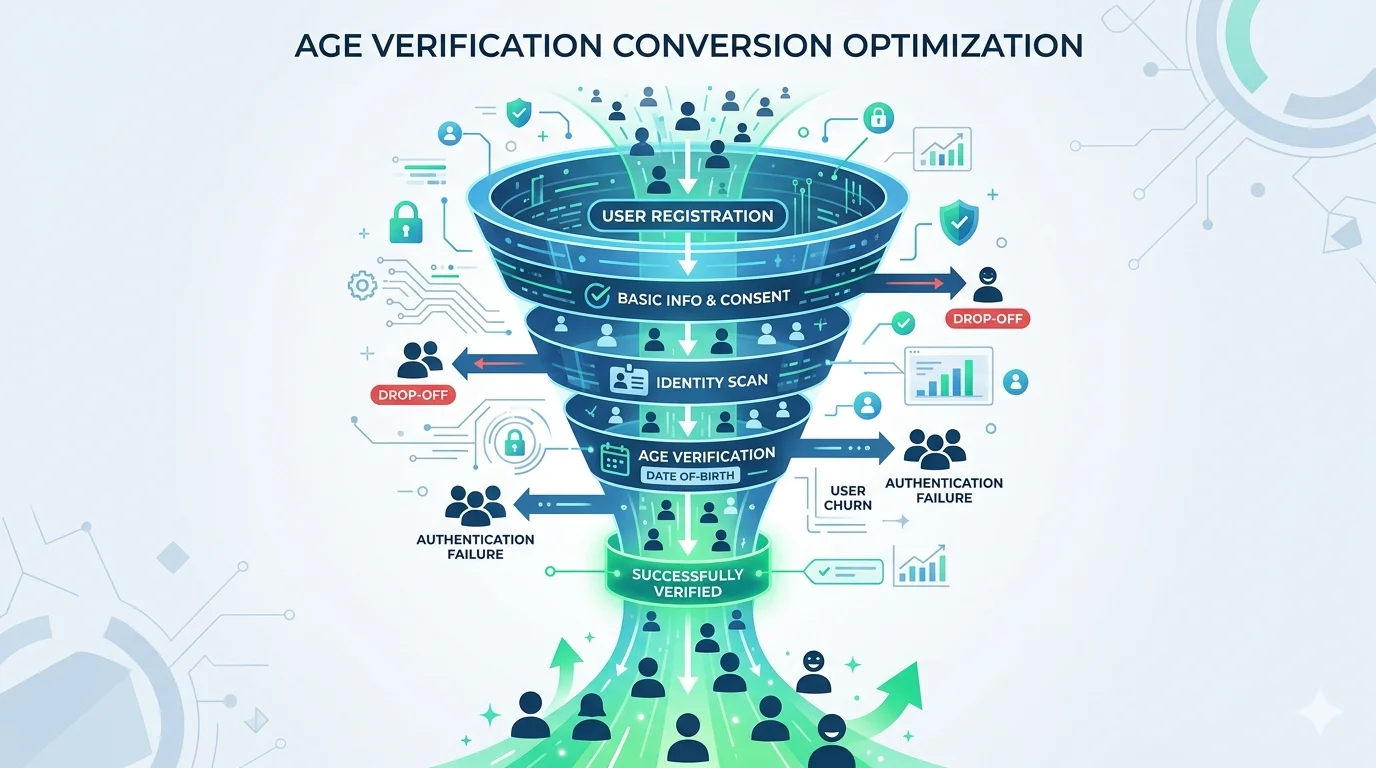
It isn’t one check, it’s an orchestrated stack. A verification flow that both converts and complies can’t be a single method. You want to resolve the obvious adults cheaply and only escalate the ambiguous ones, which means an estimation-first waterfall: a fast age-estimation pass, then a document-and-liveness step for the cases near the threshold, then a fallback for people the first two can’t clear. Each layer is its own subsystem with its own failure modes. Building one method is a sprint. Building the router between three of them, with sane behavior when each one degrades, is a roadmap.
Accuracy has to be defensible, not just present. Regulators increasingly expect you to show your check works, not just that it exists. For facial age estimation that means a measurable error rate and a threshold buffer chosen so that a 20-year-old doesn’t get locked out and a 16-year-old doesn’t slip through. The public yardstick is NIST’s FATE age-estimation benchmark, where the leading vendors post a mean absolute error of two to three years and, just as important, publish how that error moves across skin tone, age band, and sex. Reproducing that in-house means training data you probably don’t have, a bias-testing regime you’d have to build, and the honest willingness to keep proving effectiveness after launch. “We wrote a model” is not the same as “we can defend this model to Ofcom.”
The adversary is active and getting better. The moment a face check protects something valuable, people attack it. The attacks split into two families that need different defenses: presentation attacks (a printed photo, a screen, a mask held up to the camera) governed by the ISO/IEC 30107-3 liveness standard, and injection attacks that skip the camera entirely and feed a deepfake straight into the capture pipeline through a virtual camera. Passing a liveness test does nothing against injection, and injection tooling is now commodity software. An in-house build has to detect both, keep detecting both as the attacks evolve, and get the anti-spoofing certified if it wants that certification to count. This is a security product with a threat model that updates monthly, living inside your product.
Compliance is a rules engine, not a config file. The same user, on the same content, gets a different required treatment depending on which state or country they’re in and what the current guidance says. Encode that once and you’re maintaining a jurisdiction matrix: thresholds, acceptable methods, parental-consent flows, data-handling constraints, and the trigger conditions that pull a feature into scope. Every legislative session and every enforcement decision is a diff against that matrix. Nobody budgets for a compliance-rules team when they estimate “add age verification.”
Data you collect is data you can be breached for. The instinct to build in-house usually comes with the instinct to store the evidence: the ID scan, the selfie, the result. That store is now a liability, not an asset. The 2026 breach wave turned age-verification data hoards into the thing plaintiffs and regulators go looking for. A privacy-first architecture that returns an age band and deletes the image is the defensible posture, and it is much harder to build than a table that keeps everything. Getting minimization wrong is the kind of mistake you find out about in a headline.
The maintenance tax nobody puts in the estimate
Say you build all of that. You staff it, you ship it, it works on launch day. You have not finished. You have started paying a recurring tax that most build-vs-buy estimates leave off entirely, because the estimate treats age verification as a feature and it is actually a product line.
The models drift and need retraining. New spoofing and injection techniques arrive and need countermeasures, on the attacker’s schedule, not yours. Every new market means a new set of rules to encode and a new set of acceptable methods to support. Certifications like ISO/IEC 27566 and PAD attestations expire and need re-testing. The flow sits on your critical path to revenue, so it needs the uptime, latency budget, and on-call rotation of a payments system, because functionally that’s what it is: a gate between a user and the thing they came to do. Get it wrong in the tightening direction and you get abandonment and locked-out adults; get it wrong in the loosening direction and you get a fine.
None of this is exotic. It’s the ordinary cost of owning a security-and-compliance product. The mistake is filing it under “one-time build” when it’s a permanent line item, and staffing it accordingly. Two engineers for six weeks builds the demo. Keeping it highly effective across every market you operate in, against a live adversary, indefinitely, is a team you now have forever.
When building in-house is actually the right call
Buying is not always correct, and it’s worth being honest about the cases where you should build. There are a few.
You should build if age and identity verification is your product, not a feature of it. If you’re an identity company, the stack is your core competency and outsourcing it makes no sense. You should build if you have a genuinely unique constraint that no provider can meet: a closed network with no internet path, a hardware form factor with no camera and no standard integration surface, a data-residency requirement so specific that no vendor’s deployment model fits. You should build if your regulatory exposure is trivial and stable, a single lenient jurisdiction with a self-declaration regime and no realistic prospect of change, where the index-card spec still holds and probably will for years.
Notice what those cases have in common. They’re narrow, and they mostly describe companies for whom verification is either the whole business or a genuinely marginal concern. The large middle, a real product with real regulatory exposure across more than one market, where verification matters but isn’t the point of the company, is where in-house quietly turns into a tax you didn’t price. That’s most teams reading this.
Buying is not “outsource and forget”
The failure mode on the buy side is treating a provider as a black box you bolt on and stop thinking about. A bad provider is worse than a decent in-house build, because now the liability is yours and the control isn’t. So buying well means buying like you’d hire for the team you’re choosing not to build. The security-first buyer’s checklist is the long version; the short version is a handful of non-negotiables.
Ask what they retain and for how long, and make sure the honest answer is “as little as possible, deleted fast.” Ask for their independent accuracy numbers and their bias breakdown, not a marketing figure, ideally something you can line up against the NIST results. Ask how they handle injection as well as presentation attacks, and whether the anti-spoofing is certified. Ask whether one integration covers the jurisdictions you actually operate in, or whether you’ll be stitching together a different flow per market. Ask about uptime and latency in numbers, because this sits on your revenue path. A provider who answers those cleanly is doing the maintenance you’d otherwise be signing up for, and doing it at the scale that makes it economic.
The point of buying isn’t to care less about verification. It’s to move the permanent, adversarial, multi-jurisdiction maintenance burden onto someone who does only that, and keep your team on the product you’re actually trying to build.
The cost model that changes the math
The reason buying usually wins in 2026 is not only that the surface area is enormous. It’s that the pricing of a good provider is structured to make the expensive part rare, which is the same optimization a careful in-house team would eventually build for themselves at considerable cost.
The insight is that not every check needs to be a full document verification. Most of your users are unambiguously the age they claim, and clearing them should be cheap. Only the ambiguous cases, the ones near a threshold or that fail a first pass, need the heavy path. Xident’s model maps directly onto that split. A Check is the low-friction, low-cost first step: browser-based age estimation, liveness, and returning-user lookup, roughly an order of magnitude cheaper than a document scan. A Verification is the step-up: document capture with OCR and face match, reserved for the cases a Check can’t clear. Run Checks across the whole audience, escalate the few that need it to Verification, and your unit economics follow the shape of your actual risk rather than paying full price for every user at the door. Returning users carry a reusable age token so they don’t pay the cost twice.
Compare that to the in-house alternative honestly. The build isn’t a line item you clear once; it’s engineering salaries plus model training plus a security function plus a compliance-rules function plus on-call, every year, across every market, forever. Against a per-outcome price where the cheap path handles the majority, the build has to be enormous before it pencils out, and even then it doesn’t buy down the regulatory and breach risk that a specialist absorbs as a matter of course. The cost of getting verification wrong, a fine or a market exit or a breach, dwarfs the integration cost of getting it right. You can see the specific numbers on the pricing page; the structural point is that the model is built to keep the expensive operation rare, which is exactly the property an in-house build spends years trying to achieve.
The bottom line
Build-vs-buy for age verification was a genuine toss-up in 2023, when the spec really was a date-of-birth field. It isn’t a toss-up now, and pretending otherwise is how teams end up owning a production identity system they never meant to run. The work below the waterline, orchestration across methods, defensible accuracy, active anti-spoofing, a live jurisdiction matrix, and retention discipline strict enough to survive a breach, is a permanent, specialized product line, not a feature you ship and forget.
Build it in-house if verification is your business, or if you have a constraint no provider can meet, or if your exposure is genuinely trivial and stable. If you’re anywhere else, which is most places, the honest move is to buy the maintenance and keep your engineers on the thing your users actually came for. The gate is the easy tenth. The iceberg is what you’d be signing up to own.
Weighing build against buy for age assurance? Talk to Xident’s team about how the Check-and-Verification model keeps the expensive path rare, or explore the docs and integrate a working age gate in minutes instead of quarters.