For three years the compliance question was binary: do you have age assurance in place? Deploy something, point to it, move on. In 2026 that question is dead. The one that replaced it is harder to answer and impossible to fake: can you prove your age assurance is highly effective?
The shift is visible across every major regulator at once. On 26 March 2026, Ofcom and the ICO issued a joint statement clarifying that online-safety and data-protection duties are enforced together, and that “effective” is a performance bar, not a checkbox. The EU Commission declared its age-verification app “technically ready” in April and said there are “no more excuses.” The ICO’s £14.47M Reddit decision established that self-declaration and loose estimation are inadequate controls as a matter of law. The common thread is a move to performance-based compliance: the central question is no longer whether a control exists but whether it demonstrably reduces underage access, backed by evidence of effectiveness, a documented rationale, and recorded trade-offs.
That is an engineering problem before it is a legal one. If a regulator asks you to prove your age gate works, “we use facial age estimation” is not an answer — it’s the name of a component. This post lays out what “highly effective” actually means, the metrics that measure it, and the evidence trail that survives contact with an enforcement request.
“Highly effective” is defined — and it isn’t about accuracy alone
The most concrete definition comes from Ofcom’s guidance on highly effective age assurance under the UK Online Safety Act. It sets four criteria a method must satisfy:
Technically accurate — how well the method determines age under controlled test conditions. Robust — how well it holds up in real deployment, against real users and real adversaries, not in the lab. Reliable — whether the output is reproducible and derived from trustworthy evidence. Fair — whether it avoids or minimises bias and discriminatory outcomes across demographic groups.
Two things about this framing matter for anyone building the control. First, Ofcom deliberately declined to set a single numeric threshold — no “99% and you pass.” That sounds permissive; it is the opposite. It means you cannot buy a vendor’s “98% accurate” claim and consider the question closed. You own the judgement that your deployed control is effective for your risk, and you have to be able to defend it. Second, only one of the four criteria is about lab accuracy. The other three — robustness, reliability, fairness — are properties of your live system that can only be observed by measuring it in production. The EU scheme’s conformity criteria (accuracy, reliability, robustness, non-intrusiveness, non-discrimination) map onto the same shape. Accuracy is table stakes; the differentiator is everything that only shows up once real users and motivated minors are in the flow.
This is exactly why the well-known NIST FATE benchmarks on facial age estimation are necessary but not sufficient. FATE tells you how an algorithm performs on a test set. It tells you nothing about how your integration performs against spoofing, retries, shared devices, or the specific age band you’re gating. Effectiveness is a property of the deployed system, so it has to be measured on the deployed system.
The one metric that actually gates compliance: false acceptance at the threshold
Here is the most common measurement mistake, and it is a serious one. Teams report “overall accuracy” — the share of users whose estimated age lands close to their real age. That number is almost irrelevant to compliance, because it treats both error directions as equal. They are not equal. Estimating a 40-year-old as 35 is harmless. Estimating a 16-year-old as 18 and letting them through the gate is the entire failure the law exists to prevent.
The metric that matters is the false acceptance rate at the legal threshold: the proportion of users below the age line who are incorrectly waved through as above it. Its counterpart, the false rejection rate — adults wrongly blocked — is a friction and revenue problem, not a compliance breach, and the two trade off against each other. A control tuned to a 99.9% pass rate for real adults may be quietly letting a meaningful fraction of minors through. You cannot see that from an accuracy headline; you have to measure the error direction that carries legal weight, at the specific threshold you’re enforcing, segmented by method and by cohort.
Concretely, this means instrumenting your gate to answer questions like: at the 18 boundary, what fraction of estimated-adult passes were actually under 18? How does that rate move for 16- and 17-year-olds specifically, where the estimator is weakest? What is it for document-plus-liveness versus estimation alone? If you cannot produce those numbers, you are not measuring effectiveness — you are hoping for it.
Turn uncertainty into policy: the challenge-age buffer
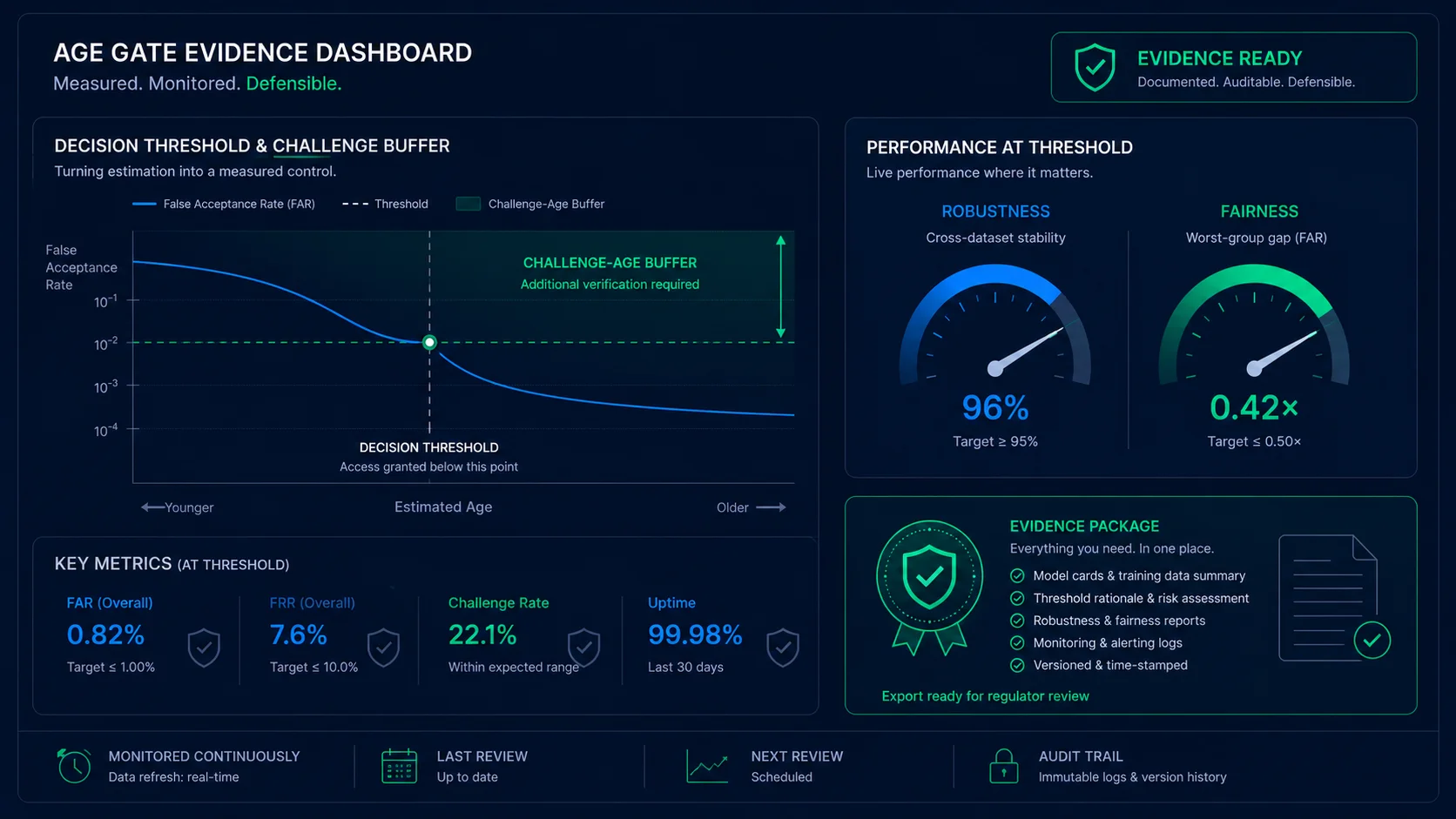
A face age estimator does not output a birthday; it outputs a distribution with real variance. The engineering discipline that converts that uncertainty into a defensible control is the challenge age, or buffer. Instead of passing anyone estimated at 18-or-over through an 18 gate, you set the pass line higher — require an estimate of, say, 21 or 25 — and route everyone in the buffer band down to a stronger method: document capture, NFC chip read, or a verified credential. The buffer trades a slice of adult convenience for a large reduction in false acceptance near the line, which is precisely where the risk concentrates.
The size of the buffer is not arbitrary, and 2026 benchmark data tells you why it has to be conservative. Independent testing — including the ACCS age-assurance technology trial and Liminal’s 2026 age-estimation index — found that across systems at a 13+ gate, true-positive rates only exceeded 95% for users aged 16 and above. In plain terms: to hit a 95% bar at a 13 gate, you’d have to set your challenge age around 16 and escalate everyone below it. The estimator is simply not reliable in the years right around a low threshold, so the buffer, not the raw model, is what makes the control effective there.
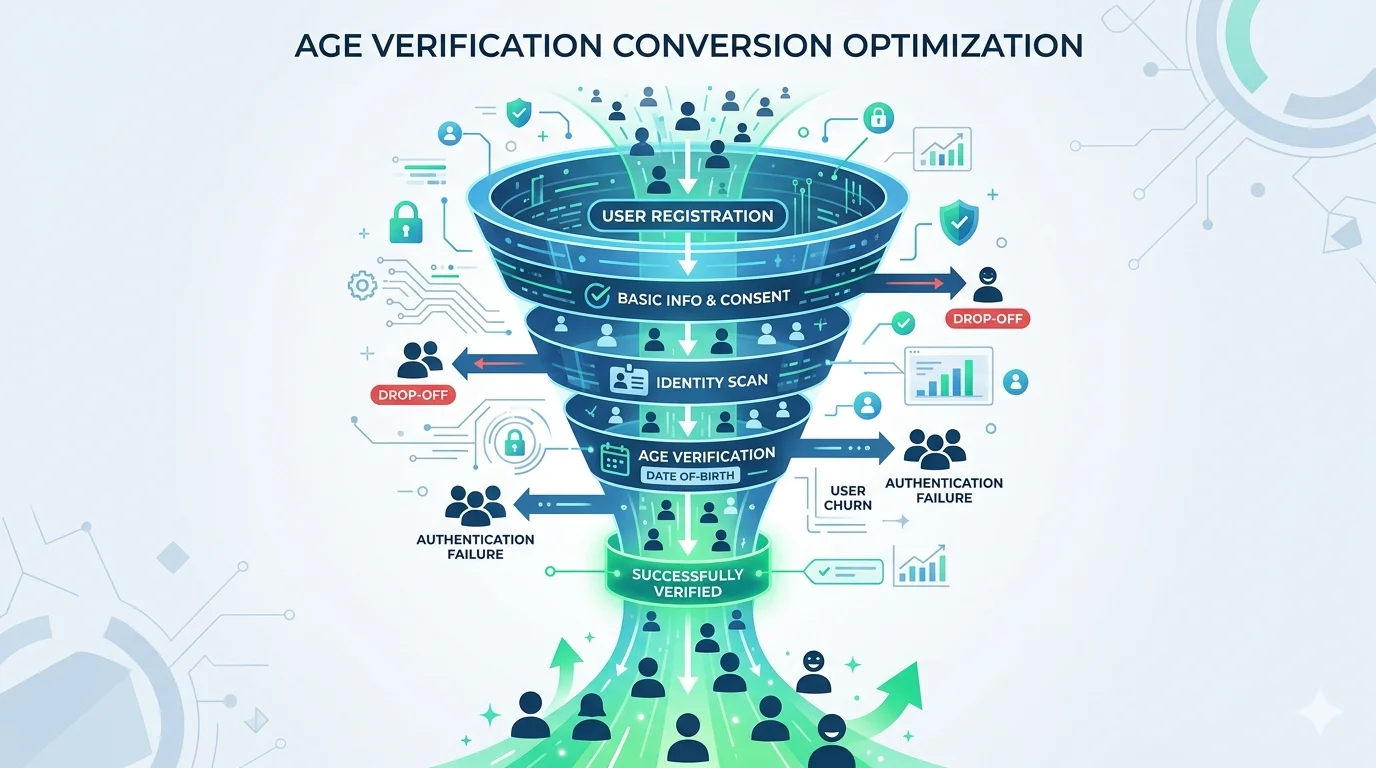
That reliability has a cost, and you should measure it too. Every user pushed into the buffer band faces extra steps, and extra steps drive verification drop-off. The right buffer is the one that holds false acceptance under your target while keeping escalation volume — and abandonment — inside what the business can absorb. Both sides of that trade are numbers you can watch on a dashboard; treat the buffer as a tuned parameter with a recorded rationale, not a default you never revisit.
Robust means “survives an adversary,” not “scores well offline”
Ofcom’s “robust” criterion is where most self-assessments fall apart, because robustness can’t be measured on a clean test set — it only appears when someone is actively trying to beat the gate. A control that scores beautifully offline can still fold to a printed photo, a video injection, a borrowed adult device, or a user who simply retries until the estimator drifts high enough to pass.
Measuring robustness therefore means red-teaming your own gate as a standing discipline, not a one-time pen test. Track the presentation- and injection-attack rates your liveness layer catches and misses. Watch retry patterns: a minor who fails once and passes on the fifth attempt is a circumvention signal, and if you aren’t budgeting and rate-limiting retries you’re handing them the buffer for free. Instrument the shared-device and proxy-verification paths where an adult verifies once and hands the session to a child. Each of these is a measurable leak rate, and each belongs in the same effectiveness report as your false-acceptance numbers — because a gate that a determined 15-year-old defeats in five minutes is not “highly effective,” whatever it scored in the lab.
Fairness is a metric, not a value statement
The “fair” criterion is easy to nod along to and hard to demonstrate, and the benchmarks show why it can’t be skipped. The 2026 evaluations found persistent demographic disparities in age estimation: higher false-positive rates for users with darker skin tones, materially worse performance in the 16–20 band, and output that swung with gender presentation and lighting — alongside limited use of fairness benchmarks or mitigation in the products tested. If your effectiveness numbers are only reported in aggregate, you are almost certainly hiding a subgroup where the control performs poorly, and that gap is both a compliance exposure and a discrimination one.
Measuring fairness means computing your false-acceptance and false-rejection rates per cohort, not just overall, and treating a bad subgroup number as a defect to fix rather than a footnote to omit. The mitigations are practical: a more conservative buffer where the estimator is weakest, a well-designed escalation path so a wrongly-rejected user isn’t dead-ended, and inclusive, accessible fallback flows so the alternative to estimation doesn’t exclude the people the estimator already struggles with. Fairness you can’t quantify is fairness you can’t defend.
The evidence trail: what to log and what to hand a regulator
Effectiveness you measured but didn’t record is, for enforcement purposes, effectiveness you didn’t have. When Ofcom sends an information request — and the second-fine cases show they will — what you produce is a per-decision audit trail plus the aggregate performance behind it. The raw identity documents are a liability you should not be holding; the decision record is the asset.
For every verification, log the outcome you can defend without exposing the person: the threshold result (over/under the line), the method used, the assurance level, and the model or ruleset version — never a retained date of birth or ID image. In aggregate, keep the KPIs that show the control works and keep working: false acceptance at each threshold, escalation and drop-off rates, retry and attack rates, and subgroup breakdowns. Re-benchmark on a schedule rather than once at launch, and lean on independent evaluation — NIST FATE, the ACCS trial, Liminal’s index, and the emerging IEEE standard for online age verification — so your effectiveness claim rests on third-party measurement, not a vendor’s marketing sheet. This is also the spine of any serious vendor security review: if a provider can’t hand you these numbers for their deployed system, they can’t help you prove yours.
A compact effectiveness scorecard worth reviewing on a fixed cadence:
- False-acceptance rate at each active threshold (+12/+15/+18/+21/+25), segmented by method and cohort — the primary compliance metric.
- Challenge-age buffer and escalation volume — is the buffer holding false acceptance under target, and what does it cost in extra steps?
- False-rejection / drop-off rate — the friction and revenue side of the same dial.
- Robustness rates — presentation/injection attacks caught vs. missed, retry-abuse and shared-device signals.
- Fairness deltas — false-accept/reject spread across demographic subgroups, with a remediation owner for any outlier.
- Coverage and freshness — share of users cleared by each method, and date of last independent benchmark.
How Xident is built to be measured
Xident is designed so effectiveness is a property you can read off, not a claim you have to take on faith. Age is returned as a threshold classification — over or under 12, 15, 18, 21, or 25 — with a configurable challenge-age buffer per surface, so you can tune the pass line to hold false acceptance where your risk demands and escalate the buffer band automatically to document OCR and face match. For liveness, the widget runs a randomised head-movement challenge in the browser and sends the head-pose values it measures; the server checks those values against the challenge.
Every decision resolves to the same record regardless of path: a threshold result, the method, and the assurance level, written to an audit log rather than a retained identity — the evidence a regulator actually asks for. The analytics layer surfaces the scorecard above, so false-acceptance, escalation, drop-off, and retry metrics are dashboards you watch, not forensics you reconstruct after an information request lands. A reusable token lets returning users re-prove the same fact without re-collecting identity, keeping coverage high without inflating the data you hold. One integrated control, instrumented to answer the only question that matters in 2026: prove it works.
The regulatory bar didn’t just rise in 2026; it changed shape. “We have age assurance” is a statement about intentions. “Here is our false-acceptance rate at the 18 threshold, here is the buffer that holds it, here is how it performs across cohorts, and here is the audit trail” is a statement about outcomes — and outcomes are what Ofcom, the ICO, and the EU are now enforcing. Build the control so it produces those numbers by default, and “highly effective” stops being a phrase you hope applies to you and becomes a report you can hand over.
This post is general information about age-assurance practice and public policy, not legal advice. Effectiveness expectations and regulatory guidance vary by jurisdiction and continue to evolve; consult qualified counsel for your specific obligations.