The debate about age assurance has spent two years arguing about accuracy. How low is the facial-age-estimation error rate? How does it vary by skin tone, by lighting, by age band? Those are real questions, and they matter. But 2026 has quietly settled a different one, and it is the question that actually shows up in the headlines: not how accurate is the check, but what happens to the data after it runs.
The evidence arrived as a wave. In February, Cybernews reported that IDMerit, a California identity-verification provider serving financial services and fintech, had left a MongoDB database open on the public internet — roughly one billion identity records across 26 countries, more than a terabyte of full names, national ID numbers, dates of birth, and KYC logs, sitting behind no authentication at all. Weeks earlier, researchers probing Discord’s age checks found an exposed frontend belonging to Persona, the vendor Discord used. And that was on top of the breach Discord disclosed in October 2025: attackers reached a third-party support provider and walked out with at least 70,000 government-ID images submitted for age verification — the attackers claim far more. Rewind to July 2025 and the women’s safety app Tea lost roughly 72,000 images, including about 13,000 selfies and photo IDs from its verification flow, after a storage bucket was left open and a link was posted to 4chan.
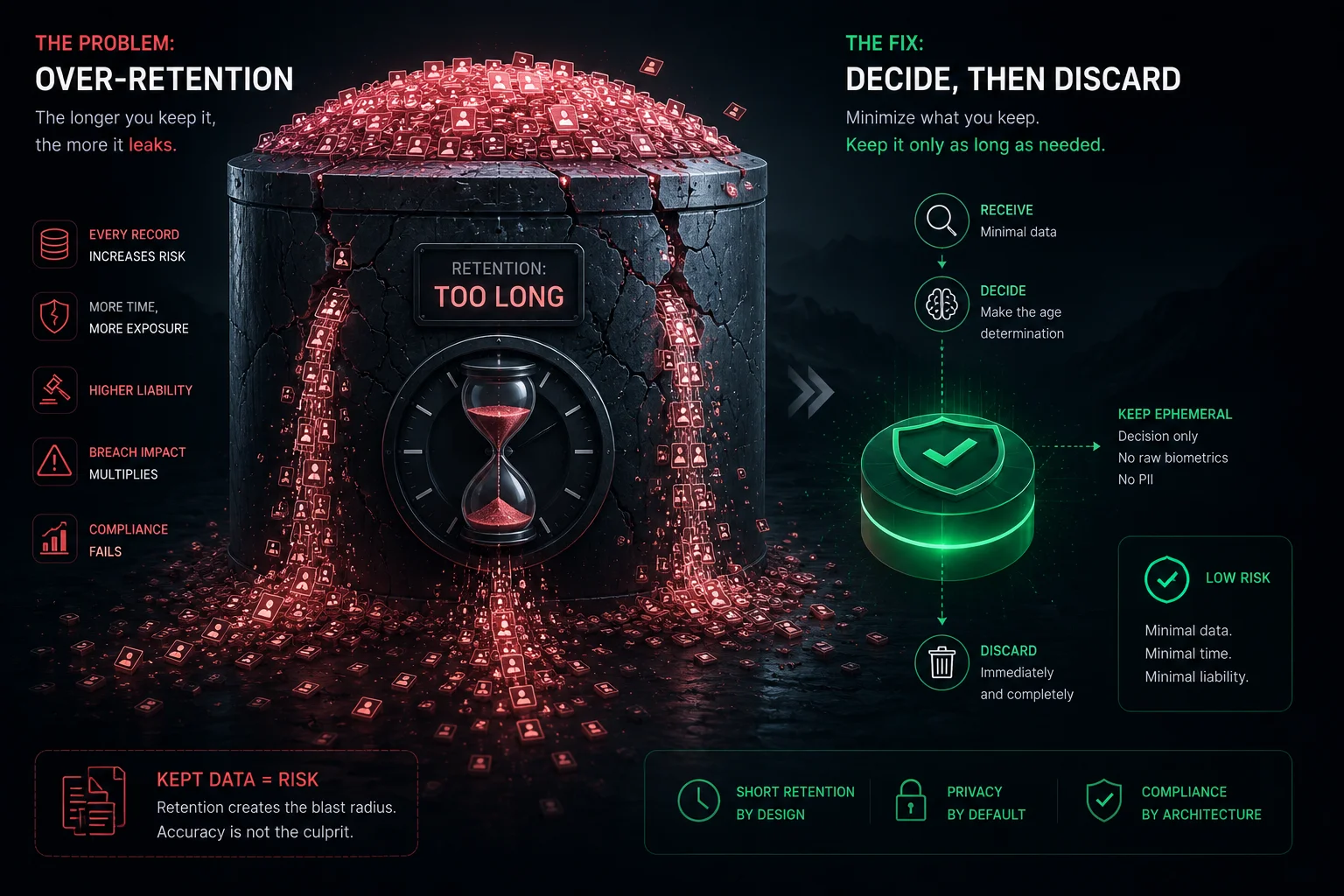
Four incidents, four different companies, one root cause. None of them failed because their age check was inaccurate. They failed because the check produced a pile of sensitive identity data, that data was retained, and the retained data leaked. Accuracy was never the exposed surface. The stored records were.
The breaches weren’t sophisticated — and that is the whole point
It is tempting to file these under “cybersecurity is hard” and move on. Resist that. Look at how each one actually happened, because the pattern is not advanced.
IDMerit required no exploit. There was no perimeter breach, no zero-day, no clever intrusion. A production database was deployed without the basic authentication control that every deployment guide has demanded for a decade, and it sat open until a researcher happened to find it. An unsecured instance is typically located by automated crawlers within hours; the only reason there is no confirmed malicious access is luck and timing. Tea was the same shape — a Firebase bucket left readable to anyone with the URL. Discord’s was a supply-chain failure: the identity images did not leak from Discord’s own hardened systems but from a customer-support subprocessor, after a single agent account was compromised and the attackers held access for roughly 58 hours.
Misconfiguration and a fourth party. That is the entire attack surface in three of the four cases. The lesson engineers should take is uncomfortable: you cannot patch your way out of this, because there is no vulnerability to patch. The exposed thing is the data itself. As long as a trove of identity documents exists, some future misconfiguration — yours, or a subprocessor’s — eventually reaches it. The only reliable way to not leak a billion ID records is to not be holding a billion ID records.
Accuracy is the wrong axis for this risk
Here is why the accuracy framing misleads. Accuracy tells you how often the check reaches the right decision. It says nothing about the blast radius when the surrounding system fails. Those are orthogonal properties, and the breach wave is entirely about the second one.
Run the thought experiment. A verification method that is 99.9% accurate but retains every ID image it processes is a growing liability — each successful check makes the honeypot larger and the eventual breach worse. A method that is merely “good enough” but returns an over/under-threshold decision and immediately discards the underlying document has almost nothing to lose in a breach, because there is almost nothing there. On the accuracy axis the first system wins. On the axis that produced every headline above, the second one wins decisively. Optimizing the metric the industry loves to benchmark — the kind of independent facial-age-estimation accuracy work NIST publishes — does not touch the retention risk at all. You can be state-of-the-art accurate and still be the next State of Surveillance case study.
This is a distinct claim from the architecture argument that a centralized verifier is a single point of failure, which the Persona and Discord incident made well. Centralization is about where the data concentrates. Retention is about whether the data should exist at all, and for how long. You can decentralize and still hoard; you can centralize and still discard. The variable the breach wave punishes is retention, and it is a variable you control independently of your architecture diagram.
Retention is the one variable you actually control
Consider what a platform can and cannot control in its age-assurance stack. You do not control your vendor’s model accuracy — you can measure it, but you cannot change it. You do not control the regulator’s threshold for “highly effective” or “proportionate.” You do not fully control the odds that some engineer, on your side or a subprocessor’s, eventually fat-fingers an access rule; misconfiguration is a permanent feature of running systems at scale.
What you do control is what gets kept. Retention is a policy and an architecture decision, made by you, that determines the size of the target every one of those uncontrollable failures is aiming at. It is the rare lever that is both fully in your hands and directly proportional to your worst-case exposure.
The failure mode is what you might call verification exhaust — the residue a naive flow leaves behind. Every check ingests an ID image, a selfie, a date of birth, and emits, somewhere, a log. The naive system keeps all of it: the images “in case we need to re-verify,” the birth dates “for analytics,” the logs “for audit.” Multiply by every user and every re-check and you have accreted, without ever deciding to, exactly the database that makes headlines. Nobody at IDMerit or Tea set out to build a breach; they built a verification feature and let its exhaust pool. The document-upload pattern is especially prone to this, because an uploaded document feels like something you should file rather than something you should shred.
What regulators already say — and the disclosure-delay trap
Retention is not only a security problem. It is, increasingly, a standing compliance breach that a security incident merely reveals.
The GDPR has said so since 2018. Article 5(1)(e) — the storage-limitation principle — requires that personal data be kept in identifiable form no longer than necessary for the purpose. Data minimisation, Article 5(1)(c), requires you collect no more than you need. An age check’s purpose is satisfied the instant it returns a decision. Holding the ID image and the date of birth after that point is, on its face, retention beyond necessity — a violation that exists continuously, whether or not anyone ever breaches the store. The breach does not create the compliance failure; it exposes one that was already accruing.
UK regulators have now made this explicit for age assurance specifically. In their March 2026 joint statement, the ICO and Ofcom told organizations to collect only the minimum data needed to establish age or age range, to avoid repurposing age-assurance data for unrelated uses, and to limit how long it is retained. That statement is the practical bridge between two regimes that platforms have treated as separate — online-safety duties on one side, data-protection duties on the other — and its message on retention is unambiguous. The Reddit data-protection fine already showed the ICO will act on the data-protection side of age assurance, not only the safety side.
Then there is the delay trap, which turns a bad breach into a worse regulatory event. Cybernews discovered the IDMerit exposure on 11 November 2025; the company secured it the next day; public disclosure came on 18 February 2026 — a 99-day gap. Retention creates the liability, and slow disclosure compounds it, because breach-notification clocks under the GDPR and a widening set of US state laws start ticking long before three months elapse. A vendor that keeps too much and tells you too late has handed you two problems wearing one trench coat.
The retention questions to put to every vendor
A security review goes deep on how a system resists attack. It tends to underweight the simpler question of how much there is to steal in the first place. Put the retention questions directly, to every vendor and to your incumbent, and treat evasive answers as findings. These complement a full vendor security checklist and the five-characteristic ISO/IEC 27566 question set rather than replacing them; retention is the axis both of those can gloss over.
| Question | What a strong answer sounds like | The red flag |
|---|---|---|
| What do you collect during a check? | Only the signal the chosen method needs, nothing repurposed | “We capture everything for future features” |
| What do you return to us? | An eligibility decision — over or under the threshold | A full identity record or raw date of birth |
| What do you retain, and for exactly how long? | Nothing beyond the check, or a short fixed window with a documented reason | “Indefinitely,” or an answer they have to go find out |
| Can you prove deletion? | Contractual deletion terms plus evidence it executes | Deletion is a promise with no artifact |
| Who are your subprocessors, and what do they retain? | A named list with each one’s retention posture | They have never mapped their fourth parties |
| Where does data sit at rest, and how is it isolated? | Encrypted, access-controlled, no open buckets or databases | Vague reassurance without specifics |
The point of the grid is not to catch a vendor in a lie. It is that the honest answers are self-limiting: a provider that has architected to keep almost nothing can answer every row in one breath, because there is nothing to hedge about. A provider that has to schedule a follow-up call to tell you what it retains has already told you what it retains.
Verify-and-discard: the architecture with nothing to leak
The antidote is not better cybersecurity bolted onto a hoard. It is an architecture that has nothing worth stealing, so that the inevitable misconfiguration reaches an empty room.
Four properties define it. First, the output is a decision, not a dossier — the system returns “over the threshold” or “under it,” never a retained birthday or ID image. Second, the identity data is discarded the moment the decision is produced; the image exists in memory for the length of the check and then is gone, so there is no store to leave open. Third, returning users are recognized through a token or a reusable, user-held credential rather than by re-collecting and re-storing their documents, which is what kills the “we keep it in case we need to re-verify” excuse. Fourth, you keep the proof that a check happened — which method ran, at what assurance level, when — as the evidence trail a regulator’s information request asks for, without keeping the identity behind it. Where the risk boundary is tightest, zero-knowledge techniques let a user prove they are over an age without revealing the document at all.
The reframe is simple. The best breach response is not having the data. Every design choice that shrinks what you retain shrinks the headline you can generate. This is the same conclusion the privacy-first architecture case reaches from the surveillance angle — verify the fact, discard the identity, keep the proof — arrived at here from the breach ledger instead.
How Xident handles retention
Xident was built so that a breach of Xident would expose as little as possible, because the identity data is not there to expose.
A check returns an over/under-threshold classification at the boundary you set — +12, +15, +18, +21, or +25 — not a stored date of birth or a filed ID image. The methods that produce those decisions, from client-side facial age estimation to document and face-match checks for stronger fintech-grade assurance, run to reach a decision and then let the underlying identity data fall away rather than pooling it into verification exhaust. Returning users are recognized with tokens, so a second visit does not mean a second copy of their ID sitting in a bucket somewhere. What Xident keeps is the audit-grade record of the check — method and assurance level — the artifact that answers a regulator without becoming the thing a regulator fines you for holding. Run the six retention questions above against it and the answers are short, which is the entire design goal.
The companies in this year’s breach ledger did not lose because their models were wrong. They lost because they kept what they should have discarded, and then a routine misconfiguration did the rest. As age-verification mandates spread and every regulated surface starts running checks, the number of identity honeypots is about to multiply — unless platforms decide, deliberately, not to build them. The next name in the breach wave will be a platform that treated retention as an afterthought and accuracy as the whole problem. The platforms that stay out of it will be the ones that made themselves boring to breach. Retention is a choice. Make it before an attacker, or a security researcher, makes it for you.
This post is general information about publicly reported security incidents and data-protection principles, not legal advice. Breach-notification timelines and retention obligations vary by jurisdiction and by the specifics of your deployment; consult qualified counsel and your data-protection officer for your own obligations.