On 29 April 2026, the European Commission published a Recommendation for a common approach to EU-wide age verification and, in the same breath, set a deadline: Member States should have age verification solutions rolled out by 31 December 2026. The vehicle is the EU Age Verification App — an open-source, white-label mobile application built on the same architecture as the European Digital Identity (EUDI) Wallet. A group of front-runner Member States — France, Denmark, Greece, Italy, Spain, Cyprus and Ireland — is already piloting it, integrating the age function into their national wallets during 2026.
If you run a consumer platform that is “accessible to minors” in the EU — which, under the Commission’s own framing, is most consumer platforms — this is the moment the abstract “the EU is working on age verification” turns into a concrete relying-party integration on your roadmap. But there is a trap in how most teams are reading the news. The headline says “the EU built an age verification app,” and the instinctive product response is “great, we’ll accept it and we’re done.” That reading will leave you non-compliant for the majority of your users through 2027 and beyond. This post explains what the blueprint actually is, what it deliberately is not, and what belongs on your backlog now.
What the Commission actually shipped
Two artifacts matter, and they are not the same thing.
The blueprint is a publicly available technical specification — architecture, protocols, and interfaces — plus an open-source reference implementation of a mobile app that each Member State can customize to its national context. The Commission made the blueprint available on 14 July 2025 and declared it feature-ready on 15 April 2026. It is aligned with the EUDI Wallet, so the age function can eventually live inside the wallet every Member State must offer by the end of 2026.
The scheme is the governance layer: a set of conformity requirements for providers of “proof of age attestations,” backed by a list of EU-based trusted providers whose attestations relying parties can accept for compliance. The conformity criteria echo the Commission’s July 2025 DSA Guidelines — accuracy, reliability, robustness, non-intrusiveness, and non-discrimination — and the “trusted, EU-based” framing is a deliberate nod to European digital-sovereignty goals. The structure is reminiscent of the Conformity Assessment under the AI Act: a product-safety approach applied to age assurance.
The privacy design is the part worth understanding in detail, because it is genuinely good and it sets the bar your own architecture will be measured against. The app is built around single-purpose, single-use proof-of-age attestations. When a user activates the app, an attestation provider verifies their age using real personal data — a date of birth from an ID, for example. But when the user later hits your platform, you receive only a proof that they are over the threshold. Three properties make this “double-blind”:
The relying party learns one bit. You get a true/false answer to “is this user over 18?” — not a birthday, not a name, not an issuer reference. The zero-knowledge-proof approach is written directly into the Recommendation’s expectations for technical safeguards.
The proof provider learns nothing about where the proof is used. The attestation provider is not told which service the user is proving their age to, which severs the other half of the tracking problem.
Each proof is single-use. Because a fresh proof is minted per interaction, presentations to different services cannot be correlated back into a profile. This is the same philosophy behind reusable, user-held credentials and selective-disclosure mobile IDs: prove the fact, disclose nothing else.
If you have read our writing on age assurance that doesn’t become surveillance, none of this will surprise you. The EU has essentially standardized the privacy posture we have argued for. That is the good news. The complication is everything the app does not do.
Why “just accept the EU app” is a compliance gap, not a compliance strategy
Four hard constraints separate “we accept EU proof-of-age attestations” from “we meet our obligations.”
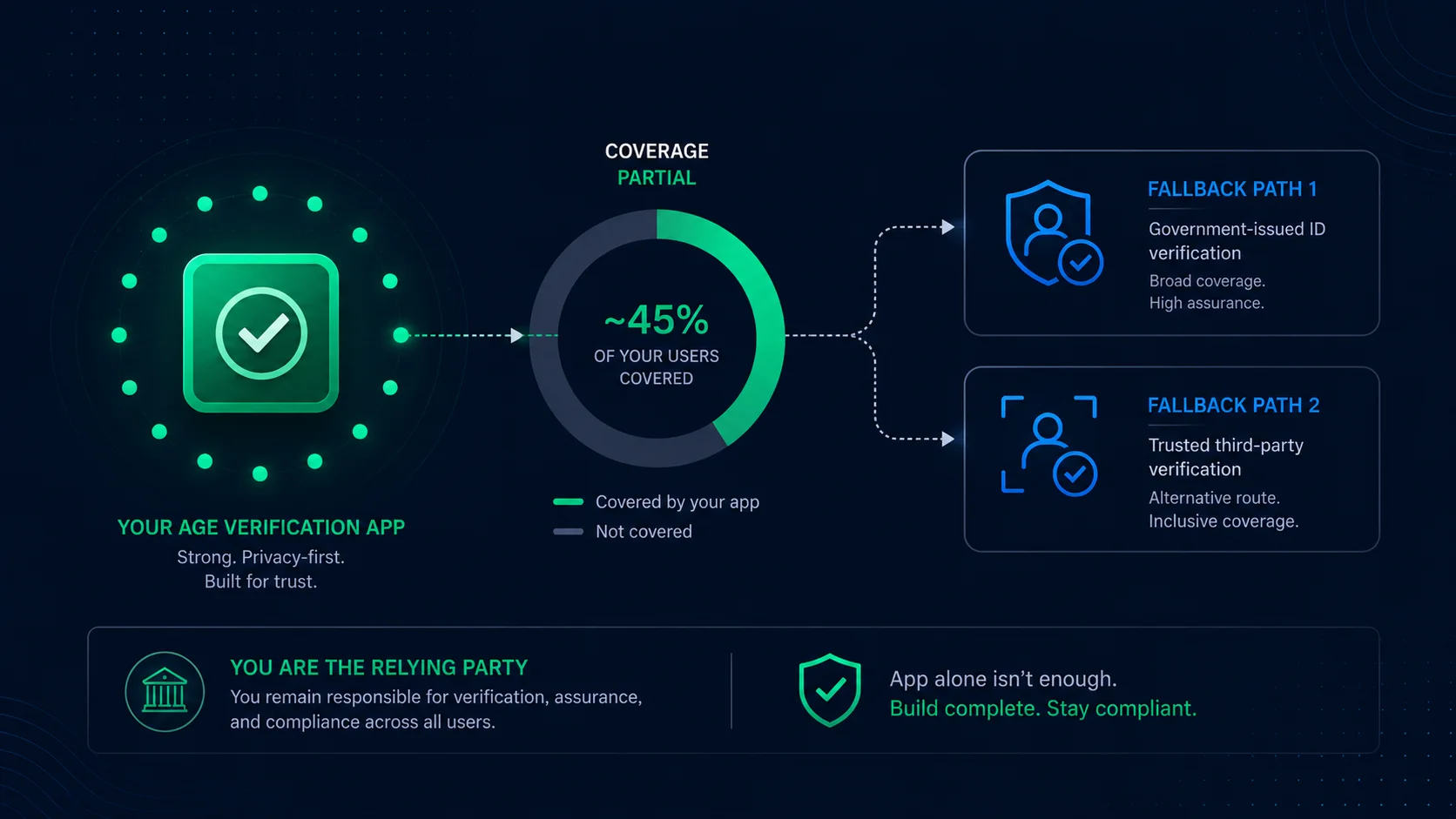
The wallet — and therefore the app — is voluntary for citizens. Member States must make it available; no citizen is obliged to install or use it. Adoption of a brand-new government app in its first year is a small fraction of any user base. If your only accepted method is the EU app, every user who has not installed it hits a wall or, worse, a bypass. A control that covers 5–15% of your audience in year one is not a control; it is a demo. You still need a verification path for the other 85–95%.
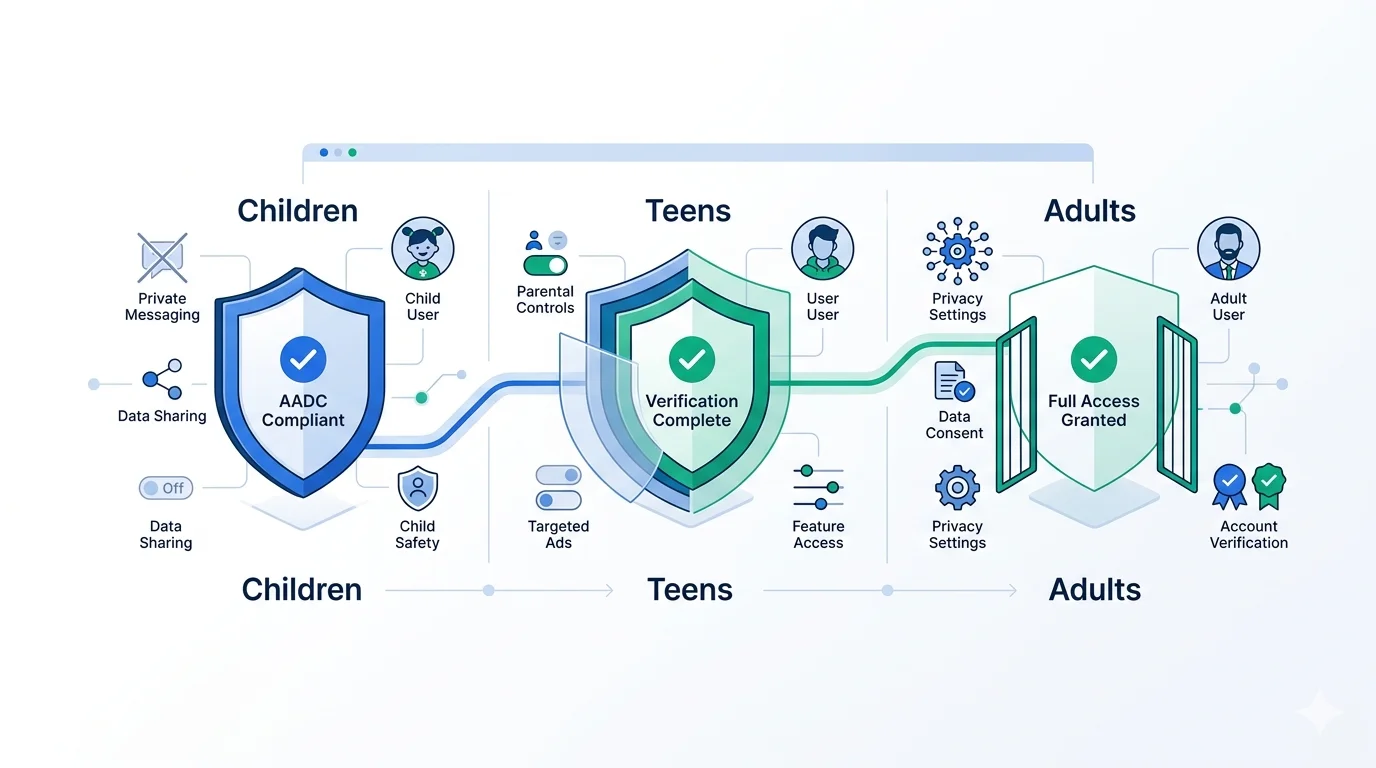
Coverage is fragmented by geography and age definition. Seven front-runner states are piloting in 2026; the rest arrive on their own timelines. And the Recommendation defines a “minor” as anyone under 18, while individual Member States set the relevant age anywhere from 13 to 18 — and GDPR’s own digital-consent age floats between 13 and 16 by Member State. “EU-wide” does not mean uniform. A single accepted attestation type does not resolve into a single threshold across your European footprint, and it does nothing at all for your non-EU users.
Age verification’s legal status is still ambiguous — but self-declaration is already failing enforcement. No DSA article names age verification as a binding obligation, so whether it is mandatory or voluntary remains genuinely unsettled. But do not mistake ambiguity for safety. Article 28(1) DSA requires “appropriate and proportionate measures” for minors’ safety, and the Commission is enforcing against the weak methods most platforms actually deploy: in April 2026 it preliminarily found Meta in breach of the DSA for failing to keep under-13s off Facebook and Instagram, and in March 2026 it opened an investigation into Snapchat for the same under-13 gap and for not adequately assessing whether users are under 17. The direction of travel is identical to the ICO’s £14.47M Reddit decision: self-declaration and loose age estimation are being ruled inadequate. Waiting for the app to be mandatory is the wrong bet; the enforcement pressure is on the methods you are using today.
The reference app is not automatically secure because it is official. When the Commission’s own age-checking app appeared in early April 2026, security researchers told Politico it took them roughly two minutes to break. “Government-issued” is not a synonym for “hardened.” Whatever you integrate, the attestation flow, the binding to a real user, and your fallback methods all remain your responsibility to get right — and to keep evidence of.
Put together: the EU app is an excellent new channel for the users who have it, and a strong signal of where the privacy bar is heading. It is not a turnkey answer to “how do we verify everyone who needs verifying.” Treating it as one is how a platform ends up compliant on paper for a minority of users and exposed in practice for the majority.
What to build now
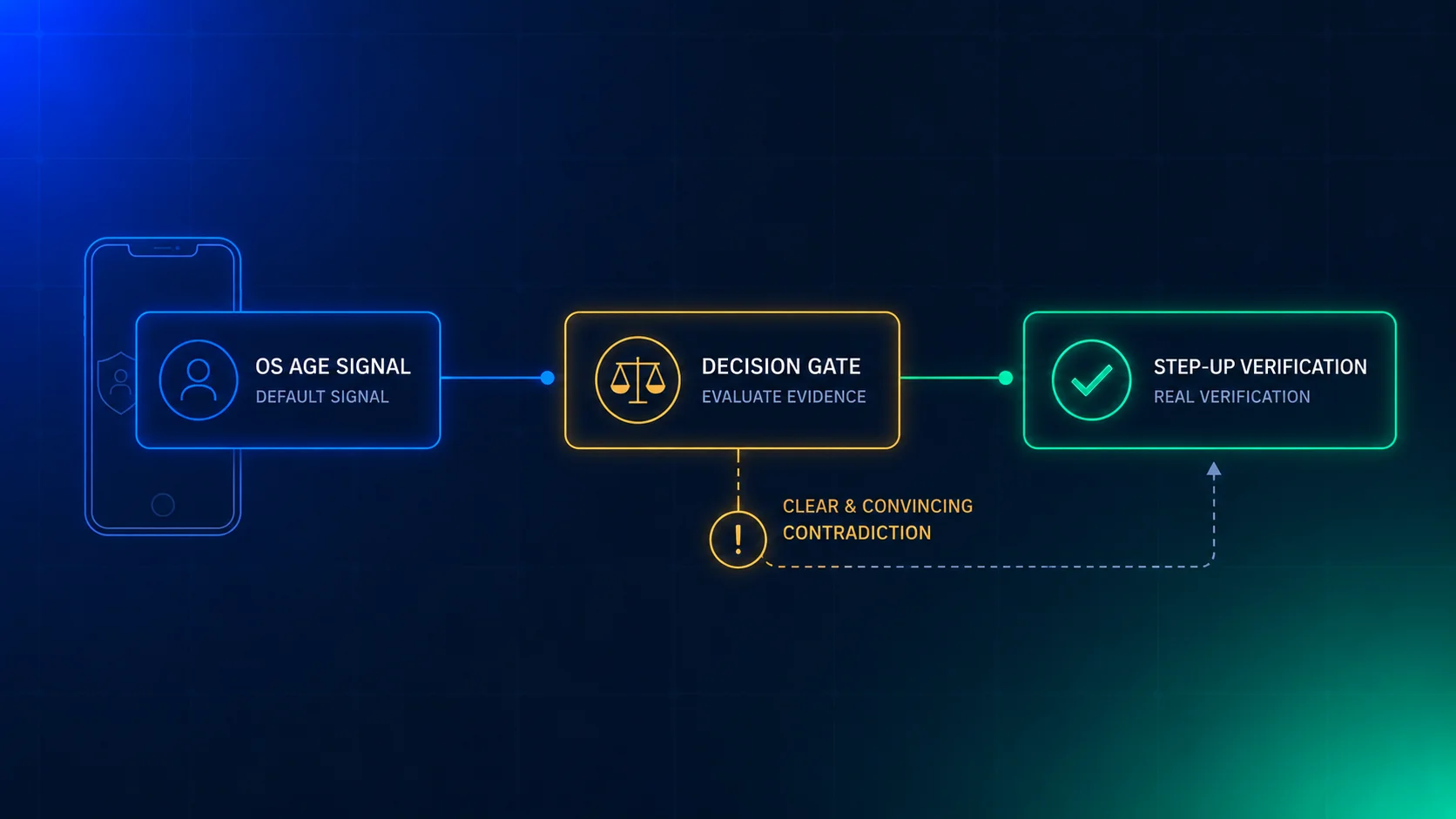
The right posture is to become a competent relying party that can accept EU proof-of-age attestations and verify the users who don’t present one — through a single decision layer, with a single evidence trail. Concretely:
Integrate acceptance of proof-of-age attestations, threshold-first. Build your flow to consume a true/false over-threshold result and nothing more. Do not architect around receiving a date of birth “just in case” — that reintroduces the data-minimization problem the whole scheme exists to solve, and it will read as disproportionate collection under both the DSA framing and GDPR.
Provide equal-strength fallback methods. For the large majority without the wallet, you need methods matched to your risk level: facial age estimation under liveness for lower-risk thresholds, escalating to document plus NFC chip verification where certainty is required. The fallback has to be strong enough that a motivated minor cannot simply choose the weaker path — otherwise the whole gate inherits the weakness of its softest option.
Normalize every path to the same decision and the same audit record. Whether age came from an EU attestation, an estimation model, or an ID scan, your platform should log a threshold result, the method used, and the assurance level — not the underlying identity. That per-decision evidence trail is what you hand a regulator; the raw ID is a liability you should not be holding.
Plan for national divergence, not a single EU switch. Map your thresholds per Member State, keep the door open to accepting attestations from multiple EU-based trusted providers as the scheme’s list populates, and don’t hard-code a single “over 18” assumption. And weigh the alternative honestly: for some markets the real decision is still geoblock or verify, and that math changes as the app’s coverage grows.
How Xident fits
Xident is designed to be exactly the relying-party layer this rollout requires: one integration that accepts privacy-preserving proofs and covers the users who don’t have one yet. Where a user presents an EU proof-of-age attestation, the flow consumes the over-threshold result and passes it straight through — no unnecessary data crosses the boundary, consistent with the blueprint’s true/false-by-default principle. Where a user has no wallet, the same flow verifies them directly: client-side facial age estimation under liveness returns a threshold classification (over or under 12, 15, 16, 18, 21, or 25), escalating automatically to document OCR and face match when the surface or the result demands it.
Critically, every path resolves to the same output: a threshold decision and an audit record, logged with its method and assurance level, rather than a retained date of birth or ID image. A reusable Xident token lets returning users re-prove the same fact without re-collecting identity — the same “verify once, present many times” model the EU scheme is built on. The result is a single control that is ready for the EU app as adoption climbs, and already covers the 85–95% of your users who won’t be carrying it in 2026.
The EU Age Verification App is a real step forward, and its privacy architecture deserves the credit it is getting. But a new proof channel used by a minority of users is not a compliance program. The obligation the Commission and national regulators are actually enforcing — knowing the age of the users you serve, by a method proportionate to the risk, with evidence you can produce — lands on you regardless of how many people install the app. Build the relying-party layer that accepts the attestation and verifies everyone else, and the end-of-2026 deadline becomes a channel you’re ready for rather than a scramble.
This post is general information about a public policy development, not legal advice. The EU age verification framework is a non-binding Recommendation whose technical and legal details are still evolving; consult qualified counsel for your specific obligations in each Member State.