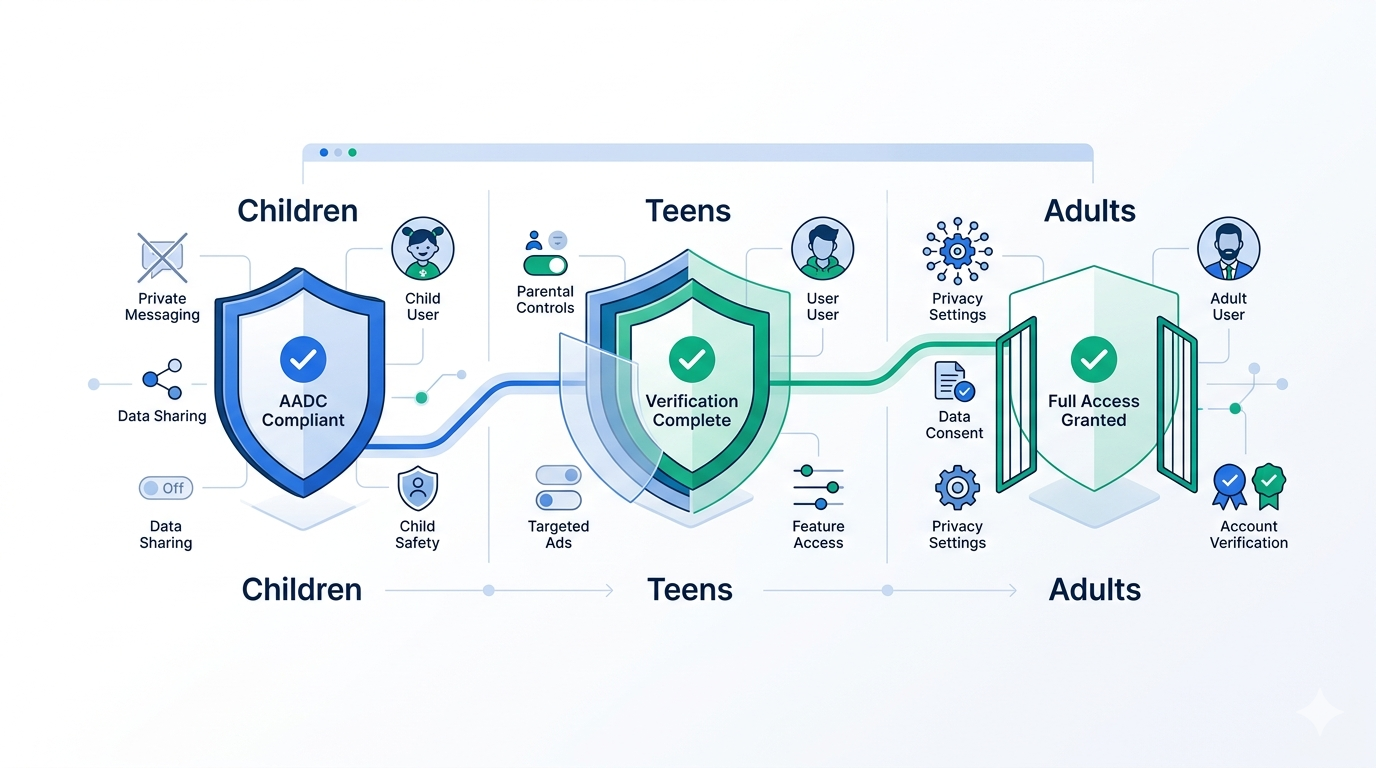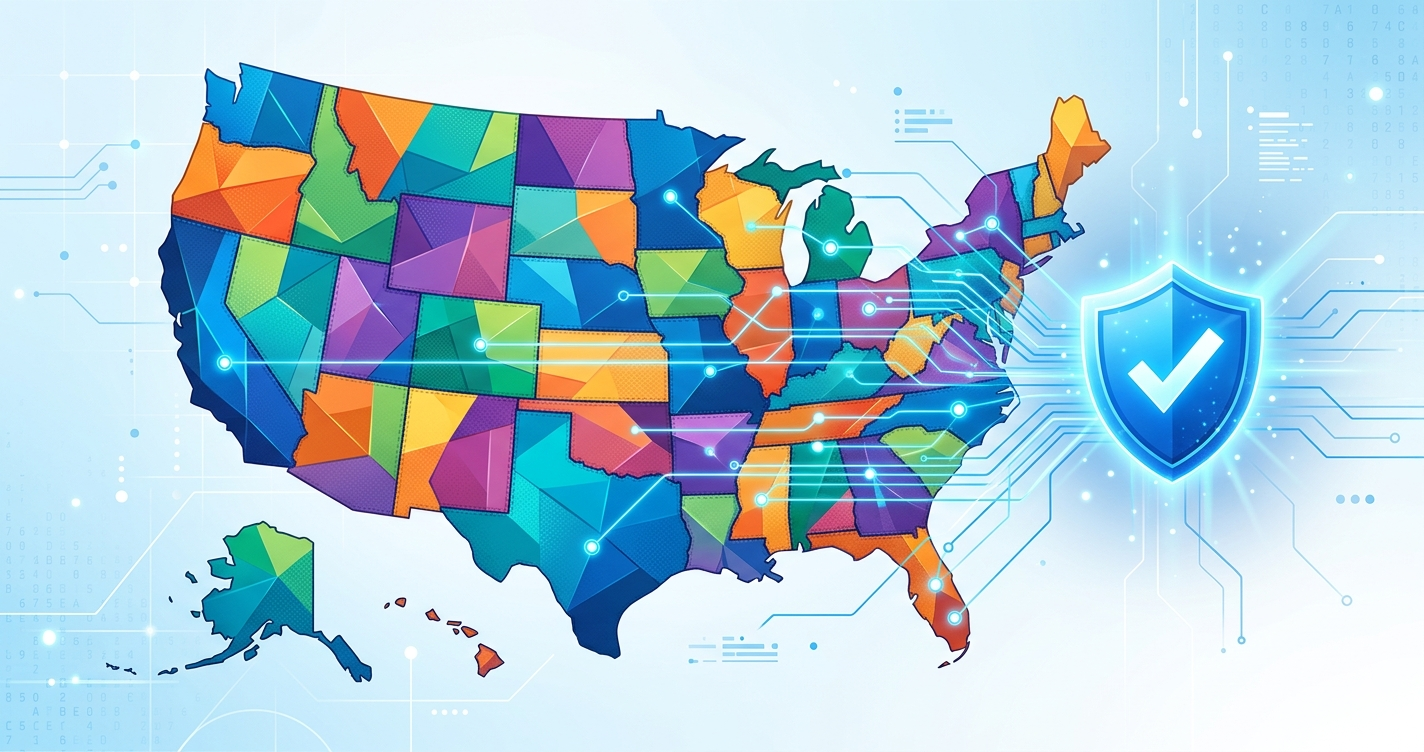
Something unprecedented is happening in US internet regulation. Over the past eighteen months, more than 25 states have enacted some form of age verification law. At least 18 new bills have been introduced in 2026 alone. For online businesses, the result is a compliance landscape unlike anything we’ve seen: overlapping deadlines, contradictory requirements, active litigation, and real enforcement beginning to bite.
If you operate a website or app that serves US users — whether in social media, e-commerce, gaming, adult content, or any category that touches minors — this isn’t a future concern. It’s a current operational problem.
The Scale of What Changed
To appreciate the urgency, consider how fast this moved. In early 2024, only a handful of states had age verification requirements, mostly focused on adult content. By the end of 2025, nine new state laws took effect in a single year. Now, in March 2026, roughly half of all US states mandate some form of age gating.
The categories affected have expanded well beyond adult content:
- Social media platforms must verify age and obtain parental consent for minors in states like New York, Florida, Virginia, Nebraska, and growing list of others
- E-commerce and delivery services selling age-restricted products (alcohol, tobacco, cannabis) face verification requirements in multiple jurisdictions
- Gaming and gambling platforms must confirm users meet minimum age thresholds
- General-purpose apps and platforms are increasingly caught by broad child safety statutes that don’t distinguish between content types
This isn’t a niche regulatory issue. It affects nearly every business with a US-facing digital product.
The Patchwork Problem
What makes this particularly challenging is that no two state laws are the same. The differences aren’t minor — they affect fundamental aspects of your compliance strategy.
Age Thresholds Vary
Florida prohibits children under 14 from creating social media accounts entirely, and requires parental consent for users 14–15. New York’s SAFE for Kids Act targets addictive algorithmic feeds for anyone under 18. Virginia limits minors to one hour of social media per day by default. Some states set the threshold at 16, others at 18. A single product may face three different age gates depending on where a user is located.
Consent Requirements Differ
Some states require verified parental consent before a minor can create any account. Others mandate opt-in mechanisms for specific features like algorithmic recommendations or notifications. New York prohibits sending push notifications to minors between midnight and 6 AM without parental consent — a requirement that demands knowing user age in real time, not just at registration.
Technology Standards Are Unclear
This is perhaps the most significant compliance risk. Most state laws mandate age verification without specifying which technologies qualify. Some laws reference “commercially reasonable methods.” Others mention government ID verification, facial age estimation, or third-party verification services. Several laws are deliberately vague, leaving businesses to guess which methods will satisfy regulators and survive court challenges.
Enforcement Is Inconsistent
Some states have begun active enforcement. Others have laws on the books but no enforcement apparatus. Several laws have been enjoined by courts on First Amendment grounds, creating uncertainty about whether complying now is even necessary — or whether a currently blocked law could become enforceable on short notice after an appeal.
The Constitutional Question
Multiple state age verification laws face First Amendment challenges, with courts divided on whether mandatory age gates constitute prior restraint on speech. The Supreme Court is expected to weigh in, but until then, businesses face the impossible choice between investing in compliance infrastructure for laws that might be struck down, or ignoring laws that might be upheld with retroactive enforcement.
What the Laws Actually Require: A State-by-State Snapshot
Here’s a representative sample of what businesses face across key states as of March 2026:
| State | Scope | Age Threshold | Key Requirement | Status |
|---|---|---|---|---|
| Florida | Social media | Under 14 banned; 14-15 need consent | Account deletion for non-compliant minors | Enforceable |
| New York | Social media feeds | Under 18 | Block addictive feeds without parental consent; no midnight notifications | Enforceable |
| Virginia | Social media | Under 18 | Default 1-hour daily limit; parental override available | Effective Jan 2026 |
| Nebraska | Social media | Under 18 | Parental consent required; parental monitoring rights | Effective Jul 2026 |
| California | Broad (AADC) | Under 18 | Age estimation for all users; DPIA for features used by children | Effective Dec 2026 |
| Texas | Adult content | Under 18 | Government ID or equivalent verification | Enforceable |
| Utah | Social media + app stores | Under 18 | App-store-level age verification | Enforceable |
| Louisiana | Adult content | Under 18 | Government ID verification | Enforceable |
This is a subset. Multiply this by 25+ states, add pending legislation in another 15, and the compliance matrix becomes genuinely unmanageable with per-state custom implementations.
The Privacy Paradox
Here’s the tension that makes this problem especially thorny: most age verification methods create new privacy risks in the name of protecting children.
Government ID verification requires collecting and processing highly sensitive documents. Facial age estimation requires capturing biometric data. Even third-party verification services create logs that can link individuals to specific websites and content categories. Every method expands the attack surface for data breaches and creates records that users never had to produce before.
This isn’t hypothetical. The Electronic Frontier Foundation has called out the surveillance implications of state age verification mandates. The CNBC investigation in March 2026 documented how age verification tools deployed for child safety are actively being used to surveil adults. Collecting identity documents to access a website is a fundamentally different privacy model than the open internet that preceded it.
For businesses, this creates a compliance paradox: you must verify age to comply with child safety laws, but the act of verification may violate data minimization principles under GDPR, state privacy laws like the CCPA, or even the same state’s own privacy protections.
The businesses that navigate this best will be those that choose verification methods that prove age without collecting identity — the principle of minimum necessary disclosure.
What This Means for Your Engineering Team
If you’re a developer or engineering leader evaluating age verification solutions, here’s what the compliance landscape demands:
1. Geolocation-Aware Verification
Your verification flow must adapt based on user location. A user in Florida faces different requirements than one in New York or California. This means your age verification layer needs to be configurable by jurisdiction — not a one-size-fits-all gate.
2. Multiple Verification Methods
No single method satisfies all state laws. You likely need a layered approach: facial age estimation for some jurisdictions, document verification as a fallback, and potentially parental consent flows for states that require them. Your system must support routing users to the appropriate method.
3. Privacy-First Architecture
Choose solutions where biometric data stays on-device whenever possible. The less data you collect, store, and transmit, the smaller your liability surface. On-device facial age estimation that never sends face images to a server is a fundamentally different risk profile than cloud-based document upload.
4. Audit Trail Without Over-Collection
You need to prove compliance — demonstrating that you verified a user’s age — without retaining the sensitive data used to do so. This means logging the outcome (pass/fail) and the method used, without storing the ID photo, face scan, or date of birth.
5. Reusable Verification
Asking users to re-verify every session is both a conversion killer and a privacy liability. The industry is moving toward reusable age credentials — verify once, carry proof across sessions and even across platforms. This dramatically reduces both friction and data exposure.
The Reusable Credential: Where the Industry Is Heading
The compliance patchwork is actually accelerating a market shift that benefits users, businesses, and regulators alike: reusable digital age credentials.
The concept is straightforward. A user verifies their age once through a rigorous process — facial age estimation, document verification, or both. They receive a cryptographic credential that proves “this person is over 18” (or any other threshold) without revealing their identity, date of birth, or any other personal data. That credential can be reused across websites and platforms instantly.
This model solves multiple problems simultaneously:
- Compliance: A single verification satisfies requirements across all jurisdictions
- Privacy: Subsequent checks reveal only the age bracket, never the underlying identity
- User experience: No repeated document uploads, selfie captures, or multi-step flows
- Cost: Reusing a credential is dramatically cheaper than re-running full verification
- Security: Less data collected means less data to breach
The EU is already piloting this model with the EU Digital Identity Wallet, which allows citizens to prove age through privacy-preserving cryptographic proofs. In the US, the market is moving in the same direction through private-sector solutions rather than government infrastructure.
Industry analysts predict that reusable age credentials will become the default verification method by 2027, driven by the sheer impracticality of per-state, per-platform, per-session verification.
How Xident Addresses the US Compliance Landscape
Xident was designed from day one around the “verify once” principle — the same architecture that the regulatory landscape is now demanding.
On-Device Age Estimation
Xident’s binary age classifiers run entirely on the user’s device using ONNX Runtime and WebAssembly. No face images are sent to any server. The model answers a simple yes/no question — “Is this person over 18?” — with a 0.03% false positive rate at Challenge-21 evaluation. This satisfies the accuracy requirements of even the strictest state laws while collecting zero biometric data server-side.
Document Fallback for Strict Jurisdictions
For states like Texas and Louisiana that mandate government ID verification, Xident provides OCR-based document verification as a fallback path. Documents are processed and immediately deleted — no persistent storage of ID images or personal data.
Reusable Xident ID
When a user completes verification, they can create a Xident ID — a reusable age credential tied to their device via passkeys. On subsequent visits to any Xident-integrated site, they verify instantly with a biometric unlock (Face ID, fingerprint, PIN). No re-verification, no data re-collection, no friction.
Configurable Rule Engine
Xident’s backend rule engine allows site operators to configure verification requirements per jurisdiction. Set different age thresholds, methods, and fallback behaviors based on user location. One SDK integration handles the compliance matrix across all states.
Privacy by Architecture
The verification result — a simple pass/fail with age bracket — is all that ever reaches the consuming platform. No date of birth, no name, no document data, no face images. This architecture satisfies data minimization requirements under CCPA, state privacy laws, and positions businesses well for whatever federal legislation eventually emerges.
Getting Ahead of 2026–2027 Deadlines
If you haven’t started implementing age verification, the timeline is tightening:
- Now: Florida, New York, Texas, Louisiana, Utah, and several other states are actively enforcing
- July 2026: Nebraska’s Parental Rights in Social Media Act takes effect
- December 2026: California’s Age-Appropriate Design Code becomes enforceable
- 2027: Additional state laws and potential federal legislation expected
The businesses that will navigate this best are those that implement a flexible, privacy-preserving verification layer now — one that can adapt as new states add requirements and courts clarify constitutional boundaries.
The worst approach is waiting for regulatory clarity, because the patchwork isn’t going to simplify. It’s going to multiply.
Key Takeaways
The US age verification landscape in 2026 presents a genuine operational challenge, but the solution architecture is clear: on-device processing where possible, document verification where mandated, reusable credentials to reduce friction and liability, and a configurable rule engine to handle jurisdictional variation.
Businesses that invest in this infrastructure now aren’t just solving a compliance problem — they’re building a competitive advantage in user experience and trust. When every competitor forces users through repetitive, privacy-invasive verification flows, the platform that offers “verify once, access everywhere” wins.
The regulatory patchwork is driving the market toward exactly the architecture Xident has built. If you’re evaluating age verification solutions, contact our team or try the integration — it takes less than five minutes to add age verification to your platform.