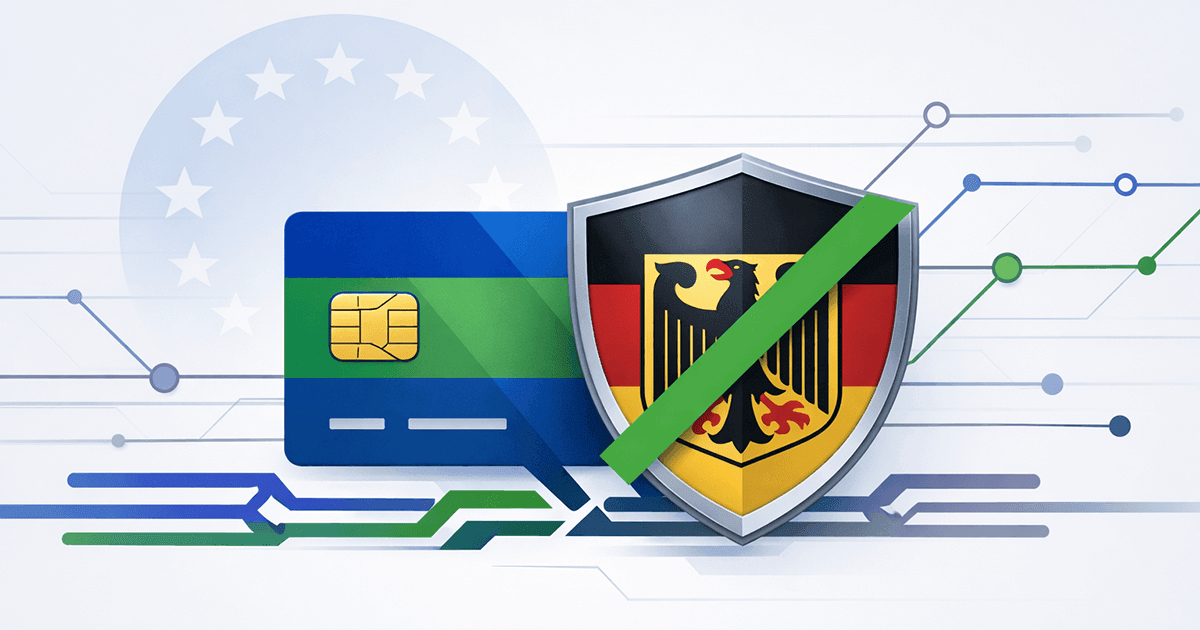
December 1, 2025 marked a significant shift in how Germany enforces youth protection regulations online. On this date, the country’s state media regulators gained a powerful new enforcement mechanism: the ability to instruct banks and payment service providers to halt financial transactions for non-compliant platforms. This development fundamentally changes the compliance calculus for any platform with a substantial German user base — and it applies regardless of where your company is incorporated.
For compliance officers, legal teams, and platform operators, the message is clear and urgent: the enforcement landscape has moved beyond website blocking. Financial pressure now backs regulatory requirements, making compliance not merely a legal preference but a business imperative.
The New Enforcement Landscape
Until December 2025, Germany’s media regulators — collectively known as the Landesmedienanstalten — could block websites that violated youth protection rules. Effective blocking could be worked around through VPNs, routing tricks, or mirror domains. But the new authority changes everything. Regulators can now instruct banks and payment service providers operating in Germany to refuse processing payments to non-compliant platforms.
This creates a practical enforcement mechanism that no technical workaround can circumvent. A platform cannot operate without payment processing. A mirror domain or routing trick provides no help if the payment rails themselves are cut off. This is enforcement with real economic teeth, and it signals that Germany intends to shift youth protection compliance from advisory to mandatory.
The legal basis for this enforcement power stems from Germany’s Interstate Treaty on the Protection of Minors in the Media (JMStV), which sets binding standards for platforms offering 18+ content to German users.
Understanding the JMStV Requirements
The JMStV is not a new regulation — it has been in place for years. What is new is the aggressive enforcement posture and the expanded enforcement mechanisms as of December 1, 2025. Understanding what the JMStV actually requires is the first step toward compliance.
The core requirement is straightforward: platforms offering content restricted to users 18 and older must implement age verification. The regulation does not require any particular technology. It does not mandate facial recognition, document uploads, or any specific method. Instead, it sets a functional requirement: prove that users are of age before granting access to restricted content.
However, there is a critical practical constraint: the system you choose must be on the KJM’s approved list. The KJM (Kommission für Jugendmedienschutz) is the joint body of Germany’s state media authorities, and it maintains an official list of approved age verification providers. Using an unapproved system — even one that technically works — does not satisfy JMStV compliance in the eyes of German regulators.
The KJM Approval Criteria
Understanding what the KJM looks for in approved providers reveals something important about Germany’s priorities in age verification: privacy and data minimization rank alongside accuracy.
KJM approval requires providers to demonstrate several capabilities:
Identity Confirmation. The provider must verify that a user is who they claim to be. This can be done through document-based verification, biometric analysis, or other identity confirmation methods. The goal is preventing trivial circumvention — a child cannot simply claim to be an adult without some form of substantiation.
Data Minimization. Providers must demonstrate that they collect only the minimum personal data necessary for age verification. Excessive data collection is a red flag for KJM reviewers. This principle is particularly important for biometric-based approaches.
Security and Encryption. All data transmission must be encrypted. Data must be protected against unauthorized access. This is a floor expectation, not a differentiator.
GDPR Compliance. Age verification systems must comply with the General Data Protection Regulation. This includes providing transparent privacy policies, honoring data subject rights, and maintaining appropriate data retention policies. Many systems fail on this dimension — they handle age verification securely but stumble on GDPR compliance details.
For providers using machine learning-based age estimation, there is an additional requirement: a 3-year safety buffer. This means the technology must recognize users as at least 21 years old in order to approve them for 18+ services. This buffer is intentional — it reduces the risk of borderline cases being incorrectly approved. The margin of error in age estimation, even with the best models, is non-trivial, and the KJM builds in a safety threshold.
Currently Approved Providers
As of the information available, the following providers have received KJM approval:
- Yoti — The first ML-based provider to gain KJM approval, marking a significant moment in the acceptance of technology-driven age verification
- IDnow — Offering multiple verification methods including VideoIdent, AutoIdent, eID, Wallet, and IDCheck.io
- Veriff — A broad-based identity verification platform
- Sumsub — Offering comprehensive identity and age verification solutions
- Shufti — Document-based and biometric verification
- Verifymy — Age verification and identity solutions
- Gataca — Identity and credential verification
This list is not static. Additional providers may gain approval as they meet KJM criteria. However, at present, platforms must choose from this roster if they want regulatory certainty in Germany.
The Territorial Scope: It Applies to You
A critical misunderstanding persists in some corners of the tech industry: the belief that JMStV applies only to German companies or German-based platforms. This is incorrect.
The JMStV applies to any platform accessible to German users that offers 18+ content. The regulation does not care where your servers are located or where your company is incorporated. A US-based platform serving German users with adult content must comply. A UK company operating an 18+ service accessible in Germany must comply. Geography of incorporation is irrelevant; geography of user access is what matters.
This also means that common workarounds — mirror domains, geographic routing, content region-locking — do not provide compliance relief. If regulators determine that your platform is accessible to German users and offers restricted content, the JMStV applies. The new payment-blocking enforcement mechanism makes this more than theoretical: platforms cannot hide behind technical obfuscation and expect to retain payment processing.
Broader Regulatory Context: The Bigger Picture
The December 1, 2025 date marked not just the implementation of payment-blocking enforcement but also the entry into force of new youth protection obligations for operating system providers. Germany is expanding its regulatory framework beyond platforms to address youth protection across digital ecosystems.
Additionally, there is a timeline consideration: by December 2026, designations will be made regarding which operating system providers fall within the scope of these new obligations. This indicates that Germany’s youth protection framework is evolving to address not just content platforms but infrastructure layers.
EU-Level Trends and Convergence
Germany’s aggressive enforcement posture is not happening in isolation. At the EU level, several trends are converging:
The Digital Services Act (DSA) imposes obligations on large platforms to protect minors, including age assurance measures where appropriate. While the DSA does not mandate any specific technology, it does create pressure on platforms to implement age verification for restricted services.
The European Union is developing an EUDI (European Digital Identity) wallet, expected to launch in September 2026. This wallet will enable users to prove identity attributes — including age — through a standardized digital credential. Once deployed, EUDI wallets may become a primary verification mechanism across the EU, potentially simplifying cross-border compliance.
The EU Age Verification Blueprint is an emerging framework addressing best practices for age assurance across member states. These efforts signal that EU-wide convergence on age verification standards is underway. Early movers who implement robust, privacy-first age verification now will be better positioned when these EU-level standards solidify.
Privacy-First Approaches: A Competitive Advantage
An important observation emerges from the KJM approval criteria: regulators are not indifferent to how age verification is implemented. Systems that minimize biometric data collection, avoid unnecessary personal data retention, and prioritize user privacy are viewed favorably.
This creates a strategic opportunity for platforms and providers. The compliance landscape is moving toward privacy-first solutions. Technologies that perform age estimation without storing facial images, that use client-side inference to avoid transmitting biometric data to servers, and that minimize the personal data footprint are not just regulatory-compliant — they are increasingly preferred.
As regulations tighten globally, privacy-first age verification will likely become a standard expectation rather than a differentiator. Platforms that adopt these approaches now reduce their compliance risk and position themselves favorably as the regulatory environment evolves.
What This Means for Your Platform
If your platform serves German users and offers 18+ content, the time for action is now. Here are the practical steps to consider:
First, assess your German user base. Determine what percentage of your traffic comes from Germany and whether your service actually offers age-restricted content under JMStV definitions. Not all platforms with adult-oriented content are in scope — the regulation targets broadcast-equivalent media content restrictions. However, if you offer services or content that would not be sold to minors in a physical storefront, you are likely in scope.
Second, evaluate approved providers. Review the currently KJM-approved list and assess which provider’s technology, data practices, and pricing align with your platform’s needs and compliance philosophy. If privacy minimization is important to your brand, prioritize providers with privacy-first architectures. If you need document-based verification for high-certainty use cases, prioritize providers with robust document verification capabilities.
Third, plan your implementation timeline. Payment-blocking enforcement is already in effect. While regulatory enforcement has historically been gradual, the existence of enforcement authority creates liability exposure for every day you delay. A reasonable implementation timeline is measured in months, not quarters.
Fourth, consider broader implications. The German regulatory environment is a bellwether for EU-wide trends. Implementing age verification for German users now positions your platform to meet emerging DSA requirements and to adapt to future EUDI wallet integration.
Conclusion
Germany’s December 2025 enforcement escalation is a watershed moment for digital platforms. The age of regulatory suggestions has passed. Payment-blocking enforcement creates immediate business risk for non-compliance, and that risk applies to platforms globally, not merely those incorporated in Germany.
For compliance officers and platform operators, the message is clear: assess your exposure, evaluate approved providers, and plan implementation now. The regulatory landscape has shifted, and the cost of inaction has increased dramatically. Privacy-first, KJM-approved age verification is no longer a nice-to-have — it is a business imperative for platforms serving German users.
The good news is that approved solutions exist, that privacy-first approaches are available, and that early implementation positions platforms favorably as the EU regulatory environment continues to evolve. The time to act is now.