The European Union is about to fundamentally change how online identity works. By December 2026, all 27 EU member states must offer at least one EU Digital Identity Wallet (EUDI Wallet) to their citizens under the revised eIDAS 2.0 regulation. For platforms that need age verification, this is the most significant infrastructure shift since GDPR.
This isn’t a theoretical framework. Denmark, France, Greece, Italy, and Spain are already customising national wallet apps. The European Commission has published its second version of the age verification blueprint. And over 650 million people are projected to use mobile driver’s licenses globally by the end of 2026.
If you operate an age-gated platform in the EU — or serve EU users from anywhere — here’s what you need to understand.
What Is the EUDI Wallet?
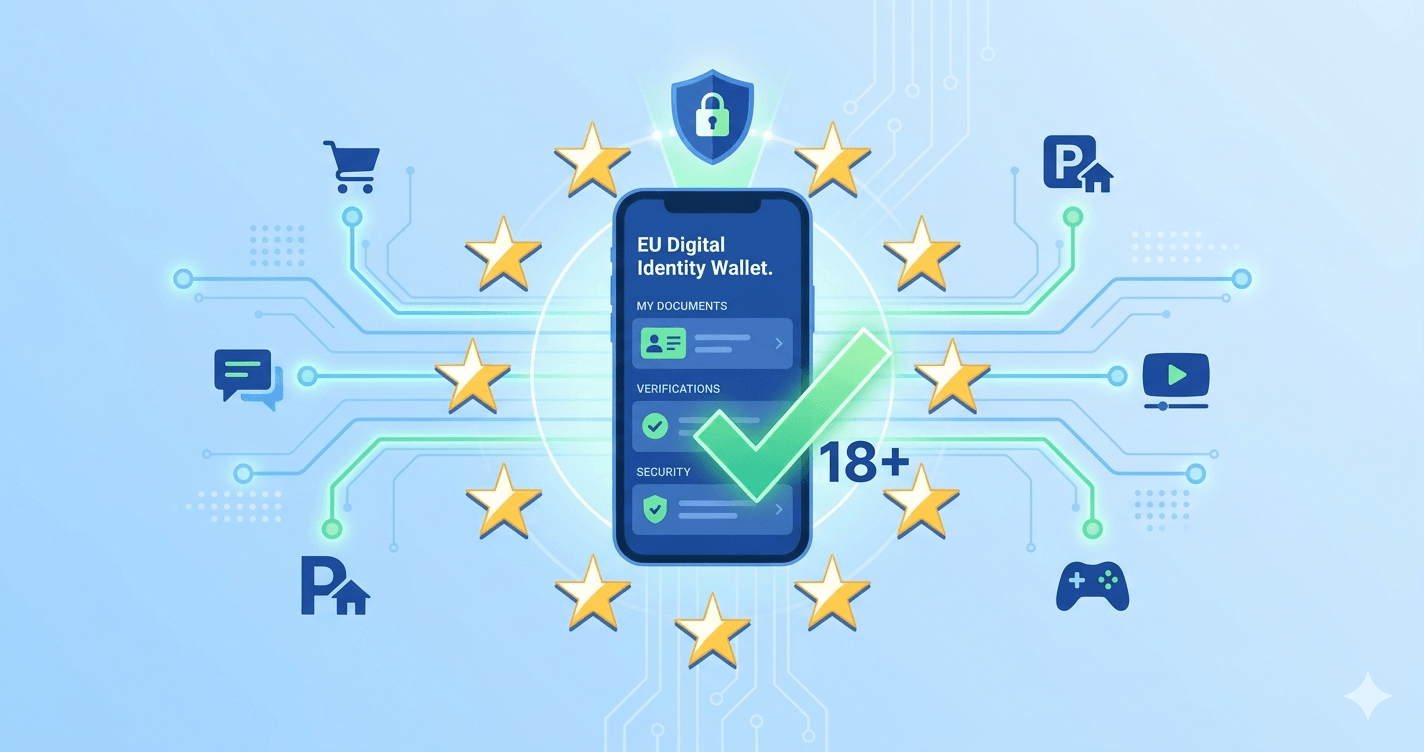
The EU Digital Identity Wallet is a government-issued mobile app that lets citizens store verified personal attributes — name, date of birth, address, qualifications — and selectively share them with online services. Think of it as a digital passport that you control, where you decide exactly which pieces of information to disclose for each interaction.
The key principles:
- Citizen-controlled: Users choose what to share and with whom
- Free of charge: Issuance, use, and revocation cost nothing for individuals
- Voluntary: Citizens cannot be forced to use it, and services cannot refuse users who decline
- Cross-border: A wallet issued in France works for a service based in Germany
- Selective disclosure: Share only what’s necessary — prove you’re over 18 without revealing your birthdate
That last point is the one that matters most for age verification.
Selective Disclosure: Age Verification Without Identity
Today’s age verification typically works in one of two ways: you either upload a government ID (sharing far more data than necessary) or you submit to biometric age estimation (which processes facial imagery). Both approaches involve collecting personal data that creates privacy and compliance obligations.
EUDI wallets introduce a third option: selective disclosure. A user can present a cryptographic proof that they are over 18, over 21, or over 25 — without revealing their name, exact date of birth, address, or any other identifying information.
The technical mechanism behind this is zero-knowledge proofs (ZKPs) — a cryptographic technique where one party can prove a statement is true without revealing the underlying data. In practice, the flow works like this:
- A citizen’s identity is verified once during wallet issuance (by their government)
- The wallet stores a verified date-of-birth credential
- When a platform requests age verification, the wallet generates a proof: “This person is over 18” → true/false
- The platform receives the boolean result — nothing else
- No identity data is transmitted, stored, or processed by the platform
This is a fundamentally different model from document scanning or biometric estimation. The platform never sees personal data. There’s no biometric template to breach. There’s no document image to store. The privacy engineering is done at the credential layer, not the application layer.
The EU Age Verification Blueprint
The European Commission hasn’t left this to chance. In early 2026, it released the second version of its age verification blueprint — a technical framework specifically designed for EUDI wallet-based age checks.
Key design principles of the blueprint:
- Identity checked once: The user’s identity is verified during wallet issuance, not during each age check
- No identity data in the proof: The proof of age contains no personally identifiable information
- Anti-tracking: The protocol prevents service providers from correlating age checks across platforms
- National customisation: Each member state adapts the app to local requirements while maintaining interoperability
Denmark, France, Greece, Italy, and Spain are the first countries to implement the blueprint. Others are expected to follow throughout 2026 as the December deadline approaches.
What This Means for Online Platforms
You Must Accept EUDI Wallets
Under eIDAS 2.0, online service providers that require identity verification must accept EUDI wallets as a valid means of identification. If your platform performs age verification, you will need to accept wallet-based age proofs alongside your existing methods.
This doesn’t mean you can only use wallets. You can still use biometric age estimation, document verification, or other approved methods. But you cannot reject a valid wallet-based age proof from an EU citizen.
Your Compliance Surface Shrinks
Paradoxically, wallet-based age verification makes compliance easier. Since you never receive personal data — only a boolean age proof — your GDPR obligations for that interaction are minimal:
- No biometric data (Article 9 special categories) to worry about
- No document images to store and protect
- No data retention decisions to make — there’s nothing to retain
- No cross-border data transfer issues — the proof is privacy-preserving by design
For platforms currently navigating the intersection of age verification and GDPR, this is a significant simplification.
Adoption Will Be Gradual
Not all EU citizens will have wallets on day one. The regulation mandates that member states must offer wallets by December 2026, but citizen adoption will ramp over time. You’ll need to support wallet-based verification as one option alongside traditional methods.
The practical implication: your age verification system needs to be multi-modal. It should accept wallet-based proofs when available, while falling back to biometric age estimation or document verification for users who don’t have a wallet yet.
How This Compares to Existing Approaches
| Approach | Data Collected | Privacy Risk | Accuracy | Friction |
|---|---|---|---|---|
| Self-declaration | None | None | Very low | None |
| Credit card check | Card details | Medium | Low (age ≠ cardholder) | Low |
| Document upload | Full ID image | High | High | High |
| Biometric estimation | Facial imagery | Medium* | High | Low |
| EUDI wallet proof | Boolean only | Minimal | Very high | Low |
*Medium with on-device processing (like Xident); High if processed server-side.
Wallet-based proofs offer the best combination of accuracy, privacy, and user experience. But they require the user to have a wallet — which is why a multi-modal approach is essential during the transition period.
The Verify-Once Model Gets Stronger
If you’ve been following Xident, you know we’ve built our architecture around the “Verify Once” principle: verify a user’s age once, then issue a reusable token for subsequent visits. EUDI wallets take this concept even further.
With wallet-based age proofs, the “verify once” happens at the government level during wallet issuance. Every subsequent age check is just a cryptographic proof — instant, privacy-preserving, and practically zero-friction. The wallet effectively becomes the universal “verify once” infrastructure that the entire EU ecosystem shares.
This aligns perfectly with where we’ve been heading. Xident already supports token-based returning users, reducing verification costs by up to 80%. As EUDI wallets roll out, we’ll integrate wallet-based proofs as a first-class verification method alongside our existing on-device age estimation and document verification.
What Platforms Should Do Now
Before Q3 2026
- Understand the regulation: Read the eIDAS 2.0 implementing acts, particularly the four implementing regulations covering technical specifications
- Audit your verification flow: Map where age or identity checks happen in your product and assess wallet integration points
- Talk to your verification provider: Ask whether they support (or plan to support) EUDI wallet-based age proofs
- Assess your user base: Determine what percentage of your users are in the EU and which member states they’re in
Before December 2026
- Implement wallet acceptance: Add EUDI wallet verification as an option in your age-gating flow
- Maintain fallback methods: Keep biometric and document-based verification for users without wallets
- Update privacy policies: Reflect the new verification method and its minimal data processing
- Test cross-border scenarios: Ensure your system accepts wallets from all 27 member states
Beyond 2026
The EUDI wallet framework is likely to influence similar initiatives globally. The UK, Australia, Canada, and several APAC nations are monitoring the EU rollout closely. Building wallet-compatible verification infrastructure now positions you for a broader global shift toward decentralised, privacy-preserving identity.
How Xident Helps
Xident is designed for exactly this kind of transition. Our architecture already prioritises privacy-preserving verification:
Multi-Modal Verification
- On-device age estimation: AI-powered, no biometric data leaves the device
- Document verification: When higher assurance is needed
- Liveness detection: Prevents spoofing attacks
- EUDI wallet proofs: Coming Q4 2026 — accept wallet-based age attestations natively
Privacy by Architecture
Our on-device processing model — where facial analysis happens in the browser via WebAssembly, not on our servers — was built on the same principle that drives EUDI wallets: the platform should never see personal data it doesn’t need. Wallet-based proofs are a natural extension of this philosophy.
Seamless Transition
Platforms using Xident won’t need to rebuild their verification flow when wallets arrive. Our SDK will handle wallet-based proofs as another verification method, automatically selecting the best option based on what the user has available:
- User has EUDI wallet → Zero-knowledge age proof (fastest, most private)
- User without wallet → On-device biometric age estimation (fast, privacy-preserving)
- High-assurance required → Document verification + liveness (thorough, compliant)
Developer Experience
The same SDK integration that takes 5 minutes today will support wallet-based verification without code changes. We handle the protocol complexity — wallet presentation, proof verification, cross-border interoperability — so you don’t have to.
The Bigger Picture
The EUDI wallet isn’t just about age verification. It represents a fundamental shift in how digital identity works: from centralised databases controlled by platforms to decentralised credentials controlled by individuals.
For age verification specifically, this shift resolves the tension that has plagued the industry since the first age-gating regulations: how do you verify age without creating a surveillance system? Zero-knowledge proofs answer that question definitively. You prove what needs to be proven — nothing more.
The December 2026 deadline is real. The technical standards are published. The first member states are shipping apps. The question isn’t whether this is happening — it’s whether your platform will be ready when it does.
Preparing for EUDI wallet integration? Contact our team to discuss your compliance timeline, or explore our docs to start integrating Xident’s multi-modal age verification today.
Sources
- European Commission: EUDI Regulation
- European Commission: Age Verification Blueprint v2
- IEEE SA: Trends in Online Age Verification for 2026
- eIDAS 2.0 Compliance Requirements
- How eIDAS 2.0 Will Reshape Identity Verification
- New America: Exploring Privacy-Preserving Age Verification with ZKPs
- EFF: Zero Knowledge Proofs and Digital ID