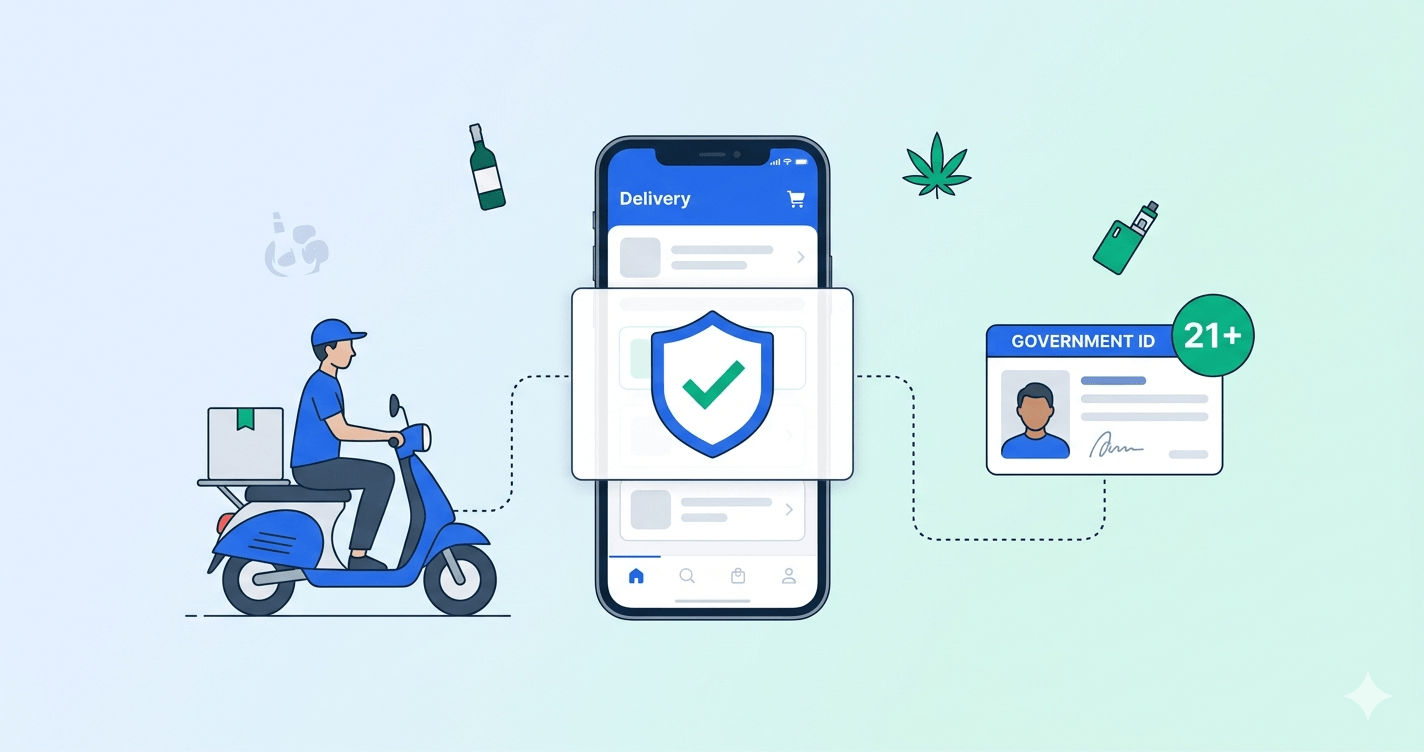
The on-demand delivery economy has reshaped how consumers buy alcohol, cannabis, tobacco, and vape products. DoorDash, Uber Eats, Instacart, Gopuff, and hundreds of regional platforms now deliver age-restricted goods to doorsteps within minutes. Regulators have noticed — and in 2026, they’re no longer distinguishing between a liquor store checkout counter and a delivery app checkout screen.
If you operate, build, or integrate with a delivery platform that handles age-restricted products, this post breaks down what’s required, what’s changing, and how to implement compliant age verification without turning your checkout flow into an abandonment funnel.
The Regulatory Landscape Has Shifted
For years, delivery platforms treated age verification as a last-mile problem: check ID at the door, collect a signature, move on. That approach is no longer sufficient. Regulators now expect verification at multiple points in the transaction — not just at delivery.
Federal Requirements
Three federal frameworks now directly impact on-demand delivery of age-restricted products:
The PACT Act applies to any platform that facilitates the sale and shipment of tobacco and vape products. It requires age verification at the point of sale (checkout), adult signature at delivery, and monthly reporting to the Bureau of Alcohol, Tobacco, Firearms and Explosives (ATF). Platforms that merely “facilitate” delivery — even if they don’t hold inventory — are increasingly being pulled into PACT Act obligations.
FDA Deeming Rules require that no tobacco or nicotine product be sold to anyone under 21. For online transactions, the FDA expects third-party age verification, not self-declaration checkboxes. A federal task force seized over 2.1 million unauthorized vaping products in early 2025 specifically because the distributors’ online checkout systems lacked front-end ID verification.
The STOP Act (Synthetics Trafficking and Overdose Prevention) imposes additional requirements on international shipments of certain substances, including nicotine products, with enhanced age verification obligations at customs and final delivery.
State-Level Requirements
Thirty-five states have updated their alcohol delivery regulations since 2024. The specific requirements vary widely, but the trend is unmistakable: states are moving from “check ID at the door” to “verify age before the order is placed.”
Key patterns emerging across states:
- Pre-checkout verification is now required in at least 12 states for alcohol delivery. The order cannot be submitted without completing age verification first.
- Cannabis delivery is legal in 16 states (medical and/or recreational), but every one of them requires identity verification at both checkout and delivery. Several states mandate that the delivery driver capture a photo of the customer’s ID.
- Tobacco and vape delivery faces the strictest requirements. Multiple states have banned direct-to-consumer vape shipments entirely. Those that allow it require PACT Act compliance plus state-specific verification steps.
The “Grouped Risk” Shift
A critical regulatory development in 2026: regulators no longer evaluate age controls through a product-specific lens. Tobacco, vaping, alcohol, and cannabis are now grouped under a shared risk category — youth access to regulated substances distributed via digital channels. This means a compliance failure in one product category can trigger scrutiny across your entire platform.
Why Delivery Platforms Face Unique Challenges
On-demand delivery introduces verification challenges that don’t exist in traditional e-commerce:
The Multi-Party Problem
In a typical delivery transaction, at least three parties are involved: the consumer, the platform, and the delivery driver (often a gig worker). The question regulators ask is: who is responsible for verifying age? The answer, increasingly, is everyone.
Platforms cannot delegate age verification entirely to drivers. If a 19-year-old orders a bottle of wine through your app and a gig driver hands it over without checking ID, the platform bears regulatory liability — not just the driver.
The Speed-Compliance Tension
On-demand delivery promises speed. Age verification introduces friction. These two forces are in direct tension, and platforms that handle it poorly see measurable drops in conversion and order completion rates.
The data is clear: adding a full document verification step at checkout can increase cart abandonment by 15-25% if implemented poorly. But skipping verification entirely exposes the platform to fines that dwarf any lost revenue.
The Doorstep Verification Gap
Even with pre-checkout age verification, regulators still expect verification at delivery for certain product categories. This creates a second friction point — and a second failure mode. Drivers who skip ID checks, customers who aren’t home, proxy deliveries to someone other than the verified buyer — all of these create compliance gaps.
A Practical Architecture for Delivery Age Verification
The most effective approach is a layered verification architecture that applies the right level of assurance at each stage of the transaction.
Layer 1: Account-Level Verification
Verify the user’s age once during account creation or first age-restricted purchase. This is your baseline assurance layer.
What this looks like:
- The user submits a selfie and a photo of their government-issued ID
- The system performs document authentication (is the ID real?), data extraction (what’s the date of birth?), face matching (does the selfie match the ID photo?), and liveness detection (is this a real person, not a photo of a photo?)
- Once verified, the user receives an age-verified status on their account
Why this matters: Account-level verification eliminates repeated friction. The user verifies once and can place age-restricted orders without re-verifying at every checkout. This is the single biggest lever for reducing abandonment while maintaining compliance.
With Xident, this entire flow can be embedded in your app with a single API call. The user completes verification in under 30 seconds, and your platform receives a cryptographic age attestation that can be stored and re-validated without retaining the user’s original identity documents.
Layer 2: Checkout Verification
At checkout, validate that the verified account holder is the one placing the order. This doesn’t require full re-verification — it requires authentication.
What this looks like:
- Confirm the user’s age-verified status is still valid
- For high-risk orders (large quantities, new delivery addresses, flagged accounts), optionally step up to a liveness check
- Record the verification event for audit purposes
Implementation tip: Use a tiered approach. Low-risk orders from verified accounts sail through. High-risk signals (first order, unusual patterns, high-value carts) trigger a quick liveness check. This keeps 90%+ of orders friction-free while maintaining a defensible compliance posture.
Layer 3: Doorstep Verification
For product categories that require delivery-time verification (alcohol in most states, cannabis everywhere, tobacco under the PACT Act), equip your drivers with in-app verification tools.
What this looks like:
- The driver’s app prompts them to scan the customer’s ID using their phone camera
- The system validates the ID in real-time and confirms the customer meets the age threshold
- The delivery is logged with a timestamp, GPS coordinates, and verification result
- If verification fails, the driver is instructed to refuse delivery
Why you need technology here, not just training: Relying on drivers to visually inspect IDs is a compliance liability. Drivers are not trained age verification specialists. They’re under time pressure, and they face social pressure from customers. An automated scan-and-verify flow removes human judgment from the equation and creates an auditable record.
Xident’s SDK includes a lightweight driver-side verification mode designed specifically for this use case — minimal UI, fast scan, real-time result, full audit trail.
Layer 4: Ongoing Compliance and Audit
Regulators don’t just want you to verify age — they want you to prove you verified age. Every verification event should be logged with:
- Timestamp and transaction ID
- Verification method used
- Result (pass/fail/escalated)
- For doorstep verification: GPS location and driver ID
Xident generates compliance-ready audit logs automatically. When a regulator or licensing authority requests proof of your age verification practices, you can export a complete, timestamped record of every verification event — without storing users’ raw identity documents.
Conversion Impact: The Numbers That Matter
The fear that age verification destroys conversion is understandable but outdated. Modern verification flows, implemented correctly, have minimal impact on completion rates.
Account-level verification (one-time):
- Completion rate: 85-92% when using AI-powered document scanning with liveness detection
- Average time to complete: 20-35 seconds
- Drop-off is concentrated in the document capture step — high-quality camera UX is critical
Checkout verification (returning users):
- Zero additional friction for previously verified users
- Step-up verification (when triggered) adds 5-10 seconds
- Conversion impact: less than 1% for returning users
Doorstep verification:
- Adds 15-30 seconds to delivery handoff
- Driver compliance rate: 95%+ when using automated scanning (vs. 60-70% with manual ID inspection)
- Refused deliveries: typically under 2%
The key insight: verification friction is a one-time cost. Once a user is verified, every subsequent order is frictionless. Platforms that implement account-level verification see their age-restricted order volume increase over time as their verified user base grows.
Common Implementation Mistakes
Mistake 1: Treating Verification as a Checkout Blocker
Don’t gate the entire checkout on age verification. Instead, prompt verification during account setup or when a user first adds an age-restricted item to their cart. By the time they reach checkout, they’re already verified.
Mistake 2: Using Self-Declaration for Compliance
“Are you 21+? Yes / No” checkboxes are not age verification. They are liability magnets. No regulator in 2026 considers self-declaration compliant for delivery of age-restricted products.
Mistake 3: Ignoring the Driver Experience
If your driver-side verification flow is clunky, drivers will skip it. Invest in a fast, simple scanning experience. The verification step should take less time than the customer signing for the delivery.
Mistake 4: Storing Raw Identity Documents
You need proof of verification, not copies of IDs. Storing raw identity documents creates a data breach liability that dwarfs your compliance risk. Use a verification provider that returns attestations (verified: yes/no, age threshold met: yes/no) without requiring you to store PII.
Xident’s architecture is designed around this principle: your platform receives a cryptographic age attestation. The underlying identity documents are processed in a secure enclave and never stored on your servers.
Mistake 5: One-Size-Fits-All Across Product Categories
Alcohol, cannabis, and tobacco have different regulatory requirements. Your verification flow should reflect this. Cannabis delivery in California has different requirements than alcohol delivery in New York. Build your integration to support configurable verification rules per product category and jurisdiction.
What’s Coming Next
Several regulatory developments will further shape delivery age verification in the coming months:
Federal preemption discussions are ongoing. Multiple bills in Congress propose establishing a single federal standard for online age verification, which would simplify compliance for platforms operating across state lines — but potentially raise the floor for everyone.
The FTC’s COPPA safe harbor framework, established in February 2026, creates a legal pathway for platforms to collect age verification data without running afoul of children’s privacy laws. This removes a significant barrier that previously made some platforms reluctant to implement robust verification.
Device-level age signals from Apple and Google are maturing. In the near future, platforms may be able to receive a privacy-preserving age attestation directly from the user’s operating system, eliminating the need for document scanning entirely for certain use cases.
Reusable age credentials — the “verify once, prove everywhere” model — are gaining regulatory acceptance. Xident’s token-based returning user system already implements this pattern, allowing a user verified on one platform to prove their age on another without re-verifying.
Getting Started
If you’re building or operating a delivery platform that handles age-restricted products, here’s the pragmatic path forward:
-
Audit your current compliance posture. Map every product category you deliver against the federal and state requirements that apply. Identify gaps between what regulators expect and what your platform actually does.
-
Implement account-level verification first. This is the highest-leverage change. It satisfies pre-checkout requirements, reduces per-order friction, and builds a verified user base.
-
Add driver-side verification for categories that require it. Use automated scanning, not manual inspection. Create an audit trail.
-
Build configurable rules per jurisdiction and product category. Regulations differ by state. Your verification logic should be parameterized, not hardcoded.
-
Integrate with a provider that handles the complexity. Age verification involves document authentication, biometric matching, liveness detection, regulatory mapping, and audit logging. This is not a feature to build in-house.
Xident’s API is purpose-built for this use case. A single integration gives you account-level verification, checkout-time authentication, driver-side scanning, and compliance audit logs — across all product categories and jurisdictions. You can be live in hours, not months.
Have questions about age verification requirements for your delivery platform? Contact us at contact@xident.io or check out our documentation for integration guides.