If you sell alcohol, tobacco, vape products, cannabis, or any age-restricted goods online, 2026 is the year the regulatory floor rises sharply. Self-declaration checkboxes (“Are you 21+? Yes/No”) are no longer acceptable in most jurisdictions. The FDA, the ATF, and an expanding patchwork of state laws now demand verifiable, auditable age checks — and the penalties for getting it wrong range from fines to criminal liability.
Here’s what’s changed, what you need to implement, and how to do it without destroying your checkout conversion rate.
The Regulatory Landscape for Age-Restricted E-Commerce
Federal Requirements
Three federal frameworks now converge on online retailers of age-restricted products:
The PACT Act — Originally targeting tobacco, the Prevent All Cigarette Trafficking Act now covers all electronic nicotine delivery systems (ENDS). If you sell vape products online, you must register with the Bureau of Alcohol, Tobacco, Firearms and Explosives (ATF), submit monthly shipping reports, and ensure age verification at both the point of sale and delivery. Carriers must collect adult signatures on delivery.
FDA Deeming Rule — The FDA requires retailers to verify the age of anyone who appears under 30 before selling tobacco or vape products. For online sales, this means a simple checkbox doesn’t cut it. You need a third-party identity verification system that checks against authoritative data sources.
FTC / COPPA — While COPPA traditionally focused on children under 13, the FTC’s February 2026 policy statement created a safe harbor for platforms that collect age verification data specifically for compliance purposes. This matters because it removes the catch-22 where collecting age data could itself violate privacy rules. If your verification process meets the safe harbor conditions, the data collection is protected.
State-Level Requirements
The state landscape is where it gets complicated. Over 25 states now have age verification requirements of some kind, but the specifics vary:
- Texas (effective January 1, 2026): Requires age verification for age-restricted online purchases. App developers must integrate age category signals from app stores.
- Utah (effective May 6, 2026): Mandates age verification at account creation for platforms serving minors. Developers must use commercially reasonable verification methods.
- Louisiana (effective July 1, 2026): Requires age verification at both the platform and app store level, with specific data handling requirements.
- California, New York, Illinois: All have proposed or enacted legislation expanding age verification requirements to e-commerce platforms selling age-restricted goods.
The patchwork problem: A checkout flow that’s compliant in Texas may not satisfy Louisiana’s data deletion requirements or California’s privacy standards. Building for the strictest interpretation across all jurisdictions is the only scalable approach.
Alcohol-Specific Requirements
Online alcohol sales face additional layers:
- State liquor authority regulations vary dramatically — some states prohibit direct-to-consumer shipping entirely, others require licensed fulfillment partners
- Common carrier requirements mandate adult signature on delivery in most states
- Three-tier system compliance affects who can legally verify age and at what point in the transaction
Why Self-Declaration Is Dead
The checkbox (“I confirm I am 21 or older”) was never a serious verification method. It was a legal fig leaf. Regulators have now explicitly rejected it:
- Ofcom (UK) states that self-declaration is “not a highly effective age verification method”
- FDA guidance requires “reasonable” verification, which it defines as checking government-issued ID or using third-party identity verification
- Multiple US courts have upheld age verification mandates while rejecting self-declaration as sufficient
Beyond compliance, the business case is clear. If a minor purchases age-restricted products from your site using a checkbox, you bear the liability. The checkbox protects no one.
What Effective Age Verification Looks Like for E-Commerce
Modern age verification for e-commerce needs to satisfy four requirements simultaneously:
1. Accuracy
Your verification method must reliably distinguish users above and below the age threshold. This means:
- False pass rate (FPR) under 1% — the percentage of underage users incorrectly verified as adults. Best-in-class systems like Xident achieve 0.03%.
- Challenge-21 or Challenge-25 thresholds — verifying users who appear within a few years of the age limit, not just those who look obviously underage.
2. Speed
Every second of verification friction costs you conversions. The industry benchmark is:
- Sub-3-second verification for AI-based age estimation
- Under 30 seconds for document-based verification
- Zero friction for returning users via token-based recognition
If your age check adds 2 minutes to checkout, you’ll see cart abandonment rates spike by 15-25%. This is where the technology choice matters enormously.
3. Privacy Compliance
Your age verification process itself must comply with privacy regulations:
- GDPR requires data minimization — collect only what’s needed to determine age, nothing more
- CCPA/CPRA requires disclosure of what data you collect and why
- State-specific deletion requirements — some states mandate immediate deletion of verification data after the check
On-device age estimation (where biometric processing happens on the user’s device, not your servers) is the only architecture that satisfies data minimization by default. You never receive the biometric data — only a yes/no age result.
4. Auditability
Regulators want proof that your verification system works. You need:
- Audit logs showing verification events (without storing personal data)
- Compliance reports demonstrating system effectiveness
- Incident response procedures for when verification fails
Implementation Approaches Compared
There are three main approaches to age verification for e-commerce. Each has trade-offs:
AI-Based Age Estimation
How it works: A brief selfie is processed by a machine learning model that estimates the user’s age bracket. No personal data is stored.
Pros: Fast (under 3 seconds), privacy-preserving (especially on-device), low friction, works on any device with a camera.
Cons: Less precise for users near the age threshold (mitigated by Challenge-21 buffers). Not accepted in all jurisdictions for high-risk products.
Best for: High-volume e-commerce where speed and conversion matter. First-line verification that can be escalated to document check when needed.
Document Verification
How it works: User photographs their government-issued ID. OCR extracts the date of birth. Optional face match confirms the document belongs to the user.
Pros: High certainty. Accepted by all regulators. Provides a clear audit trail.
Cons: Slower (15-60 seconds). Higher friction means lower conversion. Storing document images creates a data liability.
Best for: High-value transactions, regulatory environments that explicitly require ID verification, or as an escalation path from age estimation.
Database / Credit Bureau Checks
How it works: User provides name and date of birth. System checks against credit bureau or voter registration databases.
Pros: No camera needed. Fast lookup. Familiar to users from financial services.
Cons: Limited coverage (not everyone has a credit file). Less reliable for younger users (who are exactly the population you need to verify). Privacy concerns about sharing personal data with third parties.
Best for: Supplement to other methods. Useful for markets where camera-based verification isn’t practical.
The Right Answer: Layered Verification
No single method covers all cases. The most effective approach layers multiple methods:
- Age estimation as the default (fast, low friction, privacy-preserving)
- Document verification as escalation for edge cases
- Token-based returning users — verify once, recognize on return without re-verification
This layered approach gives you the best conversion rate while maintaining regulatory compliance. A user who clearly meets the age threshold breezes through in 2 seconds. A borderline case gets a document check. A returning customer is recognized instantly.
Integration: What It Takes
If you’re running a Shopify, WooCommerce, or custom e-commerce platform, integration typically involves:
Checkout-Level Integration
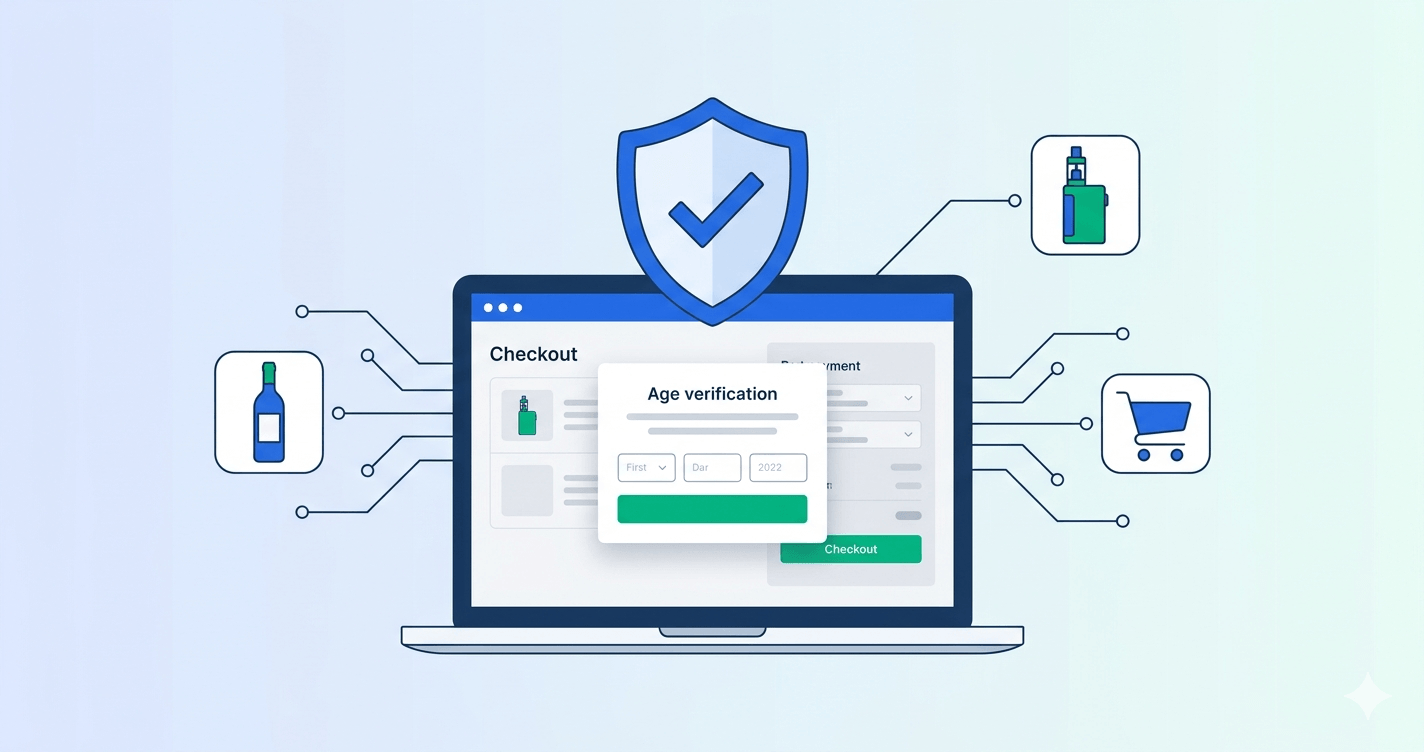
The most common pattern: trigger age verification when the cart contains age-restricted products.
// Example: Triggering Xident verification at checkout
import { XidentSDK } from '@xident/sdk';

const xident = new XidentSDK({
  apiKey: 'your-api-key',
  ageThreshold: 21, // or 18, depending on jurisdiction
  onVerified: (result) => {
    // User verified — proceed to payment
    enableCheckoutButton();
  },
  onFailed: (result) => {
    // Verification failed — block purchase
    showAgeRestrictionMessage();
  }
});

// Trigger when cart contains age-restricted items
if (cartContainsRestrictedItems()) {
  xident.verify();
}
Returning User Tokens
The biggest conversion win: don’t re-verify users who’ve already passed verification.
// Check for existing verification token
const token = localStorage.getItem('xident_token');

if (token && await xident.validateToken(token)) {
  // Returning verified user — skip verification
  enableCheckoutButton();
} else {
  // New user or expired token — run verification
  xident.verify();
}
Delivery-Level Verification
For products requiring proof of age at delivery (alcohol, tobacco under PACT Act):
- Integrate with carriers that support adult signature verification (FedEx, UPS)
- Log the delivery verification event alongside the checkout verification
- Maintain chain of compliance from purchase to delivery
The Conversion Impact: Real Numbers
The fear with age verification is always conversion loss. Here’s what the data shows:
Without age verification: Baseline conversion rate, but you’re exposed to regulatory fines, lawsuits, and reputational damage.
With checkbox-only: Negligible conversion impact, but zero actual protection. You’re one enforcement action away from a problem.
With document verification: 10-20% drop in conversion at the verification step. Users are asked to photograph their ID — many abandon the process.
With AI age estimation: 2-5% drop in conversion at the verification step. A 2-second selfie is far less friction than photographing a document.
With returning user tokens: After first verification, returning users see zero additional friction. Over time, the majority of your verified customer base breezes through checkout.
The math is straightforward: if AI age estimation costs you 3% of first-time conversions but saves you from a six-figure FDA fine, it’s not a close call.
Choosing a Provider: What Matters
When evaluating age verification providers for e-commerce, focus on:
Accuracy metrics: Ask for false pass rate (FPR) at your specific age threshold. A provider claiming “99% accuracy” without specifying FPR at Challenge-21 is hiding something.
Latency: Measure p99 verification time, not average. Your worst-case user experience matters more than the median.
Privacy architecture: Does the provider process biometrics on-device or in the cloud? On-device processing (like Xident’s WebAssembly-based approach) means biometric data never leaves the user’s device — dramatically reducing your GDPR exposure.
Platform integrations: Pre-built plugins for Shopify, WooCommerce, and major e-commerce platforms save months of development time.
Returning user support: Token-based recognition for verified users is the single biggest factor in long-term conversion performance.
Compliance coverage: Can the provider demonstrate compliance with FDA, PACT Act, GDPR, and the specific state laws in your operating jurisdictions?
Getting Started
If you’re currently using a checkbox or no age verification at all, here’s the priority order:
- Audit your product catalog — identify every SKU that’s age-restricted in any jurisdiction you ship to
- Map your regulatory obligations — federal (FDA, PACT Act, FTC) plus every state you sell into
- Implement at checkout — start with AI age estimation for speed, add document verification as escalation
- Enable returning user tokens — reduce friction for your existing customer base immediately
- Add delivery verification — integrate adult signature requirements with your shipping carriers
- Build your audit trail — log verification events (without personal data) for regulatory reporting
The regulatory direction is clear: age-restricted e-commerce without real age verification is an unsustainable position. The platforms that implement it well — fast, private, accurate — will turn compliance into a competitive advantage.
Xident provides age verification that completes in under 3 seconds with a 0.03% false pass rate. Our SDK integrates with any e-commerce platform in minutes. Get started free →