Every time a user hits an age gate, the same ritual plays out: upload an ID, take a selfie, wait for a result. Move to the next platform, do it again. And again. Each check creates a new data collection event, a new liability surface, and a new friction point that drives drop-off.
This model is breaking. Regulators are pushing for stronger age assurance — the UK’s ICO just fined Reddit £14.5 million for relying on self-declaration — while privacy advocates are pushing back against the surveillance overhead of repeated biometric checks. The result is a growing consensus around a different architecture: verify once, prove everywhere.
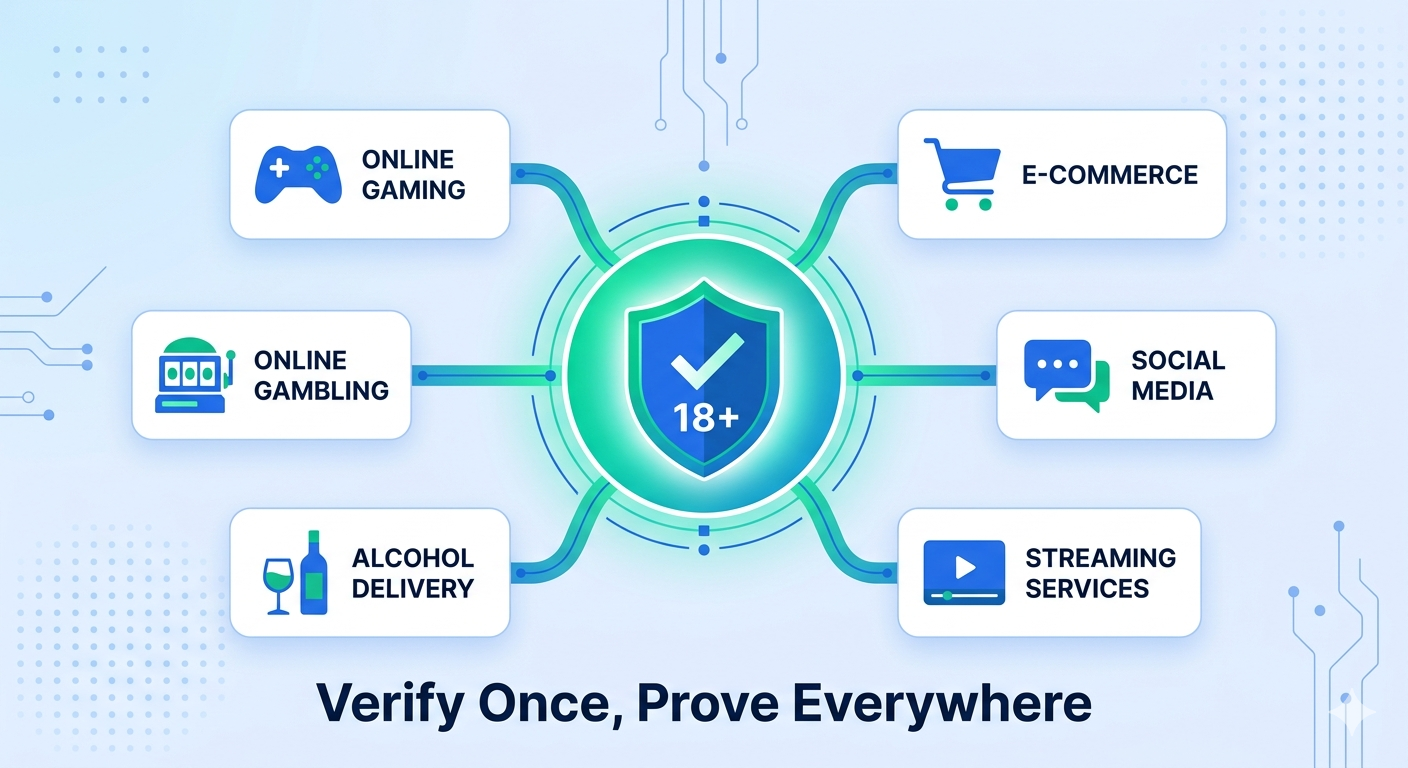
Reusable age credentials let a user complete a single, high-assurance age check and then present a cryptographic proof of that result across any platform that accepts it — without re-verifying, without sharing personal data, and without creating new biometric templates at each site.
Here’s how this shift is happening, what’s driving it, and what it means for platforms that need age verification today.
The Problem with One-Time Checks
The current model of age verification treats every platform interaction as an isolated event. A user proves their age on Platform A, and that proof stays on Platform A. When they visit Platform B, the process starts from scratch.
This creates three compounding problems:
Privacy accumulation. Each verification collects personal data — document images, biometric templates, metadata. Multiply that across every age-gated service a user touches, and you have dozens of independent data stores, each one a potential breach surface. Under GDPR, each store carries independent controller obligations: data minimisation, storage limitation, breach notification. The compliance overhead scales linearly with the number of verifications.
User friction. Drop-off rates on age verification flows typically range from 15% to 40%, depending on the method. Face-scan flows lose fewer users than document-upload flows, but both introduce friction that compounds across multiple platforms. Users who have verified their age three times in a week are not getting more trustworthy — they’re getting more frustrated.
Redundant infrastructure. Every platform that runs its own age verification needs to maintain biometric processing pipelines, document validation logic, liveness detection, and data retention policies. For platforms where age verification is a compliance obligation rather than a core competency, this is pure overhead.
The industry has known about these problems for years. What’s changed is that the infrastructure to solve them is now production-ready.
How Reusable Age Credentials Work
A reusable age credential is a cryptographic token that attests to a verified age threshold — “this person is over 18” — without containing the personal data used to establish that fact. The token is issued after a one-time verification and can be presented to any relying party that trusts the issuer.
The architecture follows a three-party model:
1. The Issuer performs the initial age verification. This could be an identity provider, a government wallet, or a verification service like Xident. The issuer runs the full verification flow — document check, biometric match, liveness detection — and, upon success, issues a signed credential.
2. The Holder stores the credential in a wallet or token store. This could be a dedicated identity wallet, a browser credential, or a platform-specific token. The holder controls when and where to present the credential.
3. The Verifier is any platform that needs to confirm the user’s age. Instead of running its own verification, it accepts the credential from the holder and validates the issuer’s signature. The verifier never sees the user’s ID document, biometric data, or date of birth — only the age-threshold assertion and its cryptographic proof.
The cryptographic backbone typically uses one of two approaches:
- Verifiable Credentials (VCs) based on W3C standards, where the issuer signs a JSON-LD credential that the holder can present to verifiers. The credential contains only the age-threshold claim, not the underlying data.
- Zero-knowledge proofs (ZKPs), where the holder can prove “I am over 18” without revealing anything else — not even which issuer verified them, if the scheme supports unlinkability.
Both approaches achieve the same core property: the verifier gets a trustworthy age assertion without receiving personal data.
What’s Driving the Shift
Three forces are converging to make reusable credentials the default model within the next 12–18 months.
Regulatory pressure is intensifying
The Reddit fine wasn’t an isolated event. It was the ICO firing a signal flare: self-declaration is not age verification. The ICO’s accompanying open letter explicitly called for platforms to adopt facial age estimation, digital ID, or photo matching — methods that actually work but that create privacy overhead when repeated at every site.
The EU’s Age Verification Blueprint, now in its second version, is designed specifically for EUDI wallet-based age checks — reusable credentials by design. France’s ARCOM has endorsed double-anonymity architectures that separate the verification act from the platform interaction. The UK’s Ofcom is evaluating “highly effective” standards that reward low false-pass rates, which favours high-assurance initial checks over repeated low-assurance ones.
The regulatory direction is clear: verify strongly once, rather than weakly many times.
The infrastructure is arriving
The euCONSENT consortium launched AgeAware in late 2025 — a standards-based, interoperable age verification network that allows global providers to recognise one another’s age checks under a shared governance framework. This is the missing piece: a trust framework that lets Issuer A’s credential be accepted by Verifier B, even if they have no direct relationship.
Meanwhile, the EUDI wallet rollout is creating government-issued infrastructure for exactly this pattern. By December 2026, all 27 EU member states must offer digital identity wallets with selective disclosure — meaning any EU citizen will be able to prove they’re over 18 to any online service without sharing their name or birthdate.
IDEMIA and Proof announced a partnership to develop interoperable verifiable digital credentials combining biometric identity assurance with cryptographic signatures. Google is integrating zero-knowledge proof technology into Google Wallet for privacy-preserving age verification. Apple’s Declared Age Range API already provides device-level age signals without biometric data leaving the device.
The plumbing is being laid at every layer of the stack.
Economics favour consolidation
Running age verification in-house costs money — not just the per-check fee, but the infrastructure, compliance, and data-protection overhead. Reusable credentials shift the economics: the initial verification can be higher-assurance (and higher-cost) because it only happens once, while subsequent presentations are effectively free.
For a platform processing 100,000 age checks per month, the difference between verifying every user from scratch versus accepting reusable credentials from returning users is significant. If 60% of your users have already been verified elsewhere, you’re paying for 40,000 checks instead of 100,000 — and eliminating the data-protection obligations for the other 60,000.
The Trust Framework Problem
Reusable credentials only work if verifiers trust issuers. A cryptographic signature proves that someone issued the credential — but who decides which issuers are trustworthy?
This is the governance challenge, and it’s being addressed through three models:
Government-anchored trust. The EUDI wallet model anchors trust in government issuance. If a member state’s wallet says a user is over 18, that assertion carries the authority of the issuing government. This is the highest-assurance model but is limited to government-issued wallets.
Consortium trust. AgeAware and euCONSENT create a governance layer where private-sector verification providers can join a trust network by meeting defined standards. Members agree to recognise each other’s age checks, creating interoperability without requiring government issuance. This is the model most likely to scale globally.
Bilateral trust. Two parties agree directly to accept each other’s credentials. This is the simplest model but doesn’t scale — it requires n² agreements for n participants.
The industry is converging on a hybrid: government wallets as the gold standard, consortium networks as the interoperability layer, and bilateral agreements as a fallback for jurisdictions without established frameworks.
What This Means for Platforms
If you’re operating an age-gated service today, here’s what the reusable credential shift means in practice:
Short term (now – Q4 2026)
Accept tokens from returning users. You don’t need to wait for industry-wide credential networks. If you’re already verifying users, issue your own age tokens — signed assertions that a user has passed verification — and accept them on return visits. This eliminates re-verification friction for your existing user base while you’re ahead of any interoperability standard. Xident’s token-based returning user system does exactly this.
Prepare your integration layer. Ensure your age-verification flow can accept external credentials in addition to running first-party checks. The API surface should support both “verify this user now” and “validate this credential” as first-class operations.
Medium term (2027)
Join a trust network. As euCONSENT and similar frameworks mature, platforms that participate early will be able to accept credentials from a growing pool of issuers — reducing their verification costs and friction without sacrificing assurance.
Support EUDI wallet presentations. When government wallets go live, platforms operating in the EU will need to accept wallet-based age proofs. The technical integration is straightforward — it’s a standard verifiable presentation flow — but the compliance implications (relying-party obligations, wallet trust lists) need to be understood early.
Long term (2028+)
Credential-first architecture. The end state is a world where most users arrive at your platform with a valid age credential already in hand. Your verification flow becomes a fallback for the minority of users who don’t have one yet, rather than the default for everyone.
Privacy Advantages Are Real
The privacy improvement isn’t incremental — it’s structural. Under the current model, every platform that verifies a user’s age becomes a data controller for that user’s biometric and identity data. Under a reusable credential model:
- The verifier never receives personal data — only a cryptographic age assertion
- The issuer processes personal data once, not repeatedly
- The holder controls which credentials to present and to whom
- Unlinkability (in ZKP-based schemes) means the issuer can’t track which verifiers the user visits
This isn’t just better privacy engineering. It fundamentally changes the compliance profile. A platform that accepts age credentials instead of running verification has no biometric data to breach, no document images to store, and no GDPR Article 9 (special category data) obligations from the age check itself.
For platforms in regulated industries — gambling, alcohol, social media — this is a material reduction in compliance risk.
Where Xident Fits
Xident is built for this transition. Our architecture already separates the verification act from the credential:
- Xident ID tokens let verified users return to any Xident-integrated platform without re-verifying. The token confirms the age threshold without containing the underlying biometric or document data.
- On-device processing means biometric data never leaves the user’s device during the initial verification. There’s no central biometric database to bridge into a credential system.
- Flexible verification methods — document check, face match, liveness detection, age estimation — mean the initial verification can be calibrated to the assurance level the credential network requires.
As trust frameworks like euCONSENT and EUDI wallets mature, Xident-issued credentials will plug into these networks. The initial high-assurance check becomes the foundation for a portable age proof that works everywhere the user goes.
If you’re building age-gated services and want to get ahead of the reusable credential shift, explore our documentation or talk to our team about integrating Xident’s token-based verification today.
The Bottom Line
The age verification industry is moving from a model of repeated, isolated checks to one of portable, privacy-preserving credentials. This shift is being driven by regulatory pressure (the Reddit fine, Ofcom’s “highly effective” standard, the EU’s age verification blueprint), infrastructure readiness (EUDI wallets, AgeAware, Google Wallet ZKPs), and straightforward economics (verify once is cheaper than verify everywhere).
Platforms that prepare now — by issuing tokens to returning users, building credential-acceptance into their verification flows, and monitoring trust framework developments — will be positioned to benefit as the ecosystem matures. Those that don’t will be stuck running redundant verification flows, accumulating unnecessary data, and paying for checks that a reusable credential could have eliminated.
The question isn’t whether reusable age credentials will become the norm. It’s whether your platform will be ready when they do.