For most of the last two years, the sentence “age inference is not age verification” was something you argued in a design review. One side said a platform could keep the friction low by quietly guessing a user’s age from how they behaved; the other side said a guess is not a control. It was a defensible disagreement, and reasonable teams landed on both sides of it. On July 16, 2026, Ofcom ended the disagreement the way regulators end disagreements: by opening a case.
The regulator announced a formal investigation into TikTok’s use of age inference — the practice of estimating how old a user is from behavioral and account signals such as the videos they watch and the accounts they interact with, rather than confirming age through a measured check. On the same day, Ofcom published its statutory Report on the use of age assurance, which stated plainly that inference of this kind is “not included in our industry guidance as a method that is capable of being highly effective for this purpose.” We made the conceptual version of this case in May. This is the enforcement version, and it comes with a number: up to £18 million or 10% of qualifying worldwide revenue.
What Ofcom did on July 16 — two documents, one message
The two artifacts published that day are meant to be read together. The report is the regulator’s evidence base; the investigation is the regulator acting on it.
The investigation targets TikTok Information Technologies UK Limited under Section 12 of the Online Safety Act — the duty to protect children from encountering harmful content. Ofcom’s stated concern is narrow and specific: whether TikTok’s reliance on age inference has left it unable to identify a meaningful share of the children on the platform, and therefore unable to apply the protections the Act requires. The regulator says its first phase — gathering information and evidence — will take roughly three months, with a public update expected in October 2026 (Biometric Update). No finding has been made, and TikTok has not been penalized. But an investigation of this kind is not a warning shot; it is the machinery that produces fines, and Ofcom has already issued six of them and opened cases against more than ninety services.
The report explains why TikTok’s method drew the attention. Ofcom’s evidence suggests that inference models “may have failed to correctly identify a significant proportion of children,” which is the precise failure mode a child-protection duty exists to prevent. The regulator went further on the incoming under-16 social media restrictions: current inference systems are, in its assessment, unlikely to be capable of supporting a meaningful age restriction at the point of entry, and stronger forms of assurance will be required to reliably separate a 15-year-old from a 16-year-old. That is a direct statement that the cheapest, most invisible approach to age-gating is not a compliance strategy — it is a compliance liability waiting for an information request.
Inference, estimation, verification: three words teams still treat as one
The reason this ruling matters beyond TikTok is that most product teams collapse three distinct things into one mental category labelled “the stuff that isn’t asking for an ID.” They are not the same, and Ofcom’s guidance draws the line exactly between two of them.
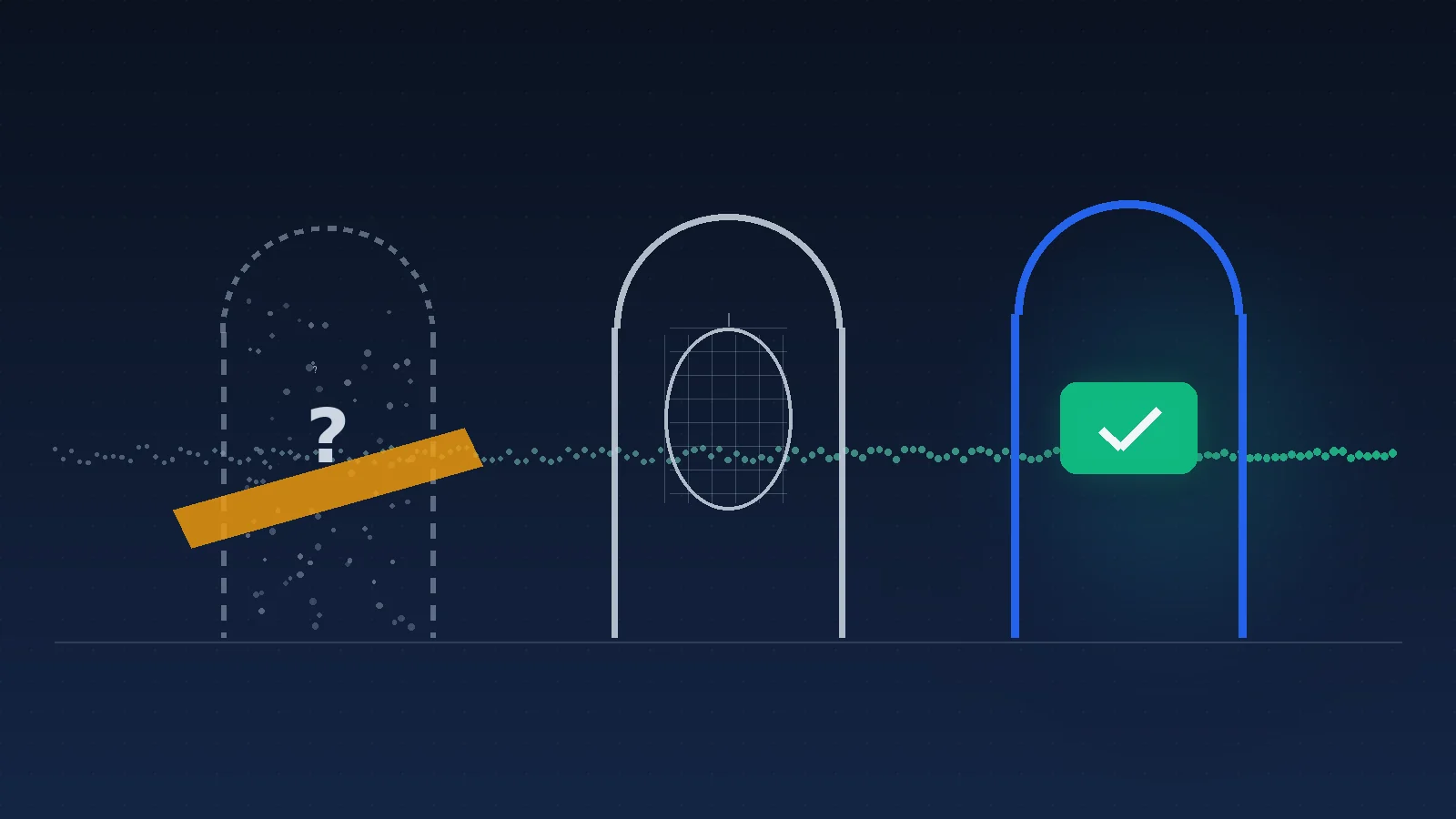
Age inference is passive derivation. The platform never asks the user anything; it infers age from behavior, account tenure, network, and interaction patterns. It is invisible, frictionless, and — this is the whole point of the investigation — unfalsifiable at the individual level. You cannot tell a regulator why the model decided a specific account was an adult, and you cannot show that the decision was accurate for the children it missed. This is what TikTok leaned on.
Age estimation is active measurement. Facial age estimation captures a real signal — an image — and returns an estimated age range with a stated accuracy profile you can benchmark against something like the NIST FATE evaluations. It does not identify the person and it does not require a document, but it measures rather than guesses, and it produces an auditable confidence value. Ofcom lists facial age estimation among the methods capable of meeting the “highly effective” standard.
Age verification is confirmation against an authoritative credential — a chip-read passport, a mobile driver’s license with selective disclosure, a bank- or wallet-backed identity. Highest assurance, highest friction, reserved for the cases that need it.
The trap is that inference and estimation both market themselves as “no ID, low friction,” so teams file them in the same drawer. Ofcom’s four-part test pries them apart. To be “highly effective,” a method must clear technical accuracy, robustness against circumvention, reliability, and fairness — all four, not a majority. Measured facial age estimation can be evaluated against each. Behavioral inference fails the first two almost by construction: its accuracy on the population that matters (children presenting as adults) is exactly what it cannot demonstrate, and its robustness collapses the moment a user’s behavior does not match the model’s training distribution. “We don’t ask for an ID” was never the compliance claim. “We can prove this is accurate, hard to circumvent, reliable, and fair” is — and inference cannot make it.
The data underneath the ruling
The report is not an opinion piece; it is backed by the first real corpus of UK age-assurance operating data, and the numbers explain both the enforcement posture and the specific hostility to inference.
Across a sample of 32 services, more than 69 million age checks were completed in the second half of 2025 — a roughly 23-fold increase over the prior six months. The share of children who encountered highly effective age checks when prompted rose from 25% to 43% between July 2025 and January 2026. All of the UK’s ten most popular pornography sites, and a majority of the top 100, now run age checks. In other words, the adult sector — the one everyone expected to resist — largely complied, using measured methods. The gap Ofcom is now closing is on the general-audience social platforms, which the regulator says have failed to enforce their own minimum-age rules (Biometric Update).
Read against that backdrop, the TikTok investigation is not an outlier. It is the leading edge of the enforcement expansion the “one year on” effectiveness report telegraphed: adult content first, general-audience platforms next, and inference-based gates as the first target because they are the weakest link in the dataset. If your age gate is a behavioral model, you are now standing where the porn sites stood in mid-2025 — except the regulator already has the operating data to argue you are not “highly effective,” and a live case to cite.
Where behavioral inference actually belongs
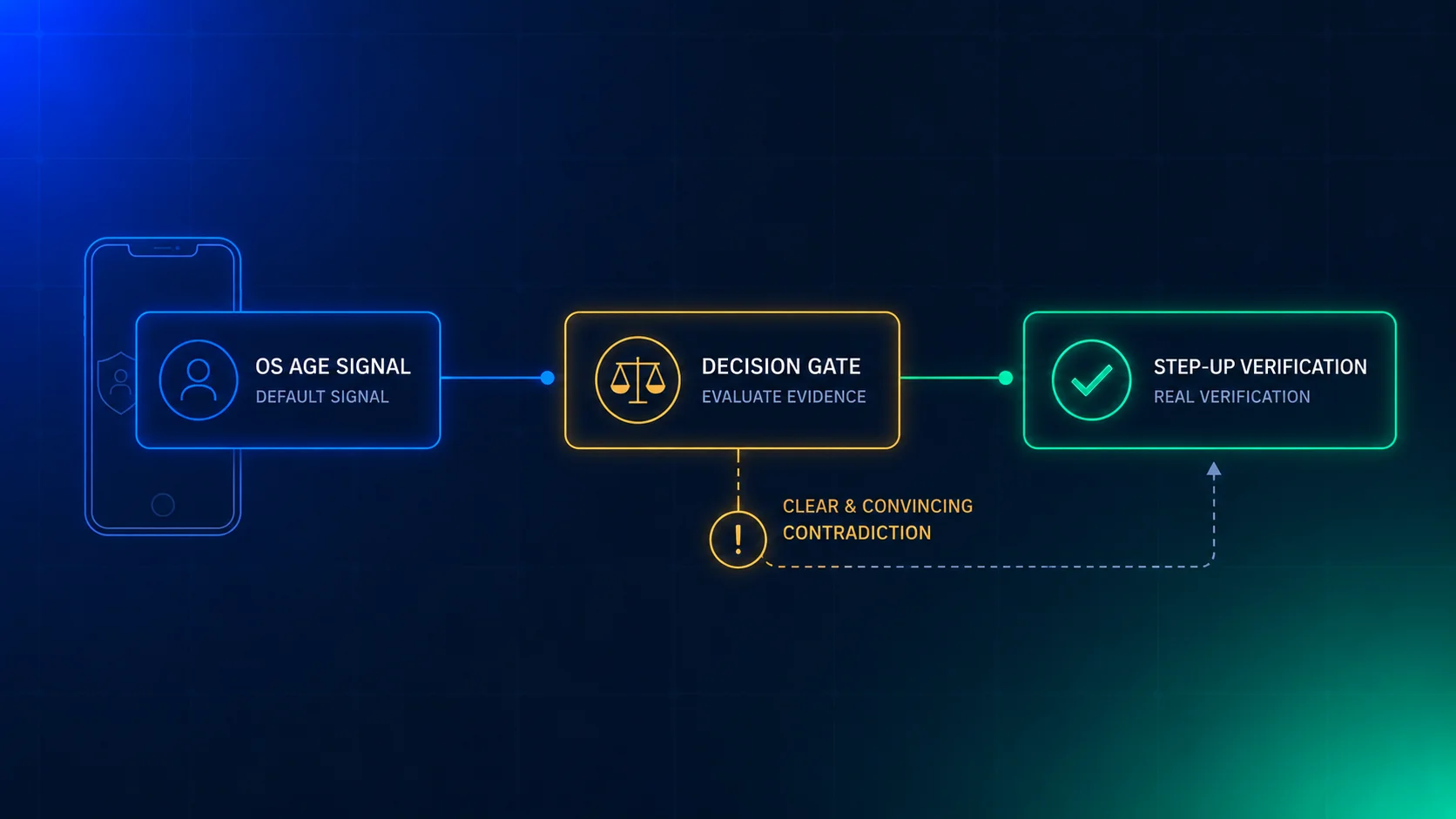
None of this makes behavioral signals worthless. It makes them a router, not a gate of record. The distinction is the entire design lesson of the TikTok case.
Behavioral inference is legitimately useful as a pre-gate triage input. It can decide who to challenge and how hard: an account whose signals scream “likely minor” can be routed straight to a stronger check, an account with a long, coherent adult history can be offered the lowest-friction measured path first, and a signal that shifts suspiciously mid-session can trigger a re-check. Used this way, inference reduces friction for the confident majority without ever being the thing that records the decision. What it cannot be is the artifact you hand a regulator as proof that a given user was verified as an adult. The moment inference is the final answer rather than a hint about which question to ask, you are TikTok in July.
The test to apply to your own stack is Ofcom’s: for every point where age determines access, ask whether the decision of record was produced by a method you can defend on accuracy, circumvention-resistance, reliability, and fairness. If the honest answer is “a behavioral model decided, and we cannot show it was accurate for the children it cleared,” you have an inference gate wearing an assurance costume.
The architecture that survives the TikTok question
The design that answers a regulator’s “prove it” without nuking your funnel is the same two-tier model we build Xident around — and it maps cleanly onto Ofcom’s approved-methods list.
Resolve the majority with a measured Check. The low-friction tier is not inference; it is a measured method that Ofcom already recognizes as capable of being highly effective — facial age estimation for a confident age-range read, a returning-user credential lookup for someone who has verified before, a liveness or authenticated-device signal, an open-banking or wallet handoff. This is the tier that keeps friction low while still producing an auditable, defensible decision. Most users clear here, and the record you keep is a real measurement, not a guess.
Reserve full Verification for the contested minority. When the measured Check lands too close to the threshold — the under-16 line is the hard case precisely because estimation error brackets it — escalate to a document or chip-read Verification with selective disclosure. High assurance is expensive, so you spend it only where the cheaper measured tier could not resolve the case, not on your whole population.
Let inference route, never record. If you use behavioral signals at all, wire them in front of these two tiers as a prioritization hint — who to challenge, how hard, when to re-check — and never as the stored decision. This is the single architectural change that separates a defensible stack from the one under investigation.
Retain the assertion, not the evidence. What your systems store is a signed “this user is over 18” (or “over 16”), not the face scan or the ID image behind it. This is the direct answer to the data-minimization half of the OSA/ICO joint expectations, and the single most effective way to make the inevitable breach boring instead of catastrophic.
Layer a reusable credential across the whole flow and a user who clears the measured Check once can prove their age at the next gate — on your platform or another — without repeating anything. Verify once, prove everywhere, and the per-session friction tax becomes a one-time cost.
What to do before Ofcom’s October update
The TikTok case gives every platform a dated deadline to think against. Six moves are defensible today and directly on the enforcement trajectory:
- Audit your critical path for inference. Find every point where age decides access and identify whether a behavioral model, an account-tenure heuristic, or a self-declared birthday is the decision of record. Those are your exposure points.
- Replace inference-as-gate with measured estimation. Where inference currently gates, swap in a measured method Ofcom recognizes — facial age estimation, credential lookup, open banking, MNO or wallet checks — and keep the behavioral model only as a router in front of it.
- Design the step-up explicitly. Decide, as policy, how a low-confidence measured Check escalates to full Verification, and where the confidence threshold sits relative to the age line you must enforce.
- Document against the four criteria. For each method you rely on, write down its evidence for accuracy, circumvention-resistance, reliability, and fairness. If you cannot write that page, Ofcom’s first information request will write it for you.
- Fix your vendor claims. Do not let “AI age estimation” in a sales deck hide a system that is actually behavioral inference. The label the regulator cares about is the mechanism, not the marketing.
- Assume other regulators follow. The OSA is the most advanced enforcement regime, not the only one; the EU, Australia, and a growing list of US states are converging on the same “highly effective” logic. Build one measured flow that clears the highest bar among them.
The real headline
Another Ofcom investigation is, on its own, routine. What makes this one matter is the category it targets. For two years, “inference is not verification” was a claim you could dispute in good faith; on July 16 it became a claim with a live case and a nine-figure penalty attached. The platforms that read the TikTok investigation as a TikTok problem will keep guessing until an information request arrives. The platforms that read it correctly will move the behavioral model to where it belongs — routing traffic, never recording decisions — resolve the majority with a measured Check, reserve Verification for the contested few, and keep the assertion instead of the evidence.
Inference was always the weak link. Now it has a case number. Build the gate that measures — not the one that guesses.
Xident provides privacy-first age assurance built on a two-tier model: a low-friction, measured Check for the confident majority — facial age estimation, returning-user credential lookup, liveness, and OAuth — and a high-assurance Verification for the contested few, returning a signed age assertion rather than retaining the underlying identity document. If you are relying on behavioral inference anywhere on your critical path and want to move it to a defensible, “highly effective” footing before your regulator asks, see how the two operations work or talk to us.