The identity verification industry is built on a fragile assumption: that the video stream your customer sends to verify their identity is authentic. That assumption is breaking.
By 2026, Gartner predicts that 30% of enterprises will consider standalone identity verification and authentication solutions unreliable in isolation due to deepfakes. This isn’t a distant concern about emerging technology. It’s happening now.
An Indonesian bank suffered approximately 1,100 deepfake-based fraud attacks in recent years. North Korean operatives used deepfake videos to pass remote identity verification during job interview processes. A growing “Fraud-as-a-Service” market now openly sells deepfake generation tools. The verification industry’s traditional defenses — liveness detection, face matching, document verification — are being attacked at scale by increasingly accessible tooling.
The problem isn’t that deepfakes exist. It’s that the industry’s architectural approach to identity verification makes deepfakes trivially effective.
The Vulnerability at the Heart of Cloud Biometrics
The standard cloud-based verification flow looks like this: a user submits a video or image stream to a remote server. The server performs liveness detection (checking that the person is present and not replaying a video), face matching (comparing the live capture to a reference document), and stores biometric templates for future checks.
Deepfakes attack this pipeline directly. They inject synthetic media at the source — the camera input — before it ever reaches the server’s liveness and face-matching algorithms. The deepfake doesn’t need to fool your detection system; it just needs to fool the camera.
For defenders, this creates an arms race with terrible economics. Better liveness detection is necessary but insufficient. Presentation attacks (printed photos, video replays) are getting cheaper and more sophisticated. Injection attacks bypass the camera entirely. Meanwhile, the return on investment for attacking a centralized biometric database is enormous — one successful breach of a verification provider exposes millions of verified identities, each one a credential that could be replayed or used to train new deepfakes.
This is the fundamental weakness of the cloud biometric model: it concentrates valuable biometric data in a central location and asks for it to be transmitted repeatedly across untrusted networks, all while relying on algorithmic detection to filter attacks.
With the rise of deepfake fraud, identity verification platforms like iDenfy are layering additional fraud signals and biometric checks to counter increasingly sophisticated spoofing attempts.
The Breach Amplification Problem
When a cloud-based verification provider is breached, the damage cascades in ways password breaches don’t. In October 2025, a Discord vendor leaked approximately 70,000 government IDs. Those weren’t passwords. They were identity documents, and the biometric data associated with them.
You can reset a compromised password. You cannot reset your face. A stolen facial template, document image, or liveness video is a permanent compromise of that individual’s identity across every system that uses the same biometric data.
Cloud-based verification providers store these templates because they enable the two-step flow: initial identity verification, then faster re-verification on return visits using stored biometric templates. The efficiency gains are real. So are the catastrophic consequences of a breach.
When deepfakes are in the threat model, centralized biometric storage becomes a liability, not an asset.
Necessary But Insufficient: The Limitations of Better Detection
Some vendors are doubling down on the detection problem, investing heavily in more sophisticated liveness detection and deepfake classification algorithms. These efforts matter — they raise the cost of attack. But they miss the structural problem.
A sufficiently advanced deepfake generator can fool a sufficiently advanced deepfake detector. Both sides are improving, and neither side is winning decisively. Meanwhile, adversaries are getting access to better tools every month.
The real security question isn’t “Can we detect deepfakes?” It’s “Do we need to detect them at all?”
An architecture that minimizes how often biometrics are used and never centralizes biometric data doesn’t need to win an arms race against deepfake detection. It simply sidesteps the attack vector.
Architecture as Defense: A Multi-Layered Approach
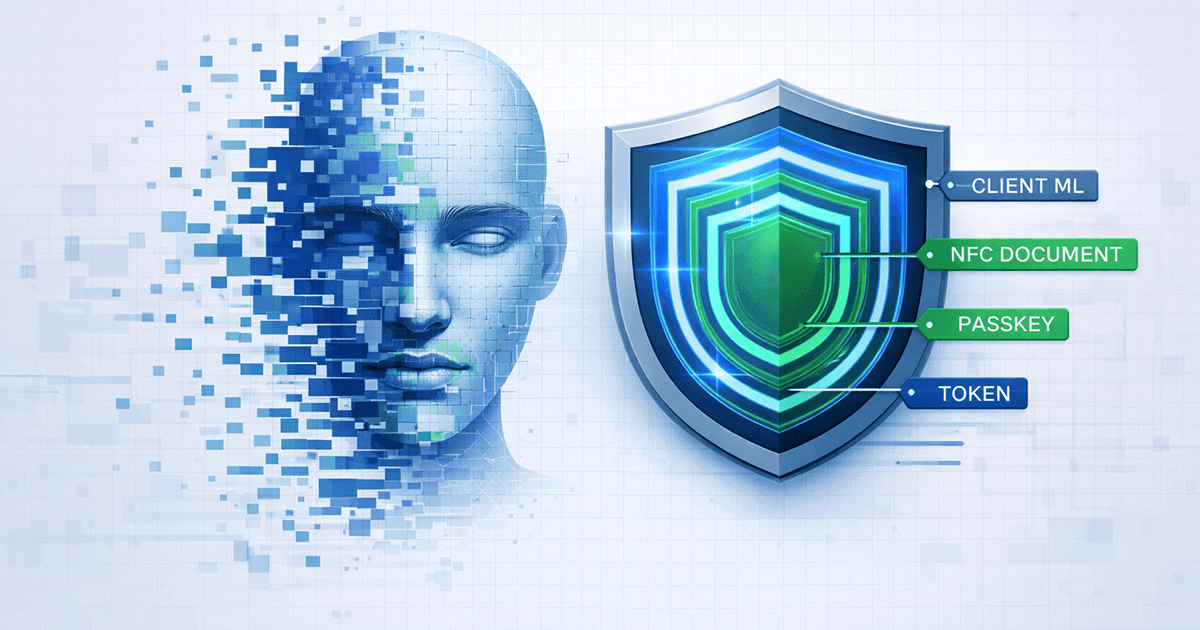
Xident’s identity verification architecture is built on this principle — defense in depth, not a single defensive wall.
Layer 1: Client-Side ML Age Estimation
Initial age verification happens using machine learning inference running locally in the user’s browser via ONNX Runtime and WebAssembly. This approach uses binary classification models (+12, +15, +18, +21, +25) with 0.03% false positive rates and 11% false rejection rates for the +18 threshold.
The critical point: facial images never leave the browser. There is no server-side biometric processing pipeline. Deepfakes targeting server-side verification systems are irrelevant because that system doesn’t exist. If a deepfake defeats the client-side model, fallback mechanisms engage without revealing biometric data to the server.
Layer 2: Document Verification with NFC and Cryptographic Proof
The second layer performs document verification using NFC chip reading from identity documents. This is cryptographically grounded — the NFC chip contains digitally signed data from the issuing government. A deepfake cannot forge a valid NFC signature. A printed document won’t contain valid cryptographic credentials. This layer anchors the verification to physical, government-issued identity that cannot be spoofed by synthetic media.
Layer 3: Account Creation and Passkey Binding
Once verified, the user creates an account and binds a passkey (WebAuthn credential) to their identity. The passkey is device-bound — the cryptographic material never leaves the device. Authentication uses this device-bound credential, which is immune to replay attacks and cannot be deepfaked remotely. Your face never becomes a token. A stolen passkey is worthless without access to the specific device.
Layer 4: Token Reuse and Reduced Biometric Exposure
Returning users authenticate using their passkey, not by re-submitting biometrics. This eliminates repeated identity verification checks. The fewer times a biometric is captured, transmitted, or verified, the smaller the attack surface. Tokens are reused across platforms, further reducing the frequency of verification events.
The outcome: biometric data (facial images) are never stored on servers. No centralized database of templates exists to steal. Client-side processing means deepfakes targeting the verification pipeline are irrelevant. Document verification provides cryptographic proof of identity. Passkey authentication provides phishing-resistant, device-bound credentials. The architecture treats deepfakes not as a detection problem but as a design problem.
Alignment with Industry Direction
This architectural approach reflects broader industry momentum. The European Union’s Digital Identity (EUDI) wallet framework emphasizes device-bound credentials and decentralized identity. NIST’s authentication guidance increasingly pushes for phishing-resistant methods. Major identity systems are moving away from centralized biometric storage and toward distributed, cryptographically grounded credentials.
The companies building identity infrastructure now are not the ones perfecting deepfake detection. They’re the ones redesigning verification systems to minimize the role of biometrics and eliminate centralized storage entirely.
The Industry Inflection Point
The verification industry’s business model was built on centralized biometric processing. Cloud-based platforms offered scale, convenience, and a two-step verification flow (initial check, then template-based re-verification). Deepfakes are exposing the structural weakness of that model: the concentration of irreplaceable biometric data in attack-prone central systems.
The traditional response — invest in better liveness detection, improve deepfake classifiers, add more layers of algorithmic filtering — is not a long-term solution. It’s an arms race against an opponent with exponential improvements in tooling and access.
The architectural response — eliminate the need for repeated biometric checks, never centralize biometric data, anchor verification to cryptographically provable evidence, and use device-bound credentials for authentication — is.
Companies in the identity verification space face a choice. They can continue to patch the cloud biometric model with incremental security improvements. Or they can redesign around the threat, building systems that treat deepfakes as a structural problem to be engineered around, not a detection problem to be solved.
The ones that thrive will be the ones that recognize that Gartner’s 2026 prediction isn’t a forecast — it’s a deadline.
Key Takeaways
-
Deepfakes attack the core pipeline of cloud-based verification systems: Liveness detection and face matching algorithms defend against synthetic media at the decision point, not at the injection point. Better detection is necessary but insufficient when deepfake generation tooling is rapidly advancing and widely accessible.
-
Centralized biometric storage amplifies breach impact: Unlike passwords, stolen facial templates and identity documents cannot be reset. One breach of a verification provider compromises millions of users’ irreplaceable biometric identity across all downstream systems.
-
Defense in depth eliminates deepfake attack vectors: Client-side processing (no biometrics on servers), cryptographic document verification (NFC-based proof), device-bound credentials (passkeys), and reduced biometric exposure (token reuse) collectively sidestep deepfake attacks rather than attempting to detect them.
-
The verification industry is at an architectural inflection point: Companies building for post-deepfake identity assurance are moving away from centralized biometric processing and toward decentralized, cryptographically grounded systems aligned with EUDI wallet frameworks and NIST authentication standards.