For two years, age assurance has been a topic for legal, policy, and trust-and-safety teams. On 30 April 2026 it became a topic for equity analysts. Roblox reported first-quarter results, and the headline was not a product miss or an ad-market wobble — it was the age check. The company that had just become the first large gaming platform to require an age check from every user before they can chat told the market that the rollout had restricted communication for unverified users, diluted it for verified ones, and slowed new-user acquisition. Daily actives landed at 132 million against the roughly 144 million the Street had modeled. Management cut full-year bookings-growth guidance from 22–26% to 8–12%. The stock fell about 18% in a single session, erasing roughly $6.7 billion in market value, and a securities class action followed within days.
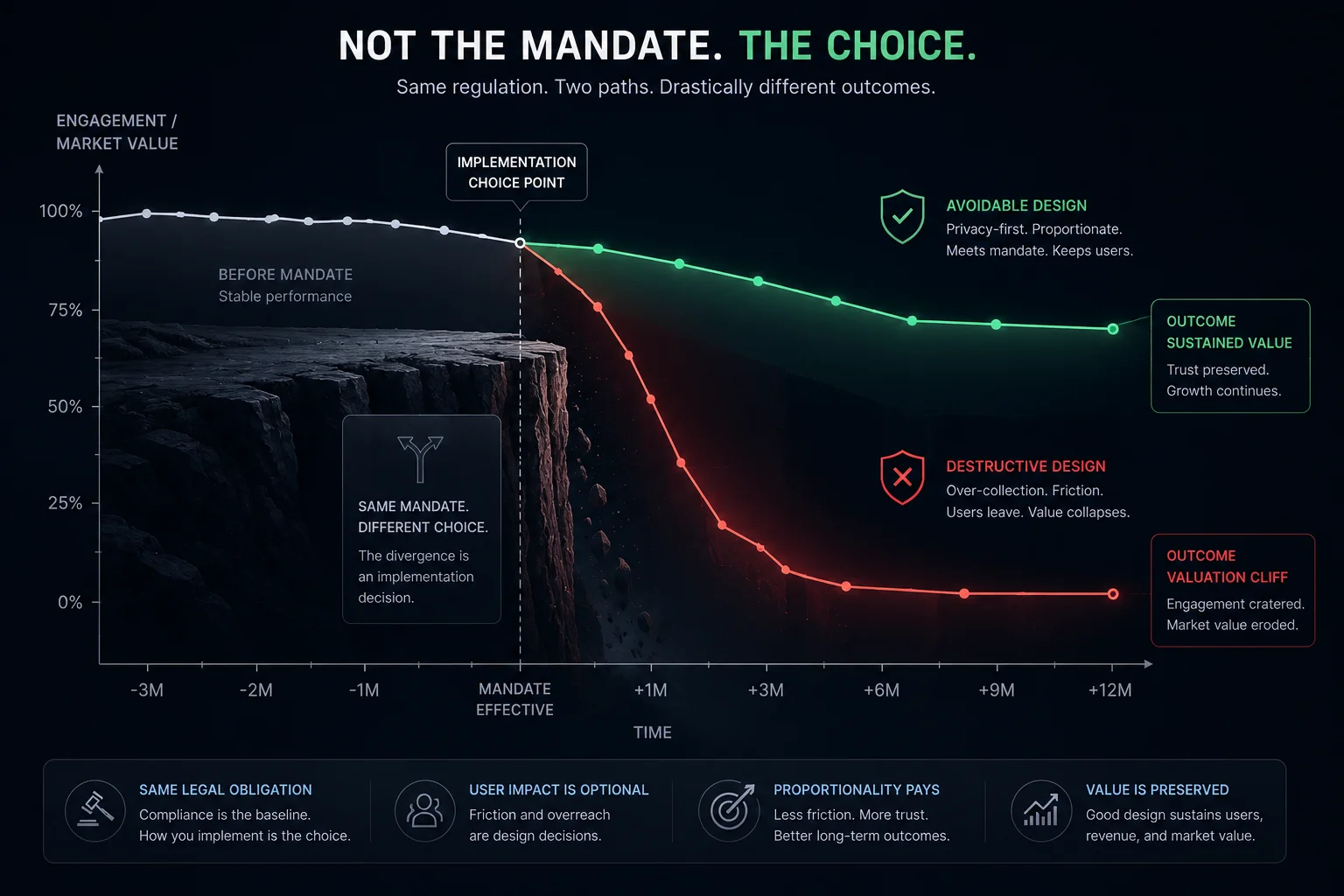
The obvious lesson — the one that will get repeated in boardrooms and quoted in every “age verification is unworkable” op-ed — is that age assurance kills engagement. That lesson is wrong, or at least badly incomplete. Roblox did not lose those users to the mandate. It lost them to a specific stack of implementation choices layered on top of the mandate. The distinction matters enormously, because the mandate is fixed and the choices are not. Every platform now staring down the same wave of child-safety obligations is about to make the same choices, and most of them can be made far better.
What actually happened on the earnings call
Start with the mechanics, because the numbers only make sense against them. Roblox announced a phased rollout in November 2025, went live in Australia, New Zealand, and the Netherlands in December, and by 7 January 2026 required every user, everywhere chat is available, to pass an age check before messaging. The method is facial age estimation supplied by Persona: a short selfie video, analyzed to place the user in one of six age bands — Under 9, 9–12, 13–15, 16–17, 18–20, and 21-plus — after which, Roblox says, the video is deleted. Chat is then permitted only between users in the same or an adjacent band, so a 13–15 user can talk to 9–12 and 16–17, but not to anyone 18 or older.
Now the print. First-quarter daily actives came in at 132 million versus the ~144 million analysts expected, and engagement hours undershot too. Management cut full-year bookings guidance to about $7.47 billion — roughly 11% below the Street — and took the growth range down from 22–26% to 8–12%. Just over half of global users, about 51%, had completed the check, which means the other half were walled off from the platform’s core social loop. Reporting put the sequential decline at around 20 million daily actives over six months. Then the disclosure angle arrived: a securities class action alleging the company failed to warn investors about the rollout’s impact between October 2025 and April 2026.
Roblox’s own explanation named three mechanisms: the checks restricted on-platform communication for users who had not verified, diluted communication for those who had, and slowed new-user acquisition. Hold those three in mind, because not one of them is required by any age-assurance law. They are consequences of how the check was built and where it was placed.
The mandate didn’t cost the users. Four design decisions did.
No regulation told Roblox to put a hard wall in front of its most monetizing feature. No regulation specified a selfie video as the method. No regulation demanded that verification sever links between users who were already connected. Each of those was a product decision, and each has a lower-bleed alternative that satisfies the identical legal requirement.
One: gating the highest-value feature with a hard, binary wall. Chat is not a peripheral feature on Roblox; social interaction is the engagement-and-spend engine, and reporting has tied access to those social features to materially higher monetization. Placing an all-or-nothing gate directly in front of it means every incomplete check is not a minor inconvenience — it is a user removed from the part of the product that makes them stay and pay. A progressive model that meets people where the risk actually is keeps the base inside the loop while still gating the genuinely age-sensitive surface.
Two: choosing a method that produced ~49% non-completion. A completion rate near half is not a law of nature; it is a friction outcome. A selfie-video step that asks a nine-year-old — or a distracted adult — to turn their head on camera will shed a large fraction of users at the exact moment you most want them to continue. Drop-off is a design variable, and the method you pick sets its floor.
Three: severing the existing social graph. The adjacent-band rule means friendships that predated the rollout could simply stop working the day a check assigned two friends to non-adjacent bands. Cutting a live connection is a far heavier user cost than declining a new one, and it converts a safety feature into a personal grievance. Gating new, risky contact is defensible; retroactively breaking established, low-risk contact is a choice that manufactures churn.
Four: treating every check as a fresh collection. When verification is a one-time-per-session or per-surface event rather than a durable, user-held result, you re-impose the friction — and re-collect the data — every time. That is the returning-user tax, and it compounds across a base of hundreds of millions.
| Implementation decision | Why it cost users | Lower-bleed alternative |
|---|---|---|
| Hard binary gate on chat (the monetizing feature) | Every incomplete check removes a user from the core social loop | Progressive gating: default-safe experience for the unverified, step up only for age-sensitive surfaces |
| Selfie-video method as the front door | High friction drove ~49% non-completion | Offer the lowest-assurance method that clears the legal bar first; escalate only on signal |
| Adjacent-band rule applied to existing connections | Broke live friendships, converting safety into grievance | Gate new/risky contact; grandfather or soft-handle established low-risk links |
| Re-verification per session/surface | Re-imposes friction and re-collects data on every pass | Durable, user-held credential or token; verify once, reuse everywhere |
The table is not hindsight sniping. It is the point: the loss decomposes cleanly into decisions, and every decision had a door that led somewhere less expensive.
Friction is a number you set, not one you inherit
The single most important figure in the whole episode is that ~51% completion rate, because friction is the variable a platform controls most directly and underestimates most consistently. Completion is not a property of “age verification” in the abstract; it is a property of the specific flow — the method, the number of steps, the copy, the fallback path, the moment in the journey where the gate appears.
The lever is method selection matched to the assurance the law actually requires. A great deal of regulated content needs only a confident over-or-under-threshold answer, not a legal identity. For that, client-side and on-device age estimation can return a decision in seconds with no upload and no server round trip for the raw image — a fundamentally lighter interaction than a recorded selfie video. Reserve the heavier methods — document capture, NFC chip reads, face match — for the cases and the age bands where the risk and the legal bar genuinely demand them, and offer them as a step-up rather than a toll every user pays on entry. The design principle is to lead with the lowest-friction method that clears the legal threshold and escalate only on signal, which is the opposite of routing an entire nine-figure user base through the same heavyweight front door.
None of this lowers the compliance bar. A platform can hold the exact same “highly effective” standard a regulator like Ofcom demands and still move completion from 51% toward the high 80s or 90s, purely by not making the flow harder than the law requires it to be.
Gate the risk, not the whole graph
The band model is the part of Roblox’s design most worth studying, because it is genuinely thoughtful and still produced the worst engagement outcome — proof that good intentions in age assurance are not the same as good product design.
Sorting users into age bands and constraining cross-band contact is a reasonable way to reduce adult-to-child interaction. The failure was applying a hard, retroactive version of it to a live social graph. There is a meaningful difference between preventing a new, unvetted adult from messaging a twelve-year-old and abruptly cutting two teenagers who were already friends because an estimator placed them one band apart. The first is the safety goal; the second is collateral damage that the safety goal never required.
Better implementations gate at the point of risk and default to safety without demolition. Unverified users get a constrained, age-appropriate experience — the approach Discord took with “teen by default” — rather than a broken one. New or elevated-risk contact triggers a check; established, low-risk connections are handled with more care than a hard cutoff. Tiering experiences by assurance level lets a platform satisfy the same child-safety duty while keeping the graph — and the engagement it carries — largely intact. The mandate is to protect minors from risky contact, not to atomize the network.
The returning-user tax nobody budgets for
Across a base the size of Roblox’s, the difference between “verify once” and “verify repeatedly” is not a rounding error; it is a recurring drag on every metric that matters. If the result of a check does not persist in a form the user carries, then every new surface, session, or context re-imposes the full friction and re-collects the same sensitive data — which also enlarges the retention footprint that turns into a breach headline.
The alternative is a durable, user-held credential or token: the user proves their age band once, and subsequent checks reference that result instead of re-running the gauntlet. Returning users skip the friction entirely, and the platform stops accumulating fresh copies of identity data it never needed to keep. This is the same “verify the fact, keep the proof, discard the identity” logic that underpins privacy-first age assurance generally — it just happens to also be the design that protects your engagement funnel. Low friction and data minimization are not in tension here; the token gets you both.
Age assurance is now a disclosure risk, too
The securities class action is the part of this story that should reframe how executives treat age assurance, independent of the engagement numbers. The complaint is not that Roblox ran an age check — running one is increasingly non-optional. It is that the company allegedly failed to warn investors about the foreseeable business impact of how it ran one. That moves age assurance out of the compliance-cost bucket and into the realm of material business risk, the kind you are expected to model and disclose before it prints.
That reframing has a direct operational consequence. If the engagement impact of an age-assurance rollout is material enough to move guidance and draw a shareholder suit, then the design of that rollout — method, friction, gating strategy, retention posture — is a board-level decision with a quantifiable range of outcomes, not an implementation detail delegated to a vendor default. The way to de-risk the disclosure is to de-risk the rollout: pilot the flow, measure completion and drop-off before a hard cutover, and choose the architecture that minimizes engagement loss for a given assurance level. A rollout you have instrumented and can prove out is one you can forecast; a rollout you have not is the one that surprises the market. The lesson from Roblox is not “delay your age check.” It is “know its cost curve before you flip the switch, and choose the point on that curve you can defend.”
There is also a sober counterpoint worth stating plainly, in the interest of not overselling the fix. Some engagement loss is real and unavoidable: a determined fraction of any base will refuse any check, and a platform whose product depends on frictionless anonymous contact will feel a mandate more than one that does not. Not every point of Roblox’s decline was recoverable through better design. But the gap between a ~51% completion, graph-severing, re-collecting rollout and a low-friction, progressively gated, verify-once one is wide — and that gap is the part that was optional.
How Xident approaches the friction/engagement trade-off
Xident was built on the premise that meeting an age-assurance mandate and protecting your engagement funnel are the same engineering problem, not opposing ones.
A check returns an over-or-under-threshold classification at the boundary you set — +12, +15, +18, +21, or +25 — so you gate precisely the risk the law targets instead of applying one blunt cutoff to your entire base. Client-side liveness and estimation let most users clear the bar with a light, on-device interaction, with heavier methods — document and face match — reserved as a step-up for the bands and use cases that need stronger assurance, rather than charged to everyone at the door. Token-based recognition means returning users are not re-verified and re-collected on every visit, which keeps friction off your funnel and identity data out of your retention footprint. And because the output is a decision rather than a stored dossier, the design that protects your engagement also keeps you off the breach ledger. The goal is to let a platform clear the same “highly effective” bar Roblox had to clear — without the cliff Roblox reported.
Age assurance is no longer a question of whether — the mandates have settled that. The open question is how well, and Roblox’s first quarter of 2026 is the most expensive public case study yet in getting the how wrong. The mandate did not cost the company 20 million daily actives, an 11% guidance cut, and a shareholder suit; a hard gate on its best feature, a high-friction method, a graph-severing band rule, and a re-collect-every-time posture did. Those were choices. The platforms that read this episode as “age verification is a growth killer” will make the same choices and print the same results. The ones that read it as “implementation is the variable” will meet the identical legal bar and keep their users. The cliff was optional. Design for the version that isn’t.
This post analyzes publicly reported company disclosures, market data, and news coverage for general informational purposes. It is not investment advice, legal advice, or a characterization of any specific company’s conduct beyond what has been publicly reported; figures are as reported and subject to revision. Consult qualified counsel and your own advisors for obligations and decisions specific to your platform.