On February 24, 2026, Discord’s CTO and co-founder Stanislav Vishnevskiy published a post with an unusually honest title: “Getting Global Age Assurance Right: What We Got Wrong and What’s Changing.” It was a mea culpa. Discord had announced a global age-assurance plan, the community read it as “everyone now has to scan their face or upload an ID to use Discord,” and the backlash was loud enough that the company pushed back its global rollout to the second half of 2026. “That’s on us,” the CTO wrote about the failure to explain what was actually happening.
Most platforms would treat that as a PR episode to survive. What makes it worth a teardown is that the corrected design Discord landed on is the clearest public articulation of how age assurance should actually be built. Strip away the Discord-specific details and you are left with a rollout playbook that applies to any platform staring down the UK Online Safety Act, Australia’s social-media ban, Brazil’s Digital ECA, the EU, and the expanding US state patchwork. This post is that playbook — the parts worth copying, and the parts Discord still hasn’t solved.
Lesson 1: Determine, Don’t Demand — The 90% Rule
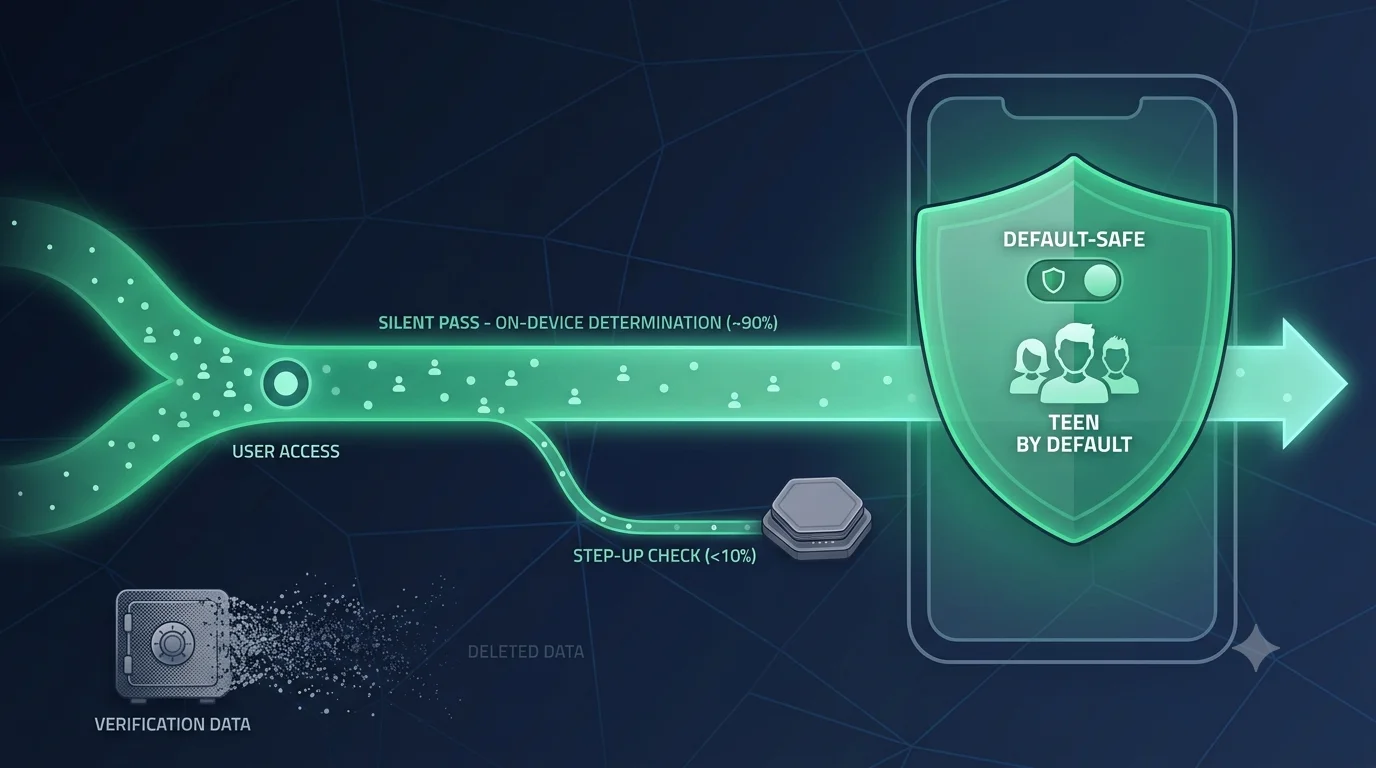
The single most important number in Discord’s redesign is this: over 90% of users will never be asked to verify their age. Not because Discord ignores their age, but because it already infers it. Discord runs the same class of account-level signals it uses to catch spam rings and raids — account age, whether a payment method is on file, the types of servers a user belongs to, general activity patterns — through an internal system to make an age determination without any user action. It explicitly does not read messages or analyze conversation content, and Discord has promised a technical write-up of the methodology before global launch.
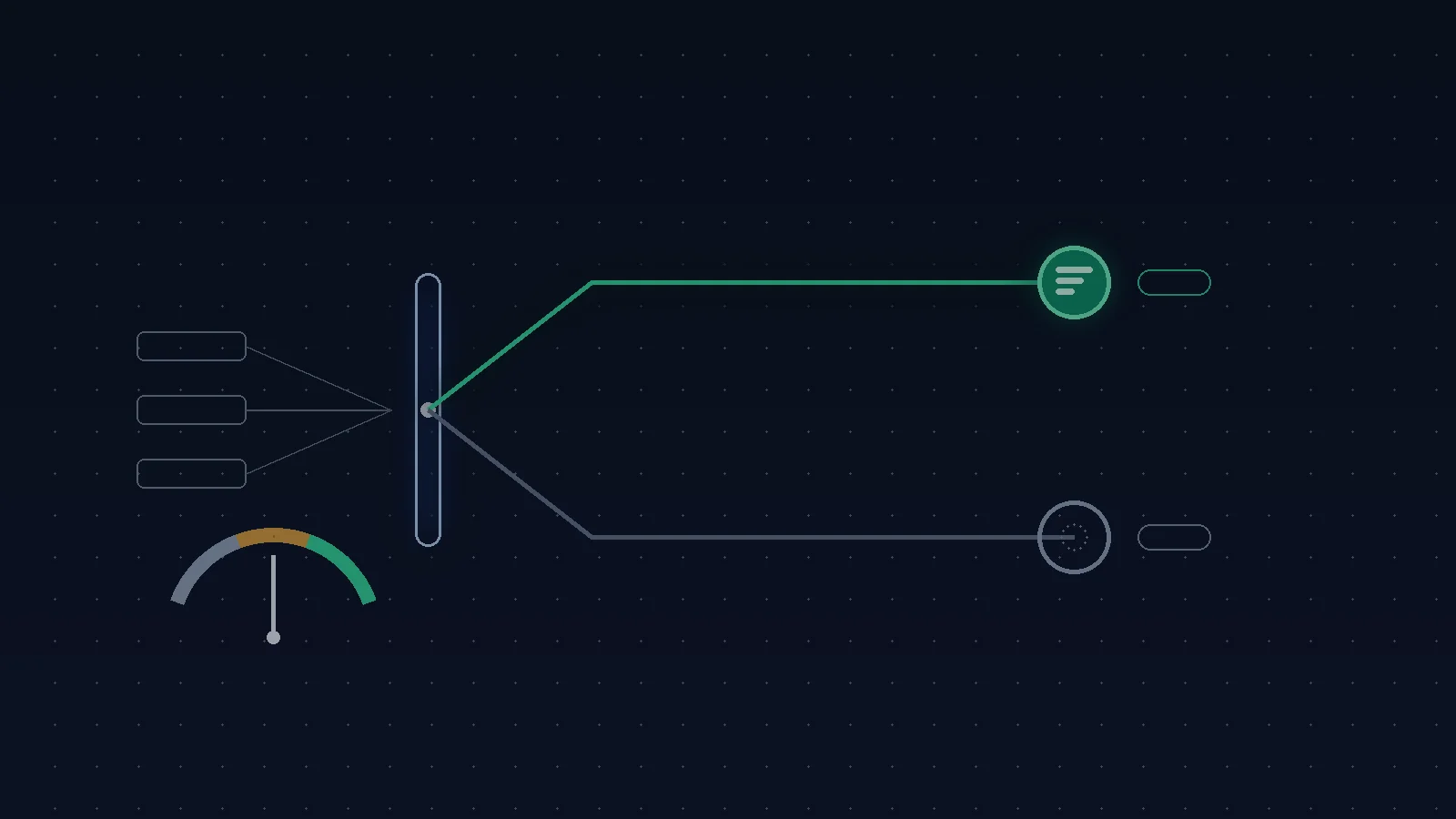
For an engineering manager, the reframe here is the whole game. Age assurance is usually scoped as a gate: a verification step every user hits on the way in. Discord rescoped it as a population-segmentation problem: silently classify the users you can, and spend your expensive, high-friction verification budget only on the residual you genuinely can’t. The hard check stops being a tollbooth on the front door and becomes an exception path for an ambiguous minority.
This inverts the cost model. A universal hard gate means you pay the conversion cost of friction on 100% of signups and the per-check vendor fee on 100% of users. A determine-first model means you pay it on the few percent who land near the line. If you are scoping age assurance as “add a verification screen to onboarding,” you have already chosen the most expensive possible architecture.
Lesson 2: Prove Age, Not Identity
Discord’s second principle is stated as bluntly as the first: “We don’t want to know who you are. We just need to know whether you’re an adult.” For the sub-10% who do need to verify, third-party vendors handle the check and pass back only an age group — and, by design, the vendor has no way to associate that identity back to the Discord account either. The unlinkability runs both directions. The user’s age group is private; no other user can see it.
That is a data-minimization stance with teeth, and it is the difference between an age-assurance system and an identity-collection system wearing an age-assurance costume. The distinction matters operationally, not just rhetorically: a system that returns a boolean (or an age band) and discards everything else has almost nothing worth stealing. A system that banks names, document images, and birthdates to answer the same yes/no question has built a breach liability that compounds with every user. The regulator asked “is this user old enough?” — answering any larger question than that is scope creep you will be holding when something leaks.
Lesson 3: Put the Biometrics on the Device
The most consequential decision in the entire reboot is a vendor requirement, not a feature. After running a limited UK test with Persona in January 2026, Discord decided not to proceed and set a new bar: any partner offering facial age estimation must perform it entirely on-device, so biometric data never leaves the user’s phone. Persona, in Discord’s words, “did not meet that bar.”
The context behind that line is the Persona–Discord incident and the broader lesson that centralized identity pipelines are honeypots. If a face image is transmitted to a vendor’s servers to be analyzed, that image now exists somewhere it can be logged, retained, subpoenaed, or exfiltrated — and the platform has inherited a risk it cannot fully see or control. Move the estimation on-device and the sensitive computation happens where the data is born and dies. The model returns an age signal; the raw biometric never makes the trip. Discord didn’t frame this as a nice-to-have. It made it a gating criterion that disqualified a vendor. Every platform evaluating a facial age estimation provider should treat “where does the face get processed” as a pass/fail question, the way Discord now does.
Lesson 4: Give Users a Method Waterfall
A single verification method is a single point of friction and a single point of failure. Discord’s correction was to commit to options. Between June and July 2026 it began testing several methods in parallel: a Google Wallet flow (a passport-backed pass where Google shares a birthdate, Discord derives the age, and the birthdate is not retained), a credit-card check, and ID-scan and selfie methods through a new vendor, Incode, alongside its existing orchestration partner k-ID.
The design pattern underneath is a waterfall: order methods from lowest-friction and most private to highest-assurance and most invasive, and let the user — and the applicable law — pick where they enter. On-device facial age estimation clears the large majority near the threshold in seconds without a document. A wallet or reusable credential handles users who already hold one. A document or chip check is the fallback for the edge cases that need it. The waterfall does two things at once: it minimizes how far down the invasiveness ladder any individual user has to go, and it gives you a compliant fallback in jurisdictions that don’t yet accept the lightweight methods.
One caveat Discord’s own list invites: a credit-card check is a payment-instrument signal, not proof of age. It belongs in the waterfall as a convenience option for some users, but no serious operator should treat “has a card” as “is an adult.” The point of a waterfall is to match method to required assurance — not to let the easiest method quietly become the standard of proof.
Lesson 5: Transparency Is a Feature — and the Orchestration Trap
Discord’s commitments include documenting every verification vendor and its data practices, naming the vendor in-product so users know who is handling their data before they choose, retaining verification data only for the minimum time necessary (in most cases, immediate deletion), and publishing age-assurance figures in its transparency reports. Treating disclosure as a shipped product surface, rather than a buried privacy-policy clause, is the right instinct — especially when, as the CTO acknowledged, much of the backlash was a communications failure rather than a technical one.
But this is also where Discord’s model reveals its sharpest unsolved problem, and Biometric Update named it: orchestration layers blur accountability. k-ID is a compliance orchestrator, not a biometrics algorithm; the actual on-device estimation is performed by subprocessors (Privately is named in k-ID’s policy; Veratad appears for document and server-based checks). So “your selfie is processed by k-ID” is technically true and practically incomplete — the user still can’t easily tell which company’s algorithm just ingested their face, and Incode arrived as an “experiment” that “may not be available to all users” with no clear in-flow disclosure of which method is firing. The lesson cuts against the grain of the previous one: transparency-as-a-feature is undermined the moment your stack is deep enough that even you can’t cleanly say who processed what. If you orchestrate, you owe users a verifiable, per-transaction answer to “who handled my biometric just now” — not a list of everyone who might have.
What Discord Still Hasn’t Solved
Three honest limits keep this from being a victory lap. First, the determine-first model doesn’t survive contact with current law everywhere. In the UK, Australia, and Brazil, statutes require approved methods like facial age estimation or ID checks and do not yet permit a platform to lean on its own non-identifying internal signals — so in those regions adults seeking age-restricted content still hit a vendor check regardless of how confident Discord’s internal system is. The elegant architecture is partly a thing Discord hopes regulators will let it use, not a thing it can use everywhere today.
Second, none of this defeats determined circumvention. Account-signal inference can be gamed by patient users, and the residual verification path inherits all the usual VPN and proxy pressures. A 90% silent-pass rate is an efficiency win, not a security guarantee; the 90% figure is about friction avoided, not minors caught.
Third, the orchestration opacity above is a real accountability gap, not a rounding error. A platform that can’t produce a clean evidence trail of which vendor performed which check, under which method, will struggle the day an Ofcom information notice lands. Transparency you can’t reconstruct on demand isn’t transparency.
How Xident Fits
The reason this teardown reads like a description of Xident is that we built the product around the same conclusions Discord arrived at the hard way. Xident is a privacy-first age and identity layer you add with an SDK, and the lessons above are its defaults rather than its roadmap.
The 90% rule maps to risk-based escalation: most users clear a threshold through on-device facial age estimation that returns an age band (+12, +15, +18, +21, +25) in seconds, and token-based returning users skip the check entirely on subsequent visits — only the ambiguous minority near the line escalates to stronger evidence. Prove-age-not-identity is the architecture: the face is classified on the device and never reaches your servers, so what you keep is the decision, not a biometric cache. The on-device mandate Discord made a vendor requirement is our baseline, not a bar a vendor has to clear. The method waterfall — on-device estimation, then document checks for the edge cases — is how the flow is structured by default. And because every check emits an exportable, session-level evidence record of the decision, you can answer a regulator with proof instead of reconstructing a vendor breadcrumb trail. If you want the specifics to demand from any provider, including us, our vendor security checklist and platform implementation guide lay them out.
The Real Takeaway
Discord’s reboot is usually read as a story about a company managing a backlash. The more useful reading is that age assurance is a rollout problem at least as much as a technology problem. The technology — on-device estimation, age-band tokens, document fallback — is largely solved and commoditized. What Discord got wrong the first time, and corrected the second, was the architecture of the rollout: who gets asked, what gets proven, where the biometric lives, how many options users get, and how honestly you explain it. Those are decisions, not features, and they are available to any platform that bothers to make them deliberately.
If you are about to bolt an age check onto your onboarding flow, the Discord lesson is to stop and rescope first. The wrong question is “which verification screen do we add?” The right one is “how few users can we route to a hard check, and how little can we learn about them when we do?” If you want to see what that looks like as something you integrate rather than build, start here.