In August 2025, Bluesky did something no Fortune 500 platform would consider: rather than build age verification for one US state, it switched the state off. Faced with Mississippi’s HB 1126 — which requires covered platforms to verify the age of every user and obtain parental consent for minors, on penalty of up to $10,000 per violation — Bluesky geoblocked the entire state of Mississippi. Its stated reasons were almost disarmingly honest: a small team, infrastructure it would have to build from scratch, and a law whose scope it considered both broad and privacy-hostile.
A week earlier, Mastodon had gone further and said the quiet part out loud. It does not have the means to comply with laws like Mississippi’s — not as a matter of will, but of structure. There is, as Mastodon’s founder Eugen Rochko put it, “nobody that can decide for the fediverse to block Mississippi.” There is no one to serve the lawsuit on, no single operator to fine, no central switch to flip. The law assumes a company. Mastodon is a protocol.
These two responses, a week apart, are the clearest signal yet of a collision that has been building for two years: the entire architecture of age-verification law assumes a centralized platform, and a growing slice of the social internet is deliberately built to have no center. This post is about why “just add age verification” breaks on a federated network, why Bluesky and Mastodon failed in two different ways that reveal two different lessons, and what a compliance path actually looks like when there is no front door to put a gate in front of.
The Compliance Playbook Assumes a Company
Strip every US state social-media law — Mississippi’s HB 1126, Utah’s, Texas’s, the rest of the patchwork — down to its operating assumptions, and they all rest on the same four pillars:
A single legal entity exists that operates the service. There is one company with a registered agent, a balance sheet, and officers who can be held liable. The service can geoblock by jurisdiction, because it controls the servers and can branch on the user’s location. The service can deploy a verification stack — a face check, an ID scan, a card check — at the one place all users pass through to get in. And there is a balance sheet that a per-user fine can be levied against, which is the mechanism that makes the whole regime enforceable.
For Meta, Discord, or any conventionally structured platform, all four hold. The law lands on a defendant, the defendant has a chokepoint to instrument, and the threat of a fine scaled to user count is a credible deterrent. This is the model regulators wrote for, and inside it, the questions are merely hard — which method, what threshold, how to keep drop-off from torching your conversion. They are engineering and procurement questions.
The fediverse violates all four pillars at once. And it does so by design, not by accident — the absence of a center is the entire point of the architecture.
Why the Network With No Center Breaks Every Assumption
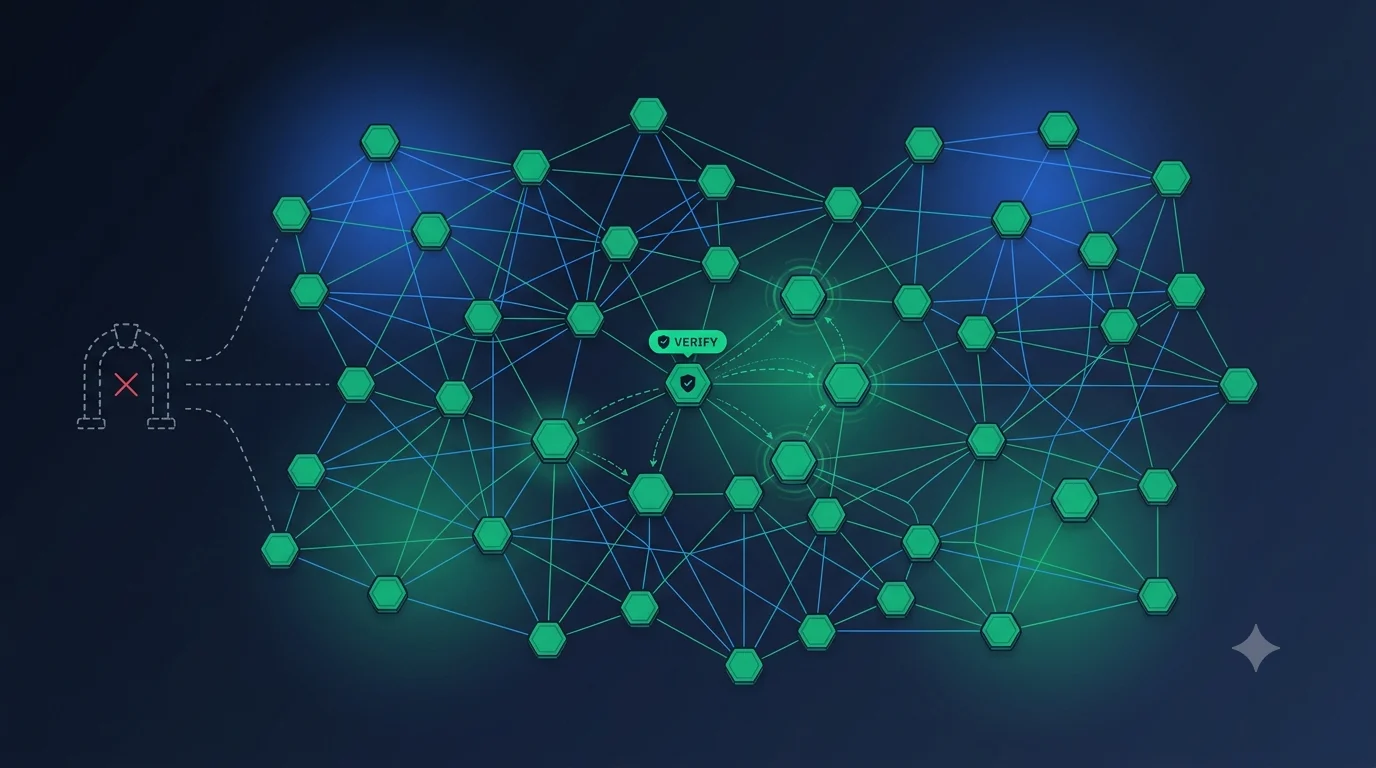
“The fediverse” is not one service. It is thousands of independently operated servers — Mastodon instances, Pixelfed image hosts, PeerTube video nodes — that speak a common protocol (ActivityPub) and federate content to one another. A user on one server follows, replies to, and sees posts from users on hundreds of others. There is no Mastodon, Inc. that runs them. mastodon.social is the largest instance, but it is one server among thousands, most of them run by volunteers, hobbyists, and small collectives on donated hardware.
Now walk the four pillars back through that structure. There is no single legal entity: there are thousands of operators, many of them individuals in different countries, none of whom controls the others. Geoblocking is per-instance and porous: even if mastodon.social blocked Mississippi, a Mississippian could sign up on any of a thousand other instances — including ones hosted abroad — and still see federated content from mastodon.social through the network. Deploying a verification stack is a per-operator problem: there is no shared front door, so “the fediverse adding age verification” would mean every one of thousands of independent admins separately building, paying for, and maintaining a verification integration. And the balance sheet that a fine is supposed to bite does not meaningfully exist: a $10,000-per-user penalty is an existential, absurd number for a volunteer running an instance for 800 friends on a $40-a-month box. As Bluesky board member Mike Masnick pointed out, the real question Mastodon’s “we can’t comply” elides is whether a large instance like mastodon.social would actually be willing to pay $10,000 per Mississippi user — and what happens to it if it can’t.
This is the same structural lesson we drew from the Persona–Discord incident, but inverted. There, centralization concentrated risk into a single breachable honeypot. Here, decentralization diffuses responsibility until there is no one for the law to hold. Both are architecture problems wearing a compliance costume. You cannot regulate a protocol the way you regulate a company, and you cannot patch your way out of a structural mismatch.
Bluesky and Mastodon Failed Differently — and That’s the Tell
It matters enormously that the two flagship decentralized platforms responded in opposite ways, because their architectures are not equally decentralized, and the gap between them is exactly where the realistic compliance path lives.
Bluesky runs on the AT Protocol, which is federation-capable but, today, operationally centralized: the Bluesky app most people use is run by a single company with a single team that can make a decision and ship code for everyone using it. That’s why Bluesky had options. In the UK, ahead of Ofcom’s July 25, 2025 “highly effective age assurance” deadline, it stood up verification through Epic Games’ Kids Web Services — Yoti facial age estimation, ID document scans, and card checks — and gated adult content and DMs behind it. When Mississippi’s law hit, Bluesky’s first move was the blunt one (geoblock the state), but it later reversed course: once it had age assurance built, it lifted the Mississippi block and let users who pass an 18+ check back in, while keeping under-18s out, and extended the same KWS-based flow to other states and to Australia’s under-16 regime. The point is that Bluesky could choose, because there was a “Bluesky” to do the choosing.
Mastodon had no such lever, and that is the deeper case. Even its 2025 software update (Mastodon 4.4) — which gave instance admins the ability to set a minimum age and require terms-of-service acceptance — only hands a tool to each operator individually. It cannot make the network comply, because “the network” is not a decision-making entity. Mastodon-the-nonprofit can ship features; it cannot ship a binding decision to thousands of sovereign servers. So the honest answer was the one it gave: the means do not exist at the layer the law is aiming at.
The tell is this: the more genuinely decentralized the architecture, the less the centralized compliance model has anything to grab onto. Bluesky looks compliant because it is, structurally, still mostly a company. Mastodon looks non-compliant because it is, structurally, actually a protocol. The law currently cannot distinguish between “won’t” and “can’t,” and that ambiguity is where the litigation is heading — NetChoice’s challenge to HB 1126 in NetChoice v. Fitch has already run through the Fifth Circuit and the Supreme Court, which in August 2025 let Mississippi’s law remain in effect while the merits are fought out. The question of who, exactly, a federated network’s duty falls on is not settled. Operators should not wait for it to be.
The Portability Problem Cuts Both Ways
Here is the property of decentralized social media that looks like the worst obstacle to age verification and is, on closer inspection, the key to solving it.
On the AT Protocol, a user’s identity and data are portable: they can move their account from one server to another and carry their followers and history with them. On the fediverse generally, the user is not a tenant of one platform — they are a person who shows up across many. The centralized model hates this, because it assumes verification happens at a platform’s gate and stays bound to that platform’s account. If the user can pick up and move, a per-account, per-platform check has to be redone everywhere, by every operator, forever. That’s the nightmare version: thousands of instances each separately re-verifying the same human.
But flip the binding. The reason per-platform verification doesn’t scale on a federated network is that it binds the proof to the platform instead of to the person. The entire premise of decentralized identity is the opposite: the credential lives with the user and travels with them. That is precisely the shape of a reusable age credential — verify once, receive a privacy-preserving, cryptographically bound proof, and present it anywhere, including on the next instance you join. A network whose defining feature is that the user is portable is, almost by accident, the ideal home for an age proof that is also portable. The fediverse doesn’t need every instance to build a verification stack. It needs every instance to be able to accept a proof the user already holds.
This is also where zero-knowledge approaches and selective disclosure stop being academic. A federated operator doesn’t want to receive and store a user’s government ID — that’s a honeypot it has no business holding and no budget to protect. It wants a yes/no answer to “is this person over the threshold,” bound to the human in the session, with nothing sensitive left on its disk. Proving an age band without revealing the underlying identity is the only version of this that a volunteer-run instance can responsibly operate, and it maps directly onto how decentralized identity was supposed to work in the first place.
What Actually Works for a Federated Operator
If you run an instance, a small AT Protocol app, or any service that doesn’t have a verification team and a legal department, the realistic compliance unit is the operator, not “the fediverse.” The network won’t comply as a whole; individual operators will make individual decisions, and the ones who want to serve users in regulated jurisdictions need a path that fits their actual constraints. That path has four properties, and they are non-negotiable for this segment.
It has to be drop-in, not build-it-yourself. The thing that broke Bluesky’s first instinct and broke Mastodon entirely was the assumption that compliance means constructing a verification stack. A volunteer admin will never do that. Verification has to arrive as a service you call, not a system you operate — the same logic we lay out in our implementation guide for social platforms, compressed to the point where a single operator can integrate it in an afternoon.
It has to minimize data to near zero. A small operator cannot be a custodian of identity documents and biometrics; the liability dwarfs the service. The correct posture is to retain the decision — an auditable record that a check happened and what it concluded — and not the documents, biometrics, or raw identifiers behind it. This is the privacy-first architecture point made existential: for a federated operator, data minimization isn’t a virtue, it’s the only way the math works.
It has to run the sensitive computation off the operator’s hands. On-device age estimation means the instance never touches the face image at all — the estimate is produced on the user’s device and only a result crosses the wire. An operator that never receives biometrics cannot breach them, cannot be subpoenaed for them, and cannot be blamed for them.
And it has to be portable across instances. Because the user moves, the proof has to move with them. A reusable, bound credential is what turns “every instance re-verifies everyone” into “the user verifies once and presents everywhere” — the only model that respects both the law and the architecture of a federated network.
The Honest Limits
Intellectual honesty requires admitting what this does not solve. For a truly leaderless node — an instance whose operator simply declines to gate anything, hosted in a jurisdiction that doesn’t care — none of this is enforceable today, and a portable-credential model only works for operators who choose to ask for the credential. There is a real, unresolved tension between laws that demand a responsible party and protocols designed to have none, and it is entirely possible the law will have to evolve toward device- or app-store-level signals precisely because the platform layer, on a federated network, sometimes isn’t there to hold. That conversation — about OS- and store-level age signals — is downstream of the same realization Mastodon articulated: you can’t put the duty on a center that doesn’t exist.
But “some nodes will never comply” is not a reason for the operators who want to serve regulated markets to do nothing. The instances that intend to grow, to take donations, to run in the US or UK or EU without an existential fine hanging over them, are the ones reading this — and for them, the choice isn’t between perfect enforcement and none. It’s between building a verification stack they can’t afford, geoblocking states they’d rather serve, or adopting a portable, data-minimizing check that fits a network with no center. Only one of those three is actually viable.
How Xident Fits
Xident was built around exactly the properties a federated operator needs, because the problems are the same whether you’re a single instance or a two-sided marketplace: you need to know a user clears an age threshold without becoming a custodian of their identity.
We deliver verification as a service you call, not a stack you build — an integration a small operator can stand up in an afternoon rather than a system a volunteer admin has to run. Sensitive computation stays off your infrastructure: facial age estimation can run on-device so the instance never receives the image, with a buffer-zone escalation to stronger evidence only near the threshold. We retain the decision, not the documents — an exportable, auditable record of what was verified and when, without warehousing IDs or biometrics on your servers, which is the only defensible posture for an operator that can’t run a security team. We classify across age bands (+12, +15, +18, +21, +25) rather than a single binary wall, so the same integration serves a 13+ access rule and an 18+ content gate. And because the result is a durable, reusable, bound credential, a user who verifies on one service can present that proof on the next — the portability that a federated network needs and a per-platform check can never provide.
If you’re weighing how to meet a state or national age-assurance rule without building infrastructure you can’t maintain, our vendor security checklist walks through the questions that separate a check you can actually operate from one that just looks compliant in a demo.
Bluesky could choose because there was a Bluesky to choose. Mastodon couldn’t comply because there was no one to do the complying. The lesson for everyone in between — every instance operator, every small federated app, every builder who took decentralization seriously — is that the verification has to belong to the user, not to a platform that may not exist. Build the check that travels with the person, and the network with no center stops being a compliance dead end.
If you operate a federated service and need an age check that fits a network with no front door, start here.