France’s Loi SREN (2024) created the most privacy-focused age verification standard in the world. Since April 2025, credit cards are no longer accepted as an age verification method for adult content sites. ARCOM — France’s audiovisual and digital communications regulator — can block non-compliant sites within 48 hours. And the centerpiece requirement, double anonymity, eliminates most conventional verification approaches.
Xident’s architecture wasn’t adapted for France’s standard. It was built this way from the start. Here’s why.
What Is Double Anonymity?
France’s standard introduces a concept unique among age verification regulations: double anonymity. It imposes two simultaneous privacy guarantees:
- The verifier must not know which site the user visits. The age verification provider cannot track which platforms a user accesses.
- The site must not know the user’s identity. The platform requesting verification cannot learn anything about the user beyond whether they meet the age requirement.
This is architecturally demanding. Most age verification systems operate as a trusted third party sitting between the user and the platform. The platform sends the user to the verification provider, which checks their age and reports back. In this model, the provider inherently knows both the user’s identity and which platform they’re visiting — violating both prongs of double anonymity.
ARCOM also requires that the verification method be accessible to at least 80% of the French adult population, effectively ruling out solutions that require specialized hardware or apps.
How Xident Approaches Double Anonymity
Xident’s approach to double anonymity rests on its design:
The Verifier Doesn’t Know Which Site
When Xident’s verification widget runs on a platform, the age estimation happens entirely client-side. The user’s browser loads the ONNX model and processes the camera feed locally. No server-side request is made during the ML fast path (Path A).
For the ML-based verification path, Xident’s servers are never contacted with information about which site the user is visiting. The model runs in the browser. The result stays in the browser. The platform receives a cryptographic token confirming the result — but Xident as the SDK provider doesn’t see that exchange.
The Site Doesn’t Know the User’s Identity
The platform integrating Xident receives only a pass/fail token. It never sees:
- The user’s face
- The user’s estimated age
- Any biometric data
- Any identifying information
For Xident account holders (Path D), the platform receives a verification token that confirms the user meets the age threshold. The token reveals an age bracket — not an identity, not a face, not a date of birth.
This is double anonymity by architecture, not by policy. The data separation isn’t enforced by terms of service — it’s enforced by the fact that the data never exists in the wrong place.
Liveness Detection
ARCOM explicitly requires protection against “attacks regardless of their degree of sophistication (such as deepfakes).” This is one of the most forward-looking requirements in any jurisdiction.
Xident’s liveness check does not detect deepfakes. The widget runs a randomised head-movement challenge in the browser and sends the head-pose values it measures; the server checks those values against the challenge. Its parts are:
- Active head movement challenges: Users must perform randomized head poses (turn left, turn right, nod up, nod down). The specific sequence is cryptographically signed and unique per session.
- Face mesh analysis: MediaPipe face mesh runs client-side to analyze 468 facial landmarks in real-time. This detects flat images, screen artifacts, and unnatural depth patterns that indicate a presented image.
- Anti-spoofing scoring: Multiple signals — texture analysis, lighting consistency, depth estimation — are combined into a spoofing probability score. The system rejects attempts that exceed the threshold.
- 5-minute expiry: Each challenge is HMAC-SHA256 signed. Each challenge expires after five minutes and cannot be verified twice.
The checks run in the browser. The server receives the head-pose values the widget measures, not face images, and checks those values against the challenge.
Non-Discrimination: ML Fairness
ARCOM requires that age verification systems avoid bias from ML training. This is a critical requirement — facial analysis systems have historically shown varying performance across skin tones and ethnicities.
Xident has not yet run a per-demographic evaluation of its age model, so it does not claim equal performance across ethnicity, sex or skin tone. Until that evaluation exists, non-discrimination is a requirement Xident cannot evidence. A platform should ask for a per-group breakdown of false pass and false rejection rates from any vendor, Xident included.
The Two-Method Requirement
ARCOM requires platforms to offer at least two verification methods. This prevents platforms from relying on a single approach that might exclude certain users.
Xident offers two methods:
- ML-based facial age estimation (Path A): Client-side ONNX inference estimates whether the user appears to be above the age threshold. Works on any device with a camera and a modern browser.
- Document OCR verification (Path B): Users upload a government-issued ID. Server-side OCR extracts the date of birth, and face matching confirms the document belongs to the user presenting it.
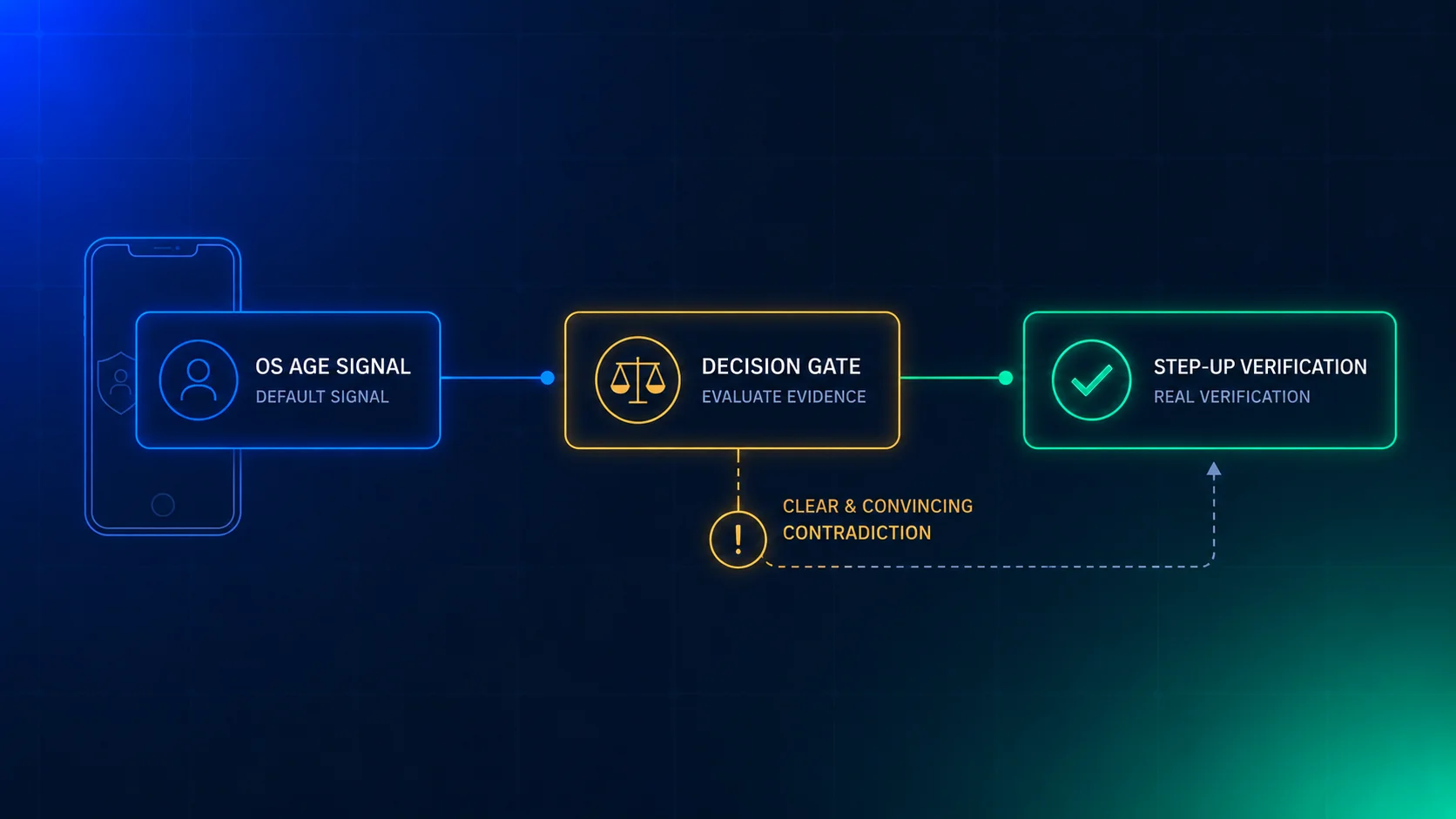
Path A runs first; users who don’t pass the ML threshold go to Path B.
Xident’s Technical Profile vs. ARCOM Requirements
| Requirement | ARCOM Standard | Xident |
|---|---|---|
| FPR (ages 13–17) | “Reliable” (inferred <2%) | Internal measurement only; not independently tested |
| Double anonymity | Required | Built-in (client-side architecture) |
| Liveness | Required (sophisticated attacks, including deepfakes) | Active liveness + face mesh + anti-spoofing; no deepfake detection |
| Non-discrimination | Required | No per-demographic evaluation yet |
| Multiple methods | ≥2 required | ML age estimation + document OCR |
| Accessibility | 80% of adult population | Any device with camera + browser |
| Credit card verification | Banned since April 2025 | Not used |
The “reliable” FPR standard in France doesn’t specify an exact number, but industry interpretation based on comparative analysis suggests a threshold around 2%.
The Penalty Landscape
ARCOM’s enforcement powers include:
- Fines up to €150,000 or 2% of global turnover for first offenses
- Up to €300,000 or 4% of global turnover for repeat offenses
- ISP blocking within 48 hours of a blocking order
- Formal notices have already been sent to major platforms
ARCOM has demonstrated willingness to act. Formal notices have been sent to adult content platforms, and the 48-hour blocking mechanism creates urgency that few other jurisdictions match. A site can go from operational to blocked in France within two business days.
Privacy as Architecture, Not Policy
What makes Xident uniquely suited for the French standard is that its privacy guarantees are architectural, not procedural.
Many age verification providers promise privacy through policies: “We won’t share your data. We’ll delete it after processing. Trust us.” France’s double anonymity standard was designed to move beyond trust-based privacy. It demands that the system architecture itself prevents data leakage.
Xident’s client-side processing model achieves this. Face data processed in the browser literally cannot leak to a server — there’s no request to intercept, no database to breach, no logs to subpoena. The platform receives a token. Xident receives usage metrics (without identifying information). The face image exists only in browser memory and is released when the session ends.
This isn’t privacy by policy. It’s privacy by architecture.
Conclusion
France’s ARCOM standard is the most privacy-focused age verification framework in the world. Double anonymity, anti-deepfake liveness detection, non-discrimination, and multi-method requirements create a compliance bar that eliminates most conventional approaches.
Xident was designed with this bar in mind. Client-side inference delivers double anonymity by default. The liveness check is a randomised head-movement challenge whose measured head-pose values the server checks against the challenge. It does not detect deepfakes. Non-discrimination is not yet evidenced: no per-demographic evaluation exists. Xident offers two methods, ML age estimation and document OCR; whether a deployment meets the two-method requirement is for the operator and ARCOM to assess.
Building age verification for France? Talk to us to get early access when we launch.