Over 44% of youth using social VR platforms report encountering hate speech. Nearly one in five has experienced sexual harassment. And a 2026 systematic review published at ACM CHI synthesized 85 studies confirming what parents, regulators, and platform operators already suspected: immersive environments amplify every online safety risk that exists on flat-screen platforms — and create entirely new ones.
Virtual reality is no longer a niche hardware category. Meta Quest headsets have shipped over 30 million units. Roblox serves 80 million daily active users and runs natively on Quest. VRChat’s monthly active users have grown 40% year-over-year. Apple Vision Pro brought spatial computing to the mainstream conversation. And the regulatory frameworks designed for web and mobile platforms are now being applied — often awkwardly — to environments where users don’t just browse content, they inhabit it.
The result is a compliance gap that’s closing fast. The UK Online Safety Act, COPPA’s amended rules, EU Digital Services Act obligations, and a growing number of US state laws all apply to VR platforms. But the technical challenges of verifying age on a headset — where there’s no front-facing camera for a selfie, where devices are shared between family members, and where avatar-based identities obscure the real person behind the controller — demand different architectural thinking than what works on web and mobile.
This post breaks down the regulatory pressure hitting immersive platforms, how major operators are responding, the technical constraints unique to VR/AR, and the architectural patterns that actually work for age verification in spatial computing environments.
Why Immersive Platforms Face Elevated Regulatory Risk
Regulators don’t treat VR like another screen. They treat it as an environment with amplified harm vectors that justify stricter oversight. Understanding why is essential to understanding what compliance actually requires.
Embodiment Changes the Nature of Harm
When a user’s avatar is groped in VR, the experience is qualitatively different from receiving a harassing text message. Haptic feedback, spatial audio, and the visual dominance of a head-mounted display create a sense of presence that makes virtual interactions feel physically real. Research from Stanford’s Virtual Human Interaction Lab has consistently shown that VR experiences produce stress responses comparable to real-world events.
For minors, this is particularly concerning. The BBC documented cases of children encountering virtual strip clubs on Meta Quest with no age checks. Meta was forced to implement personal boundaries for VR avatars after reports of sexual harassment — including against minors. A Florida Atlantic University study found that 37.6% of youth on metaverse platforms reported bullying, and 31.6% experienced malicious obstruction (being physically blocked or trapped by other users’ avatars).
These aren’t edge cases. They’re the baseline experience for a significant fraction of young VR users. And regulators are responding accordingly.
Financial Transactions in Immersive Economies
VR platforms increasingly host real economies. Roblox’s in-experience purchases, VRChat’s VRC+ subscriptions, and the broader trend toward virtual goods and avatar customization create financial transaction surfaces involving minors. Under COPPA’s amended rules — fully enforceable since April 22, 2026 — platforms that knowingly collect personal information from children under 13, including payment data, face strict consent and data minimization requirements.
The virtual gifting and tipping mechanics that migrated from live streaming into VR social platforms create identical regulatory exposure. When a minor sends virtual currency to another user in an immersive environment, the platform has facilitated a financial transaction with a child — with all the consumer protection implications that follow.
Shared Device Problem at Scale
Unlike smartphones, VR headsets are frequently shared within households. A parent buys a Meta Quest for the family. Three people use it — a 42-year-old, a 16-year-old, and an 11-year-old. The headset knows it’s the same device. It often doesn’t know which family member is wearing it.
This shared-device problem is dramatically worse in VR than on phones or tablets, where biometric unlock (Face ID, fingerprint) and individual user accounts provide at least baseline identity separation. Most VR headsets lack equivalent biometric enrollment for distinguishing between household members, making per-session age verification architecturally necessary rather than optional.
The 2026 Regulatory Landscape for Immersive Platforms
UK Online Safety Act: “Highly Effective” Age Assurance Applies to VR
Ofcom’s enforcement of the UK Online Safety Act makes no distinction between web, mobile, and immersive platforms. Any service that hosts user-generated content and is accessible to users in the UK must implement “highly effective” age assurance if that content includes material harmful to children.
VR social platforms like VRChat, Rec Room, and Roblox VR clearly fall within scope. Ofcom’s January 2025 guidance specifies that age assurance methods must be technically accurate, robust, reliable, and fair — effectively ruling out self-declaration and basic age gates. Enforcement penalties reach up to 18 million GBP or 10% of global revenue, whichever is greater.
For immersive platforms, the “highly effective” standard creates a particular challenge: the verification method must work within the constraints of a headset-based user experience, where traditional ID-plus-selfie flows are cumbersome or impossible.
COPPA’s Amended Rules: VR Platforms Are Squarely in Scope
The FTC’s updated COPPA rules expand the definition of personal information to include biometric identifiers — a category that directly implicates VR headsets collecting eye tracking, hand geometry, and spatial behavior data. Platforms directed at children or with actual knowledge that they serve children under 13 must obtain verifiable parental consent before collecting this data.
Roblox’s decision to implement mandatory age checks for chat access — making it the first major gaming platform to do so — was a direct response to this regulatory pressure. The platform now requires either government ID verification or facial age estimation for all users, with accuracy certified at within 1.4 years for under-18 users.
US State Laws: App Store Accountability Hits Headset Ecosystems
The wave of App Store Accountability Acts in Texas, Utah, Louisiana, and Alabama applies to app marketplace operators — which includes Meta’s Quest Store, Apple’s Vision Pro App Store, and any platform distributing VR applications.
Texas SB 2420, which a federal appeals court allowed to take effect on May 28, 2026, requires app marketplace operators to verify all users’ ages and obtain parental permission before minors can download apps or make in-app purchases. For VR ecosystems, this means age verification isn’t just a platform-level concern — it’s an app store-level obligation that the headset manufacturer may need to satisfy.
EU Digital Services Act and Upcoming Age Verification App
The EU’s Digital Services Act classifies very large online platforms (VLOPs) with over 45 million EU users as subject to enhanced due diligence obligations, including risk assessments specifically covering minors. Roblox, which qualifies as a VLOP, must assess and mitigate risks that its VR experiences pose to children.
On May 11, 2026, the European Commission announced that its age verification app is technically ready for deployment by member states and platforms. While initially focused on web-based verification, the app’s architecture — based on the EU Digital Identity Wallet framework — is designed to extend to immersive platforms through standards-based credential exchange.
How Major Platforms Are Responding
Meta Quest: OS-Level Age Gating
Meta has taken the most aggressive hardware-level approach. All Quest 2 and Quest 3 users now receive a mandatory prompt to enter their birthday, with a 30-day compliance window before account access is blocked. Users under 13 get parent-managed preteen accounts with the most restrictive privacy and content settings. Teens aged 13-17 have profiles set to private by default with parental supervision tools available.
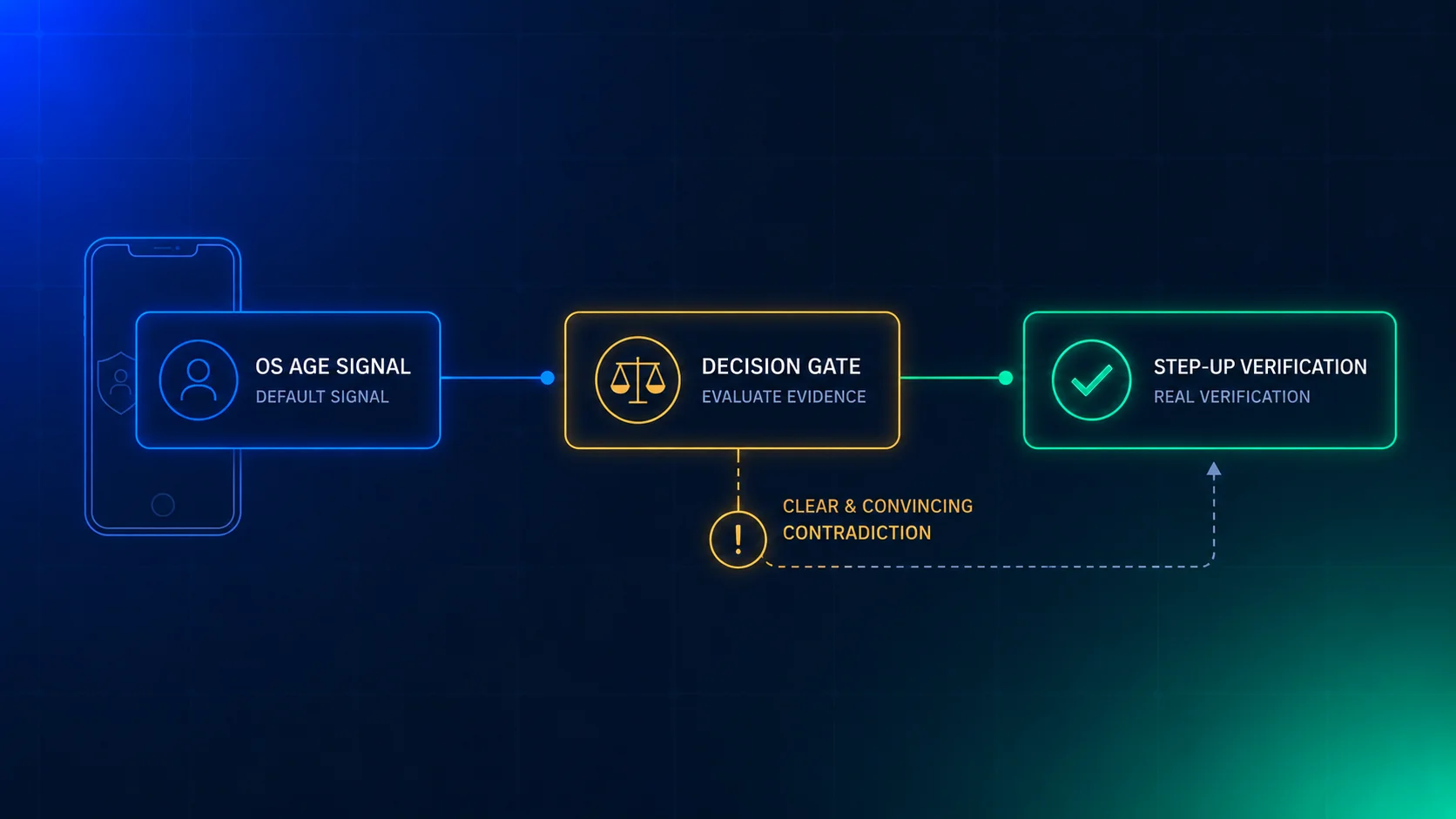
The approach leverages Meta’s control of both the hardware and the operating system. By gating age verification at the OS level, Meta ensures that all applications running on Quest — whether first-party or third-party — operate within an age-classified context. This mirrors the device-level age verification approach that Apple and Google are implementing on mobile, but with the added complexity of headset-specific user switching.
The limitation: Meta’s current system relies on self-declared birthdates. While preteen accounts require parental setup, the system doesn’t independently verify the parent’s age claim or the child’s actual age through biometric or document-based methods. For platforms operating under Ofcom’s “highly effective” standard, self-declaration alone won’t suffice.
VRChat: Third-Party ID Verification with Content Gating
VRChat’s approach pairs third-party identity verification (through Persona) with a content gating system. Age-verified users gain access to content tagged as “sexually suggestive” or containing “adult language and themes.” Unverified users and verified users under 18 are restricted from this content.
The verification process requires users to provide a government-issued ID and use a camera-enabled device — which, crucially, means most users complete verification on their phone rather than through the headset itself. This companion-device pattern acknowledges the practical reality that VR headsets aren’t optimized for document scanning workflows.
VRChat’s roadmap includes expanded content gating in H1 2026, with a stated goal of reducing the cost of verification to users. The platform has acknowledged that the current Persona-based flow creates friction that disproportionately affects users in regions where government ID is less accessible or where privacy concerns make ID upload culturally sensitive.
Roblox: Facial Age Estimation at Scale
Roblox has implemented the most technically sophisticated approach among major immersive platforms. Users complete age checks through either government ID verification or facial age estimation — a quick, automated process that uses a device camera to estimate the user’s age without storing biometric data.
Roblox’s age estimation technology has been tested and certified by third-party labs, achieving accuracy within 1.4 years for users under 18. This meets or exceeds the accuracy thresholds established by regulators in the UK (Ofcom), Germany (KJM), and France (ARCOM).
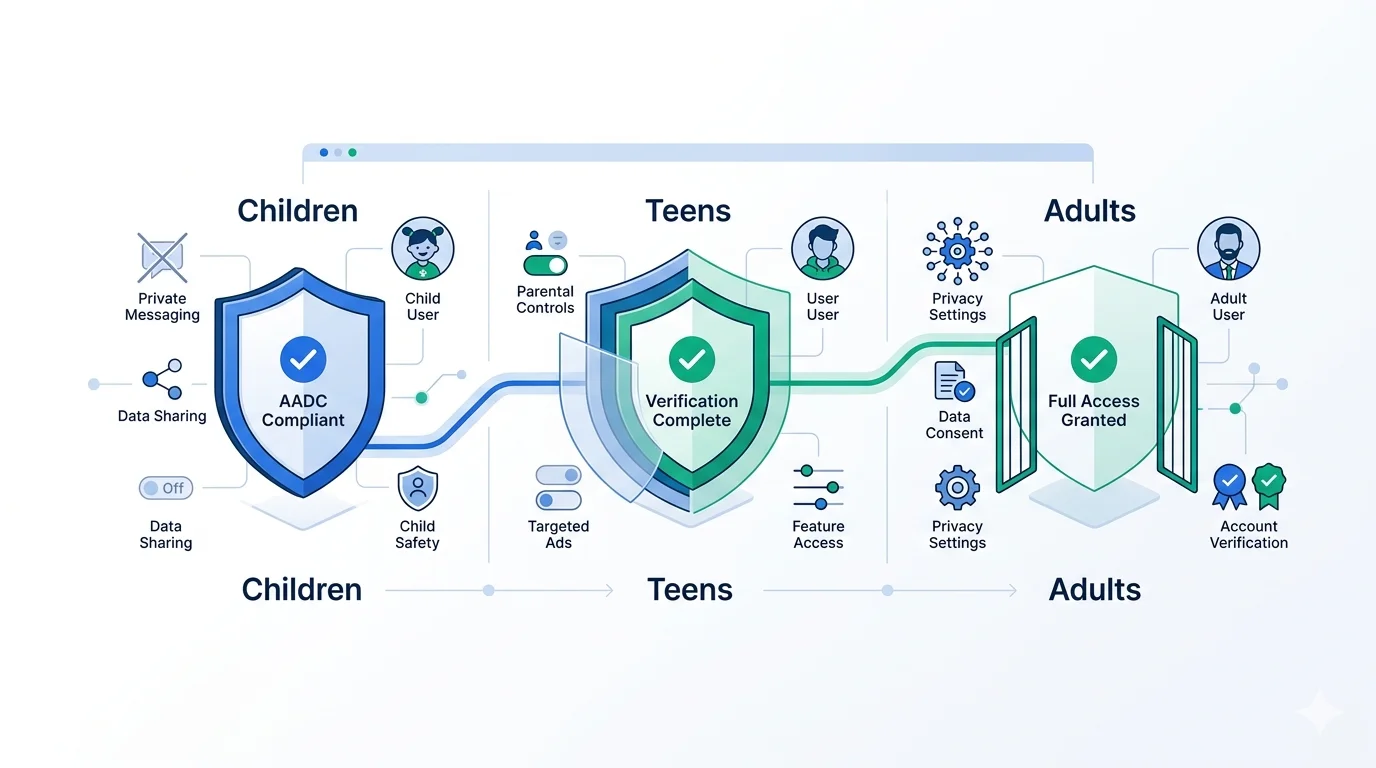
The platform uses age classification to enforce tiered access: 5-8 year olds receive the most restricted experience, 9-15 year olds get intermediate access, and 16+ users receive full platform access. VR access on Quest is restricted to users whose accounts indicate they are 13 or older.
Apple Vision Pro: Hardware-Enforced Age Floor
Apple’s approach is the most restrictive: Vision Pro is designed for users 13 and older, period. Children under 13 are not supported. Communication Safety is enabled by default for users 13-17, with the latest visionOS providing content filtering and parental notification capabilities.
Apple’s broader age verification rollout — blocking downloads of 18+ rated apps in Brazil, Australia, and Singapore, and implementing state-specific compliance in Utah and Louisiana — extends to the Vision Pro App Store. The hardware’s reliance on Apple ID, which increasingly incorporates age signals from the OS-level Declared Age Range API, provides a baseline age classification that third-party apps can query.
Technical Challenges Unique to VR/AR Age Verification
No Front-Facing Camera for Selfie Verification
Most VR headsets position cameras facing outward for spatial tracking, not inward toward the user’s face. While eye-tracking cameras exist in premium headsets (Quest Pro, Vision Pro, PSVR2), they capture infrared images of the eye region — not the full-face visible-light images needed for document-matching or age estimation.
This hardware constraint means that selfie-based verification flows — the backbone of mobile identity verification — simply don’t work on most VR devices. Solutions must either use a companion device (phone) for the camera-dependent steps, leverage OS-level signals from the headset platform, or use alternative verification methods entirely (NFC document reading via phone, bank-based verification, reusable credentials).
Continuous Identity vs. One-Time Verification
On a phone, biometric unlock provides reasonable assurance that the verified user is the one currently using the device. VR headsets lack equivalent continuous identity signals. A parent verifies their age on the family Quest, takes off the headset, and their child puts it on. Without per-session re-verification, the age attestation is meaningless.
Some approaches to this problem are emerging. IPD (interpupillary distance) measurement, gait analysis from controller movement patterns, and ear-shape recognition from in-ear audio sensors are all being researched as passive biometric signals that could distinguish between household members without requiring active re-verification. None are production-ready at the accuracy levels required for regulatory compliance, but they represent the direction the technology is heading.
Avatar-Based Identity Obscures Real Users
In VR social platforms, users interact through avatars that bear no relationship to their physical appearance, age, or gender. A 12-year-old can present as an adult avatar. A 40-year-old can present as a teenager. This identity abstraction is a feature of VR social platforms — it enables creative expression and reduces certain forms of appearance-based discrimination — but it also means that other users and content moderators cannot visually assess whether someone is a minor.
Age verification must therefore operate at the account level, not the interaction level. Platform-enforced age classification, tied to verified account status, is the only reliable mechanism for ensuring that minors aren’t accessing age-restricted content or interactions in avatar-based environments.
Latency and Friction in Immersive Contexts
Verification friction that’s acceptable on mobile — a 30-second ID scan — is significantly more disruptive in VR. Removing the headset to scan a document on a phone, then returning to the immersive experience, breaks presence and creates a fundamentally different UX burden than tapping through a verification flow on a smartphone.
The platforms that will succeed at immersive age verification are those that solve for verify-once-use-everywhere: a single verification event that produces a reusable age credential, stored at the device or platform level, that subsequent applications can query without requiring the user to re-verify.
Architectural Patterns That Work
Pattern 1: Companion Device Verification
The user completes age verification on their phone — using standard document scanning, facial age estimation, or NFC chip reading — and the verified age attestation is synced to their headset account. This is effectively what VRChat implements with Persona, and what any platform using a phone-based identity provider would follow.
Advantages: Leverages mature mobile verification infrastructure. Works with any headset regardless of camera configuration. Doesn’t require the user to remove the headset during a VR session — verification happens during account setup.
Limitations: Requires the user to have a smartphone. Creates a dependency on account-level binding between phone and headset. Doesn’t solve per-session re-verification for shared devices.
Pattern 2: OS-Level Age Classification
The headset OS maintains an age classification for the active user, established during device setup and queryable by applications through a platform API. This is Meta’s approach with Quest and Apple’s approach with Vision Pro.
Advantages: Every application on the platform inherits age classification without implementing its own verification. Reduces redundant verification across apps. Aligns with the device-level age verification model that Apple and Google are implementing on mobile.
Limitations: Only as strong as the initial verification method. Meta’s current self-declared birthday is weak. Requires platform manufacturers to invest in verification infrastructure — which they’re increasingly doing under regulatory pressure.
Pattern 3: Reusable Age Tokens
The user verifies once with a trusted identity provider and receives a cryptographic age token — a privacy-preserving credential that proves “this user is over 18” without revealing their identity, date of birth, or any other personal data. The token can be presented to any platform that accepts it.
Advantages: Strongest privacy guarantees. Aligns with EU Digital Identity Wallet architecture and the emerging ISO/IEC 18013-7 standard for mobile credential presentation. Eliminates redundant data collection across platforms. Works across devices — a token issued during phone-based verification can be presented on a headset.
Limitations: Requires ecosystem adoption. Standards are still being finalized. Token revocation and refresh mechanisms need to handle edge cases (user turns 18, token was issued for a different jurisdiction’s age threshold).
Pattern 4: Passive Biometric Age Signals
Headset sensors capture biometric signals — IPD, hand size from controller grip, movement patterns — that correlate with age. These signals provide a probabilistic age estimate without requiring active user participation.
Advantages: Zero friction. Works per-session, solving the shared-device problem. Doesn’t require a companion device.
Limitations: Accuracy is insufficient for regulatory compliance today. Raises significant privacy concerns about continuous biometric monitoring. Not endorsed by any current age assurance standard. Best positioned as a supplementary signal rather than a primary verification method.
What Immersive Platform Operators Should Do Now
Audit your regulatory exposure. If your platform hosts user-generated content, enables social interaction between users, or facilitates financial transactions — and is accessible to users in the UK, EU, or states with active age verification laws — you are in scope. The UK Online Safety Act’s July 2025 enforcement deadline has already passed. COPPA’s amended rules are fully enforceable. New state laws are taking effect monthly.
Implement companion-device verification as the baseline. The most practical near-term approach for VR platforms is to require age verification during account creation using a phone-based flow, then sync the verified status to the headset account. This works with existing identity verification infrastructure and doesn’t require hardware modifications.
Design for reusable credentials. The industry is converging on token-based age verification — where users verify once and carry a privacy-preserving proof of age across platforms and devices. Building your verification architecture around credential acceptance (rather than collecting and storing identity documents yourself) reduces your data liability and future-proofs against the EU Digital Identity Wallet and mobile driver’s license ecosystems.
Solve the shared-device problem. For platforms running on family-shared headsets, implement user-switching with per-profile age classification. At minimum, require PIN or gesture-based profile selection. At best, integrate emerging passive biometric signals as a secondary check to flag potential profile misuse.
Don’t build identity infrastructure from scratch. VR platforms should integrate with purpose-built age verification providers rather than building custom verification flows. The Persona-Discord incident demonstrated the security risks of centralized identity data. Choose a provider with on-device processing, minimal data retention, and multi-method verification support.
The Bottom Line
VR and immersive platforms sit at the intersection of every age verification trend in 2026: tightening regulations, shared-device complexity, avatar-based identity abstraction, and the technical constraints of headset hardware. The platforms that get this right will treat age verification not as a compliance checkbox but as a foundational layer of their trust and safety architecture.
The ones that don’t will learn what Reddit, Discord, and dozens of other platforms have already discovered: regulators don’t accept “we’re working on it” as a defense, and the fines for inadequate age assurance are designed to be impossible to ignore.