Most of the age-assurance enforcement coverage this year has been about regulators: Ofcom’s information requests and fines, the ICO’s £14.47M Reddit decision, the EU Commission declaring “no more excuses.” That framing quietly imports a European assumption: that the entity you have to worry about is a government agency with a fine schedule. In the United States, the more dangerous counterparty in 2026 isn’t a regulator. It’s a plaintiff’s lawyer with a class.
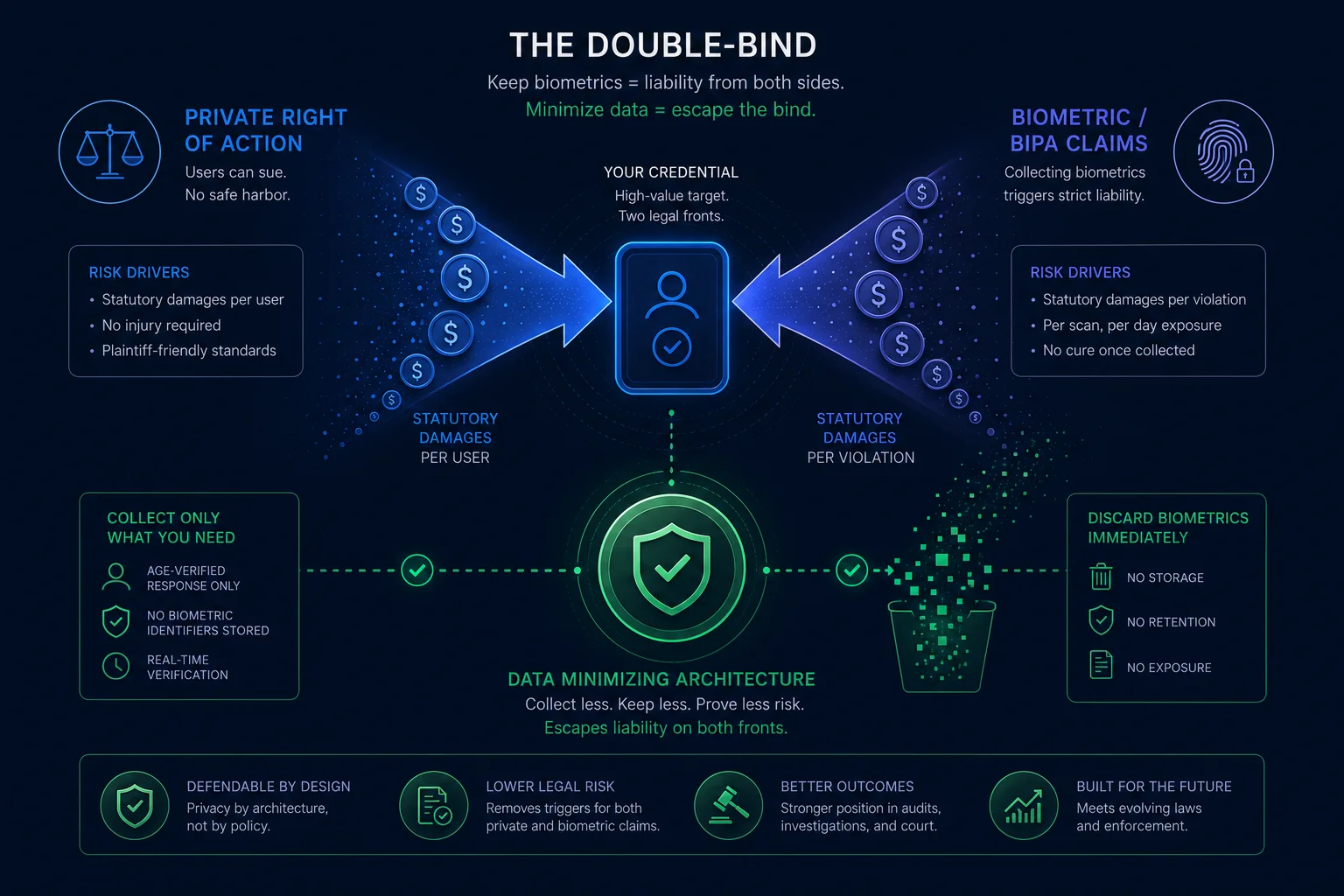
Two things converged around 1 July 2026, and together they define the US risk picture. First, a wave of state age-verification laws that carry a private right of action went live or firmed up — meaning individuals, not just an attorney general, can sue you for how you gate age. Second, the method most teams reach for to satisfy those laws — facial age estimation from a selfie — is itself one of the most heavily litigated technologies in the country under biometric-privacy law. The result is a genuine double-bind that European-style “just deploy a check” advice completely misses: you can be sued for not verifying, and sued for how you verified. This post lays out both exposures, the statutory-damages math that makes them serious, and why the defense is architectural rather than contractual.
The fine is the smaller number
Start with why a private right of action changes the calculus versus a regulator fine. A regulator penalty is discretionary, negotiated, usually singular, and typically scaled to turnover with a ceiling. Unwelcome, but bounded, and you face one counterparty who has to prioritize its docket.
A private right of action inverts every one of those properties. The counterparty is every affected user, aggregated into a class. Damages are often statutory and per-violation, so the number is a multiplication — users times a fixed figure — rather than a single assessed sum. And the plaintiff’s bar is fee-shifted and motivated: statutes that let prevailing plaintiffs recover attorneys’ fees create a standing industry whose business model is finding technical non-compliance at scale. This is the same dynamic that turned Illinois biometric law into a litigation engine, and it is now being written directly into age-verification statutes. A $2,500-per-violation figure sounds modest until you remember it attaches to a user base, not to an incident. This is a different risk class from the product-liability and negligence suits platforms already face over harm to minors; those turn on causation and duty. A statutory private right of action turns on whether you followed the procedure — which makes it far easier to plead and far harder to escape on the merits.
What went live around 1 July 2026
The clearest example is Nebraska’s Parental Rights in Social Media Act (LB 383), operative 1 July 2026. It requires covered platforms to run reasonable age verification through a third-party vendor at sign-up, mandates that verification data not be retained, and requires verified parental consent for under-18s. Enforcement runs on two tracks: the Nebraska Attorney General can collect civil penalties up to $2,500 per violation, and — critically — the Act carries a private right of action, letting individuals whose data is retained, and minors or their parents, sue the platform and the third-party vendor for relief including actual damages.
Note that vendor exposure. Most US age laws in this wave reach past the platform to the verification provider itself. A weak vendor doesn’t just fail your compliance; it becomes a co-defendant, and its retained data becomes discovery. This is exactly why a vendor security review now has to include “what does this provider retain, and does that make us both suable?” as a first-order question.
The Nebraska story also carries a caution that belongs in any honest 2026 write-up: on the eve of the effective date, a federal judge partially enjoined the law, finding the account-creation age-verification and parental-consent mandates likely violate the First Amendment. So the age-gating provisions are contested and may not survive in their current form. That is the pattern across the US patchwork: statutes pass, take effect, and get litigated on speech grounds simultaneously, leaving operators to build for requirements that are legally live and legally uncertain at the same time. The private-right-of-action mechanism, though, is spreading regardless of any single law’s fate. Minnesota’s HF 4138 attaches a private right of action with $10,000 statutory damages for reckless or knowing violations (operative 2027); Texas, Louisiana, Virginia, Utah, Arkansas, Mississippi, and Montana all authorize civil suits for failure to verify; and Washington’s My Health My Data Act treats violations as per se Consumer Protection Act claims with treble damages. Design for the mechanism, not for one bill’s headline.
The trap: the tool you deploy to comply is its own class action
Here is where the double-bind closes. To satisfy “reasonable age verification” without hoarding IDs, the obvious move is facial age estimation — a selfie, a model, an over/under decision. But in Illinois, extracting facial geometry from that selfie can make it a biometric identifier under the Biometric Information Privacy Act (BIPA), and BIPA is the only biometric-privacy statute in the country with a private right of action.
The damages structure is why BIPA drives litigation the way it does: $1,000 per negligent violation and $5,000 per reckless or intentional violation, plus attorneys’ fees and injunctive relief, with liability turning on procedural failures — no written consent, no published retention-and-destruction schedule — rather than on any demonstrated harm. Over 107 new BIPA class actions were filed in 2025 alone, against a backdrop of landmark resolutions like Clearview AI’s $51.75M settlement. Texas’s CUBI covers the same conduct but, importantly, has no private right of action — it is AG-enforced up to $25,000 per violation — so the class-action landmine is Illinois-specific even though the underlying obligation is not.
Be precise about the maturity of this risk: as of early 2026, no reported BIPA judgment or settlement has turned specifically on age verification as the use case. The contours of how courts treat age-gating biometrics are a foreseeable next wave, not settled precedent. But “foreseeable next wave” is exactly the posture in which prudent architecture decisions get made cheaply and litigation-driven ones get made expensively. If your compliance plan is “deploy facial age estimation and store what we collect,” you have simultaneously satisfied one statute and armed the plaintiff’s bar under another.
Why “keep everything to defend yourself” is exactly backwards
The instinctive response to a private right of action is defensive retention: keep the ID image, keep the selfie, keep the verification logs, so that when someone sues you can prove you did the check. This instinct is not just wrong, it is actively dangerous, because it manufactures the evidence for the other lawsuit and a breach target on top of it.
Retained biometrics and identity documents are precisely what a BIPA plaintiff needs to establish collection and retention. They are also what turns a vendor incident into a catastrophe — the Persona/Discord exposure is the reference case for how a centralized store of verification data becomes the liability rather than the defense. The two private rights of action look like a contradiction only if you conflate two different things: proof that you decided correctly and the raw identity you decided from. They are separable. You can hold durable, defensible proof that a user cleared an 18 gate on a given date via a given method, at a given assurance level, without holding the face, the document, or the date of birth that produced it. Keep the decision. Discard the identity. That single distinction is what lets one architecture answer both plaintiffs.
Data minimization is the legal strategy
For a senior team, the takeaway is that minimization stops being a privacy nicety and becomes the core litigation-defense design. Concretely:
- Return a threshold result, not an identity. Age should resolve to over/under a line — 12, 15, 18, 21, or 25 — persisted as a boolean fact, never a stored date of birth or biometric template. A boolean is not a biometric identifier; there is nothing for a BIPA class to be built from.
- Process biometrics ephemerally, ideally on-device, and never persist facial geometry. Where facial estimation runs, treat the template as transient: compute the over/under, then destroy it. Where any biometric processing does occur, pair it with the BIPA hygiene the statute actually requires — written consent and a published retention-and-destruction schedule — because those procedural steps, not the technology, are what liability attaches to.
- Build a per-decision audit trail that carries no identity. For each verification, log the defensible facts: threshold outcome, method used, assurance level, and model or ruleset version — the record that answers “we verified” for the age-law private right of action. This is the same audit-evidence discipline regulators want, and it deliberately excludes the raw identity that a BIPA class or a breach would exploit.
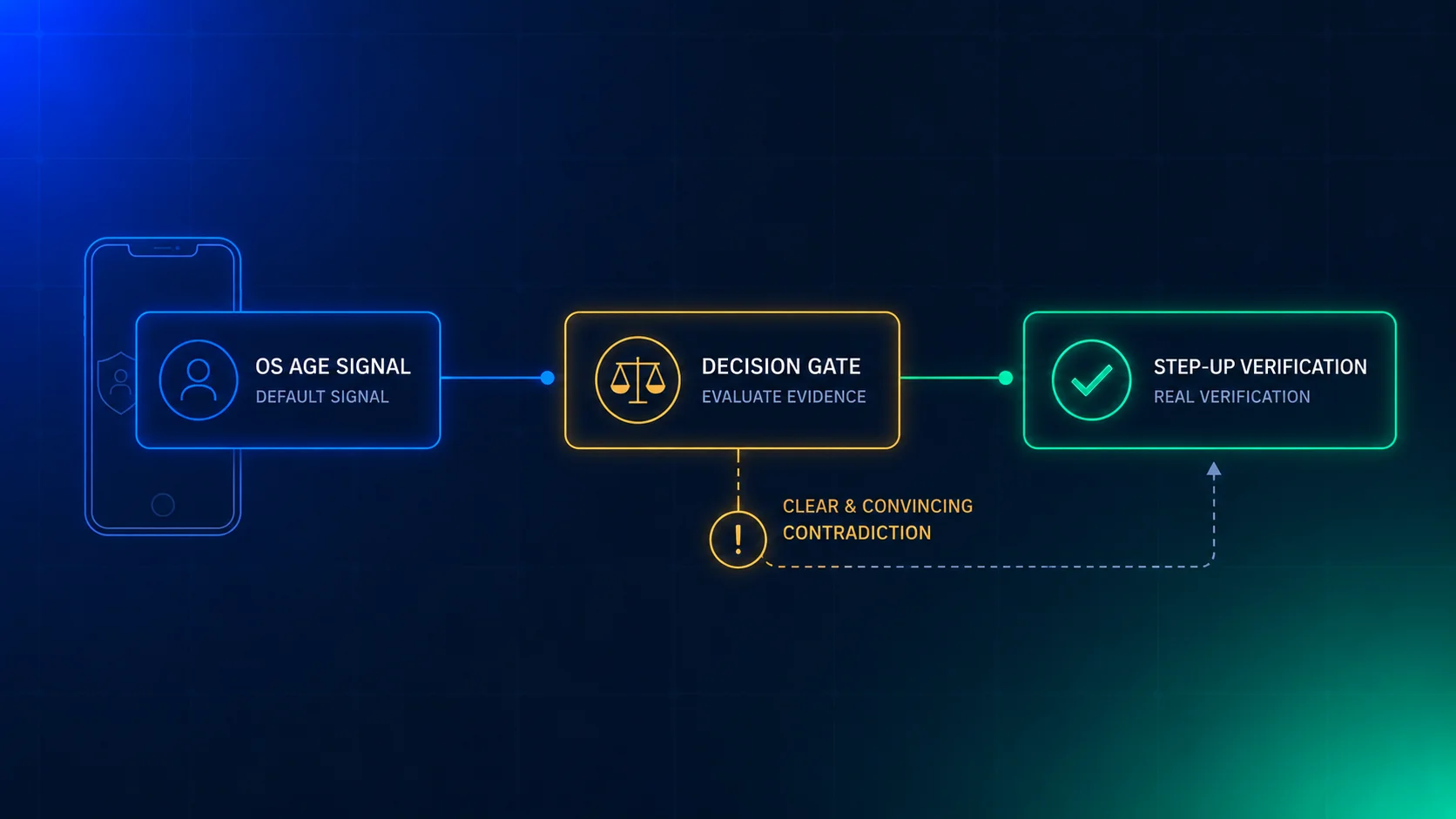
- Escalate, then discard. When estimation is insufficient and you step up to document or NFC capture, treat the captured artifact as disposable: extract the threshold decision, write the audit record, delete the source.
- Re-prove with a token, don’t re-collect. A reusable credential or token lets returning users re-assert the same fact without a fresh biometric capture, which both improves conversion and shrinks the number of collection events a plaintiff can count.
The through-line: every record you don’t keep is a claim a plaintiff can’t plead, and every decision you do keep is a defense you can produce on demand.
How Xident is built for this
Xident is architected so that satisfying an age-verification mandate does not build the evidence for a biometric class action. Age is returned as a threshold classification — over or under 12, 15, 18, 21, or 25 — with a configurable challenge-age buffer, so the persisted output is a decision, not a date of birth. Facial estimation and liveness run to produce that decision, not to build a stored template; when the flow escalates to document OCR or face match, the source artifact yields a threshold result and is not retained as an identity hoard.
Every path resolves to the same record: a threshold outcome, the method, the assurance level, and the ruleset version, written to an audit log rather than to a retained identity. That log is the “we verified” evidence the US age-law private right of action demands — and it is deliberately empty of the biometric material that fuels a BIPA claim or a breach. A reusable token lets returning users re-prove the same fact without another capture, and sub-processor discipline keeps the retained-data surface — the thing that makes a vendor a co-defendant — as small as the law allows. One integrated control, designed so the two private rights of action pulling in opposite directions are answered by the same decision: hold the proof, not the person.
The European enforcement story trained a generation of operators to ask “do we have a check, and can we prove it’s effective?” In the United States in 2026, that question is necessary but dangerously incomplete. The second question is “and does the way we prove it hand a plaintiff their case?” Teams that answer both with the same data-minimizing architecture will find the double-bind dissolves. Teams that bolt a biometric check onto a defensive retention policy will discover they built the exhibit for their own class action. Keep the decision, discard the identity, and the private right of action stops being a trap and becomes a record you can hand over.
This post is general information about age-assurance practice and US privacy litigation, not legal advice. Statutory-damage provisions, private rights of action, and biometric-privacy obligations vary by state and continue to evolve, and several of the laws discussed are subject to active constitutional challenge; consult qualified counsel for your specific obligations.