Prediction markets have gone mainstream. Kalshi processes billions in event contracts. Polymarket dominated the 2024 U.S. election cycle with volumes that dwarfed traditional polling markets. And a bipartisan Senate bill — the Prediction Market Act of 2026 — is about to make age verification a federal mandate for every platform in the space.
The problem isn’t theoretical. A Common Sense Media study found that 36% of boys aged 11 to 17 gambled in the past year, with 49% of 17-year-old boys reporting gambling activity. Prediction markets, with their event-driven interfaces and social media marketing, are particularly attractive to younger users who see them as an extension of sports culture and political engagement rather than financial trading.
Kalshi’s own internal data confirmed the gap: minors were passing KYC checks by borrowing parents’ or siblings’ government-issued IDs. The platform’s existing identity verification caught fraudulent documents — but not legitimate documents used by the wrong person. That distinction is the core architectural failure the entire industry needs to address.
The Regulatory Landscape: What’s Coming
The Prediction Market Act of 2026
Senators Kirsten Gillibrand (D-NY) and Dave McCormick (R-PA) introduced the Prediction Market Act of 2026 in April, establishing the first comprehensive federal regulatory framework for event contract platforms. The age verification provisions are not optional add-ons — they’re structural requirements.
The bill mandates age verification for all prediction market participants, requires self-exclusion programs modeled on traditional gambling safeguards, and directs the CFTC to define enforceable standards specifically tailored to prediction markets. It also establishes an Office of the Retail Advocate within the CFTC to assist consumers and target bad actors.
This is the CFTC’s equivalent of what Ofcom and the eSafety Commissioner did for social media and adult content platforms — bringing event contract markets into the same regulatory framework that already governs sportsbooks and online casinos, but with requirements calibrated to the unique characteristics of prediction markets.
Senate Scrutiny Is Active
On May 20, 2026, U.S. senators convened hearings specifically addressing how prediction market platforms use social media to advertise to underage users. The NBA and PGA Tour have publicly called for raising the minimum trading age from 18 to 21, arguing that the current floor is too low given the accessibility and gamification of these platforms.
The legislative trajectory is clear: prediction markets face the same regulatory arc that hit social media platforms under KOSA and sportsbooks under state gaming commission rules. The companies that treated age verification as an afterthought in those industries paid the price in fines, forced product changes, and reputational damage.
CFTC Enforcement Authority
The Prediction Market Act explicitly grants the CFTC rulemaking authority over age verification standards for prediction markets. This matters because it moves enforcement from a patchwork of state-level rules to a single federal standard — and the CFTC has demonstrated willingness to enforce aggressively against platforms that operate outside its framework.
Why Current Age Verification Is Failing
The Borrowed Identity Problem
Kalshi’s public disclosure in May 2026 revealed the core failure mode: their KYC system verified documents correctly but couldn’t verify that the person submitting the document was the person on the document. A 15-year-old submitting a parent’s driver’s license passes every document authenticity check, OCR validation, and database cross-reference. The document is real. The person is wrong.
This isn’t a Kalshi-specific problem. It’s an architectural flaw in any identity verification system that treats document verification and person verification as the same operation. They’re not. A valid document proves nothing about who’s holding the phone.
Self-Declaration Is Dead
The prediction market industry’s reliance on checkbox age confirmation mirrors what social media platforms did for a decade — and regulators have made their position clear. The UK’s ICO fined Reddit £14.47 million in February 2026 for relying on self-declaration. The eSafety Commissioner fined platforms A$49.5 million. Every enforcement action in the past 18 months has targeted self-declaration as the primary failure.
Prediction markets still using self-declaration for age gates are operating on borrowed time. The Prediction Market Act will close this loophole at the federal level.
Face ID Alone Isn’t Sufficient
Kalshi’s response — requiring Face ID by default — addresses the borrowed-identity problem partially. Device biometrics confirm that the enrolled device user is present, but they don’t confirm age. A 16-year-old with Face ID set up on a parent’s phone passes the check. Face ID confirms identity to the device, not identity to the platform.
Effective age verification requires a different approach: verifying the person’s age at account creation using document verification with liveness detection, then binding that verified identity to subsequent sessions through biometric or token-based re-authentication.
What Platform Operators Need to Implement
Tiered Verification Architecture
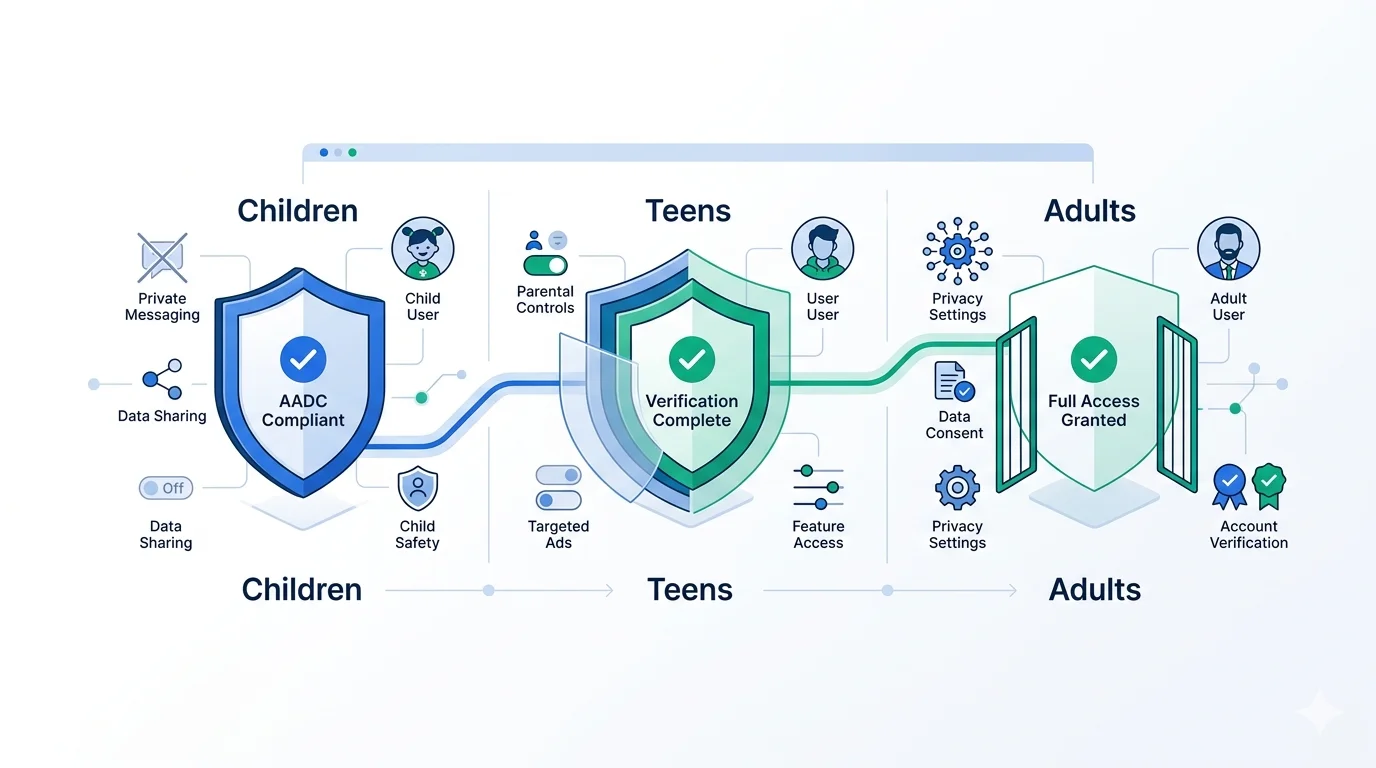
The Prediction Market Act’s requirements align with what regulators globally have converged on: a layered verification approach.
At account creation: Document verification paired with real-time liveness detection. This means verifying a government-issued ID and simultaneously confirming that the person presenting the document is the same person pictured on it — not a photo of a photo, not a replay attack, and not someone else’s document.
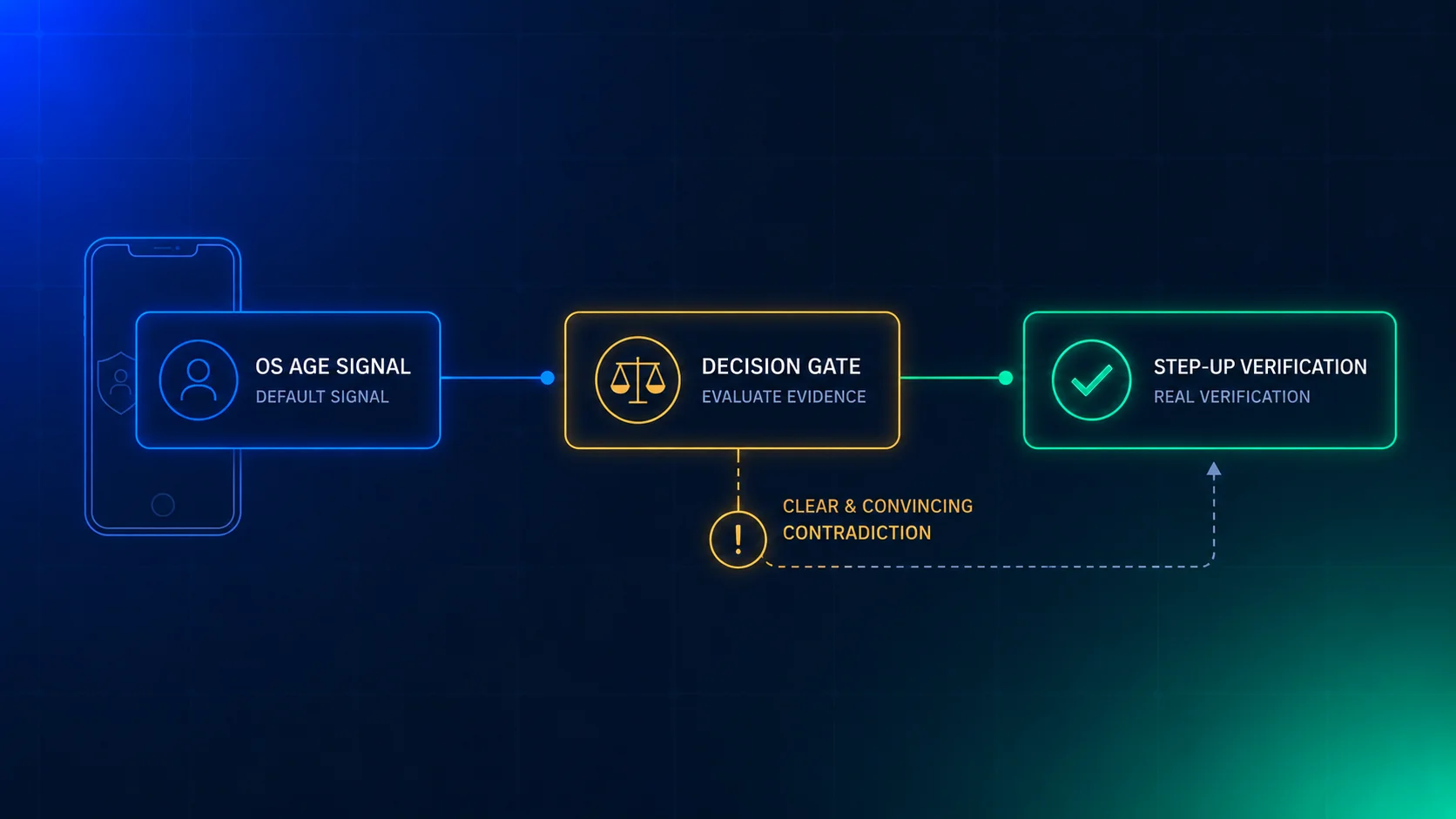
At session initiation: Re-authentication that confirms the verified user is the one accessing the account. This is where token-based returning user flows matter. You don’t need to re-verify identity every login, but you do need to confirm the verified person is present.
At transaction time: Risk-based signals that flag behavioral patterns inconsistent with the verified account holder. Sudden changes in trading patterns, access from new devices, or activity during school hours on accounts verified as 18+ can trigger step-up verification.
Privacy-Preserving Design
The CFTC, like other regulators, is moving toward standards that require effective age assurance without mass surveillance. This means:
- Verifying age once and issuing a cryptographic assertion — not storing identity documents on platform infrastructure.
- Using privacy-preserving tokens that confirm age thresholds (e.g., “user is 18+”) without revealing exact birth dates or other PII.
- Minimizing biometric data retention to the verification event itself, not storing raw biometric templates.
Platforms that build their verification stack around data minimization will have both a compliance advantage and a user trust advantage. The prediction market user base skews tech-savvy and privacy-conscious — intrusive verification that stores everything will drive churn.
Parental Controls and Transparency
Kalshi’s announcement of a “Parental Portal” and “Inner Circle” transparency features signals where the industry is heading. But bolt-on parental dashboards don’t replace robust age verification at the front door. They complement it.
The effective pattern is: verify age with high confidence at account creation, then provide parental oversight tools as a secondary layer for users whose verified age falls in the 18-20 range or for family accounts.
The Compliance Timeline
Prediction market operators face converging deadlines:
Now: Kalshi and other major platforms are voluntarily implementing enhanced age verification, setting an industry baseline that laggard platforms will be measured against.
Q3–Q4 2026: The Prediction Market Act advances through committee. The CFTC will likely issue proposed rulemaking on age verification standards, with a comment period.
2027: Expect finalized CFTC rules with enforcement teeth. Platforms that haven’t implemented compliant age verification by this point face the same enforcement risk that sportsbook operators faced when state gaming commissions tightened KYC requirements.
The lesson from every other industry that went through this transition — social media, sportsbooks, adult content, e-commerce — is that platforms that move early spend less, face fewer forced architectural changes, and maintain better user relationships than platforms that wait for enforcement actions.
What This Means for the Market
Prediction markets are at the same inflection point sportsbooks hit in 2023–2024: rapid user growth colliding with regulatory catch-up. The platforms that treated age verification as a cost center got fined. The platforms that treated it as a trust layer got market share.
DraftKings generated 620 underage gambling reports totaling $2.78 million in wagers in Ohio alone. The prediction market industry can learn from that outcome or repeat it. The Prediction Market Act exists because Congress is betting on “repeat it” — and the legislation is designed to ensure the cost of that repetition is prohibitive.
The smart play is obvious: implement robust age verification now, before the CFTC mandates it, and turn compliance into a competitive advantage with users, regulators, and partners who are all watching this space closely.
How Xident Fits
Xident solves the exact problem Kalshi publicly disclosed: verifying that the person holding the phone is the person on the ID, and that they meet the age threshold.
Our verification stack handles the full chain:
- Document verification: OCR reads the date of birth from the document image.
- Liveness check: the widget runs a randomised head-movement challenge in the browser and sends the head-pose values it measures; the server checks those values against the challenge.
- Face match — biometric comparison between the live person and the document photo, closing the gap between “valid document” and “correct person.”
- Privacy-preserving age tokens — after verification, Xident returns a token-based assertion that the user meets the required age threshold. No documents stored on your infrastructure. Xident deletes document images within 24 hours and keeps a face embedding for the retention period you choose, at most 365 days.
- Returning user flows — token-based re-authentication for subsequent sessions, eliminating the need to re-verify while confirming the verified user is present.
For prediction market platforms specifically, the integration is a single API call at account creation that returns a verified age assertion. You do not build or maintain document processing, liveness detection, or biometric matching infrastructure.
The Prediction Market Act is coming. The CFTC rulemaking is coming. The enforcement actions are coming. The cost of implementing age verification now is a fraction of the cost of implementing it after a subpoena.
If you’re operating a prediction market and haven’t integrated age verification yet, start here.