Here is the paradox every platform builder should sit with for a moment. In January 2026, Roblox did the thing the entire regulatory apparatus has been demanding: it made age verification mandatory for its whole user base, routed through real facial age estimation, at a scale no consumer platform had ever attempted. And in the months since, its legal exposure went up, not down.
By spring 2026 Roblox was facing roughly ten state attorney-general lawsuits over child-safety failures, and had agreed to pay close to $36 million across settlements with Alabama, Nevada, and West Virginia — with cases still pending in Florida, Iowa, Kentucky, Louisiana, and Texas. Oklahoma, the most recent to file, alleges the platform’s safety failures were “intentional” despite the age checks. Nebraska’s complaint puts the tension in one sentence: “Rather than meaningfully protecting children, the system has repeatedly misclassified users’ ages, placing adults in child chat groups and minors in adult categories.”
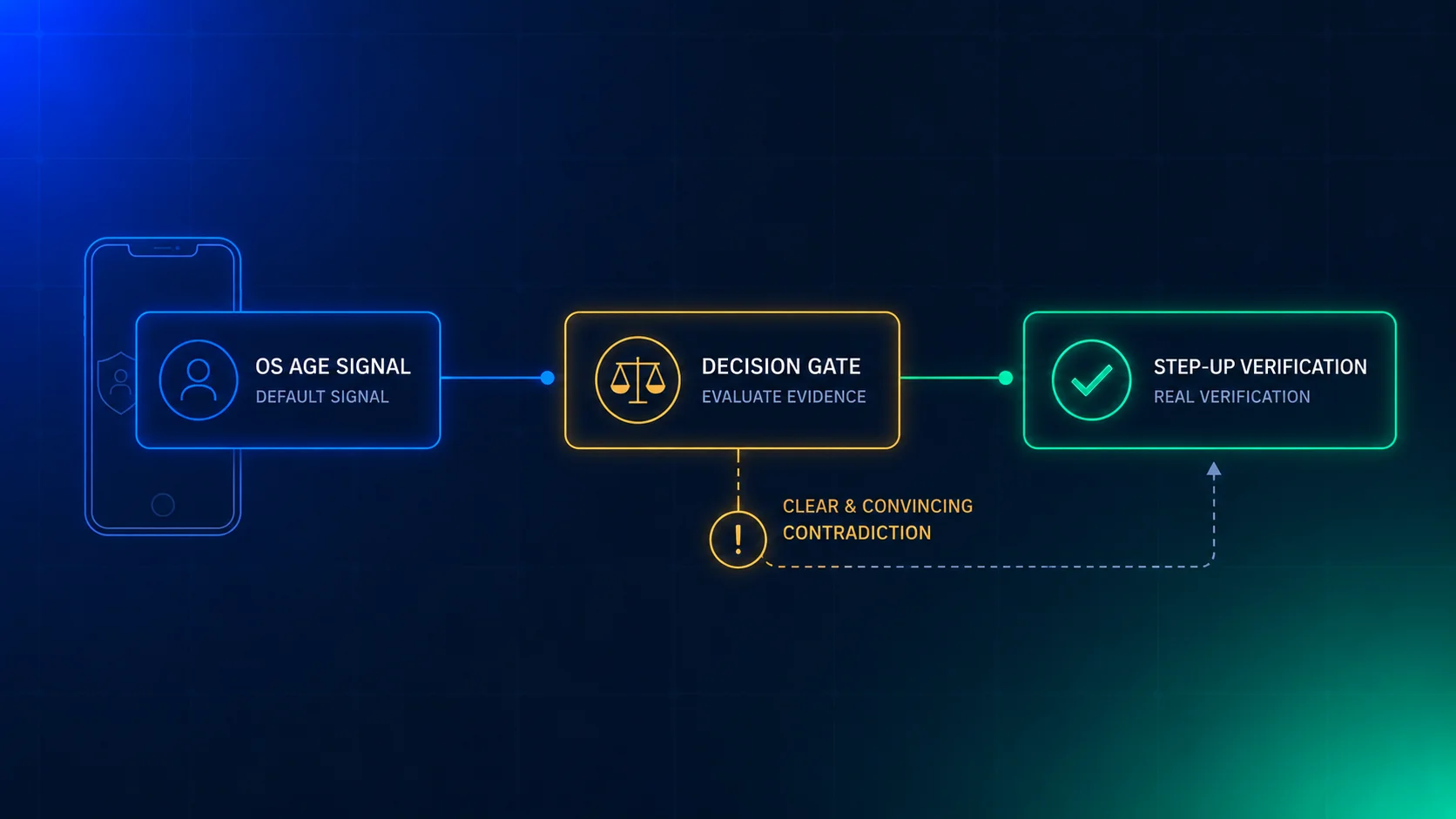
The reflexive read is “see, verification doesn’t work.” That’s the wrong lesson, and a dangerous one to internalize. The right lesson is sharper and more uncomfortable: age verification is not a liability shield. It is a knowledge-generating event, and knowledge creates duty. Once you can demonstrably tell which of your users are children, the legally and operationally interesting question stops being “did you check?” and becomes “what did you do about what the check told you?”
This post is about that gap — why it exists, the three places it opens up, and what “defensible age assurance” actually looks like when the deployment is under a microscope.
This Is the Most-Invested Operator, Not a Laggard
It matters that this is happening to Roblox specifically, because Roblox is not the company that ignored age assurance. It’s the company that went furthest.
Roblox closed Q1 2026 with around 132 million daily active users, up roughly 35% year over year, peaking near 144 million over the winter holidays. On that base it mandated facial age estimation — supplied by a third-party vendor, Persona — to access chat, sorting each user into one of six age bands from “under 9” to “21 and over.” Within weeks, tens of millions had completed the check; by February, just under half of the global daily base and roughly two-thirds of US users had gone through it. Whatever else you call that, it is the largest real-world test of consumer age assurance ever run.
So when the lawsuits and settlements landed anyway, they weren’t punishing the absence of verification. Several settlements require Roblox to keep doing age checks — Alabama and West Virginia’s deals explicitly mandate age assurance before chat, tighter limits on adult-to-minor contact, and safer defaults for younger or unverified users. The state AGs aren’t saying “you should have verified.” They’re saying “verifying was the start of your obligations, not the discharge of them.” If the most-invested operator in the category can be on the wrong side of that line, the under-invested ones should assume they already are.
Why Verifying Age Raises the Stakes Instead of Lowering Them
For years, the implicit appeal of self-declaration — the date-of-birth picker, the “I am over 18” checkbox — wasn’t just that it was cheap. It was that it preserved a kind of plausible ignorance. A platform could honestly say it didn’t know who its minors were. That posture is collapsing legally (regulators from Ofcom to the FTC now treat self-attestation as no assurance at all), and it should collapse, because it traded children’s safety for the operator’s deniability.
But notice what real verification does to your knowledge state. After a facial age estimation pass, you no longer have a fuzzy, deniable population. You have an account flagged “this user is in the 9–12 band,” sitting in your own database. That is actual knowledge of a specific minor on your service. And across negligence law, consumer-protection statutes, and the new wave of duty-of-care regimes, knowledge is the hinge. A duty you didn’t know you had is hard to enforce; a duty attached to a fact you recorded about a named account is not.
This is the inversion builders miss. Self-declaration was legally weak but epistemically convenient — you couldn’t act on what you didn’t know. Verification is legally strong but creates an obligation that runs with the knowledge: the moment your system concludes a user is twelve, every downstream product decision for that account is now a decision you made knowing they were twelve. Plaintiffs read it exactly this way. The existence of the check, and any place it failed, becomes evidence of what you knew and when — an exhibit, not an alibi.
None of this is an argument against verifying. Ignorance is worse, increasingly illegal, and morally indefensible. It is an argument that verification has to be wired to action, because the alternative — knowing and not acting — is the single worst posture you can occupy in front of a regulator or a jury.
The Three Gaps That Turn a Passing Check Into Liability
If verification is a floor, the liability lives in the distance between that floor and a system that demonstrably protects the people it just identified. In the Roblox record, that distance opens in three specific places. Every one of them is a design problem you can address before you ever ship.
1. The accuracy gap: your own errors become the plaintiff’s exhibits
Facial age estimation is good, but it is an estimate. Persona’s models reportedly achieved a mean absolute error around 1.4 years for under-18s under UK Age Check Certification Scheme testing — genuinely strong. But a 1.4-year average error against age bands as narrow as three years means boundary misclassification is not an edge case; it’s a structural property. That’s how you end up with adults placed in child chat groups and minors waved into adult ones — the two outcomes the entire system exists to prevent, now documented at scale.
The defensible pattern isn’t “pick a more accurate model.” It’s to treat the boundary as a zone, not a line. Apply a buffer: anyone whose estimate lands near a threshold gets routed to a stronger method — document verification, a reusable credential, verified parental consent — rather than being silently assigned to the riskier side of a coin flip. Tune thresholds conservatively at the boundaries that matter most for harm. And test for demographic bias explicitly, because “fair” is now a named regulatory criterion, not a nice-to-have. An error you anticipated and routed around is a design choice. An error you let stand because the model was “98% accurate” is an exhibit.
2. The binding gap: a check on no one in particular protects no one
Within days of the Roblox mandate, age-verified accounts were listed on eBay for as little as $4. That single fact dismantles any verification that isn’t bound to something durable. If a check produces a green light that can be detached from the human who passed it and handed — or sold — to anyone, then by the next login you’ve verified nobody. The minor buying a “21+” account didn’t defeat the model; they defeated the assumption that a one-time pass keeps describing the person at the keyboard.
Binding is the fix, and it’s an architecture decision, not a model decision. The age assertion has to attach to a credential, a device, or an authenticated session — and survive logout, device changes, and the passage of time — so that the system can tell when the verified human is no longer the one present. That means re-authentication, transfer and anomaly detection, and a re-verification policy rather than a result computed once and trusted forever. A verification that can’t answer “is this still the person who passed?” is collecting friction without buying assurance.
3. The action gap: knowing a user is a minor and changing nothing
This is the gap the lawsuits actually target. You can verify flawlessly and bind perfectly and still lose, if the verified result doesn’t change how the product behaves for the people it identified. The settlement terms read like a checklist of the action gap being closed under legal pressure: restrict adult-to-minor contact, default younger and unverified users into safer settings, add monitoring and escalation. Those are all things you do after you know — and they’re the part that was missing, not the check.
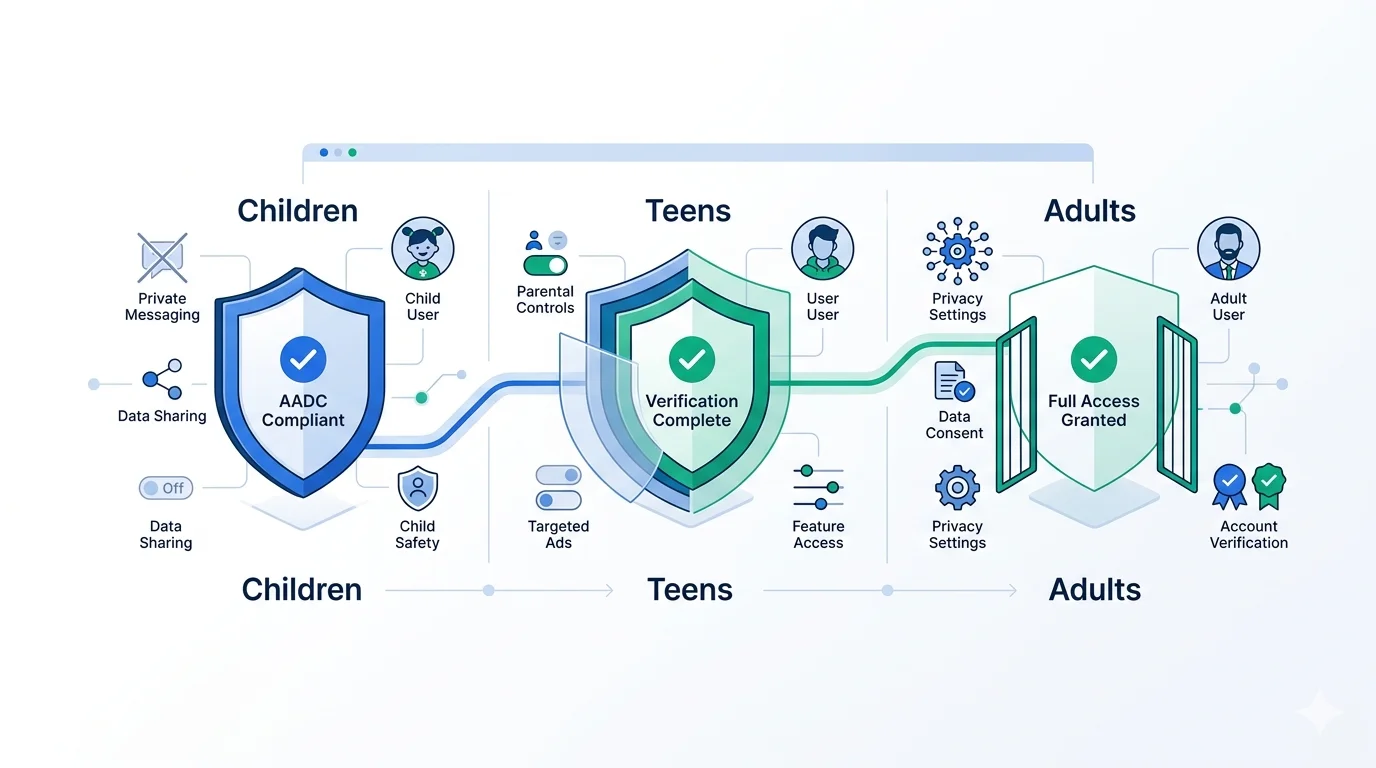
The architectural principle is that the age signal must flow into runtime behavior, not just into a compliance log. Known-minor accounts should get different defaults, different contact rules, different content surfaces, and different monitoring — automatically, as a function of the verified band. The old age gate could afford to forget its own answer the instant it opened the door. Age-aware products can’t. The result has to persist as a live attribute the system keeps acting on, every session, for as long as the account exists.
“Defensible” Is About Evidence, Not Just Accuracy
Put those three gaps together and the through-line is that regulators and plaintiffs are not grading your model’s accuracy in the abstract. They’re asking whether you can demonstrate a coherent system: that you verified, that you bound the result to the user, and that you acted on it — and that you can prove all three after the fact.
The UK’s “highly effective age assurance” standard already encodes most of this. Ofcom evaluates methods on four criteria — technically accurate, robust, reliable, and fair — where “robust” specifically means holding up in real deployment against circumvention, not just in the lab. The 2026 enforcement wave adds an unwritten fifth criterion that no certification scheme grants you: evidence that the result changed what happened to the user. That evidence is the actual deliverable in an enforcement action. The verification is the easy part; the audit trail is the part that defends you.
Practically, that means your age-assurance layer should produce an exportable record of the things that matter — the assertion reached, the method used, the band assigned, the timestamp, every re-verification and step-up event, and the policy that was applied as a result — without warehousing the raw biometrics or identity documents that created it. That last point is not a contradiction. The defensible position is “we recorded that we verified and acted, and we deleted the sensitive inputs after processing.” Keeping the face scans doesn’t strengthen your defense; it just builds the honeypot that becomes your next headline. Prove the decision, discard the evidence that created the decision.
What This Means for Build-vs-Buy
If you’re evaluating whether to build age assurance in-house or integrate a provider, the Roblox record reframes the question. The hard part was never the model call. It’s the surrounding system: buffer-zone fallback to stronger methods, a durable assertion bound to the account, a re-verification policy, transfer detection, and an audit trail you can hand a regulator — all while retaining as little sensitive data as legally possible. Most teams underestimate every item on that list because they’re benchmarking accuracy when they should be designing for defensibility.
So the things to demand — of an internal build or a vendor — are concrete: Does it return a durable, privacy-preserving age assertion you can bind to a session or credential, not a one-shot boolean? Does it support a graded band you can act on, with a buffer-zone path to a stronger method? Does it give you a re-verification mechanism rather than a permanent green light? Can it export an audit trail of decisions and actions? And does it avoid retaining the raw biometric or document data after the decision is made? If the answer to any of those is no, you don’t have age assurance — you have an age check, and the 2026 record is a long argument about the difference.
How Xident Fits
Xident was built around exactly this distinction. Our API doesn’t just return “pass/fail” — it returns a durable, privacy-preserving age assertion you can bind to a returning-user token, so a one-time check keeps describing the person actually present instead of an account that can be resold. Verification runs through layered methods with on-device processing, and estimates near a threshold fall back to stronger evidence rather than getting silently assigned to the risky side of the line. We retain the decision, not the documents: no identity files and no biometric data warehoused on your infrastructure, with an exportable record of what was verified, when, and how — the audit trail that turns a verification call into something you can defend.
The point of the Roblox lesson is not that age verification is futile. It’s increasingly mandatory, and doing nothing is the worst option of all. The point is that the check is the floor, not the ceiling — and 2026 is the year the gap between the two started getting measured in eight-figure settlements. Build for the duty the verification creates, not just the verification.
If you’re designing age assurance that has to hold up after the deployment, not just at the demo, start here.