For three years the age-assurance argument had exactly one villain: the minor who gets in. Every threshold, every accuracy claim, every regulatory demand for “highly effective” assurance was framed around the false negative — the fifteen-year-old who sails past your gate. That framing made sense when age checks were a deliberate, high-friction step a small fraction of users hit.
In 2026 that stopped being the shape of the problem. Age estimation is now running silently against entire user bases, and the failure mode that actually generates support tickets, one-star reviews, and quiet churn is the mirror image of the one everyone optimized for: the adult who gets locked out. The false positive — a legitimate 24-year-old classified as a minor and dropped into a “verify your age” flow she should never have seen — is now the dominant operational failure in age assurance. Almost nobody designed for it, and the teams shipping estimation this year are discovering that the hard part was never keeping kids out. It was letting adults through.
The Rollout That Changed the Failure Distribution
The reason the failure distribution flipped is scale. When age checks were an explicit gate on an adult-content site, the population running them was small and self-selected. Estimation changed that by running on everyone, invisibly, as a background classification.
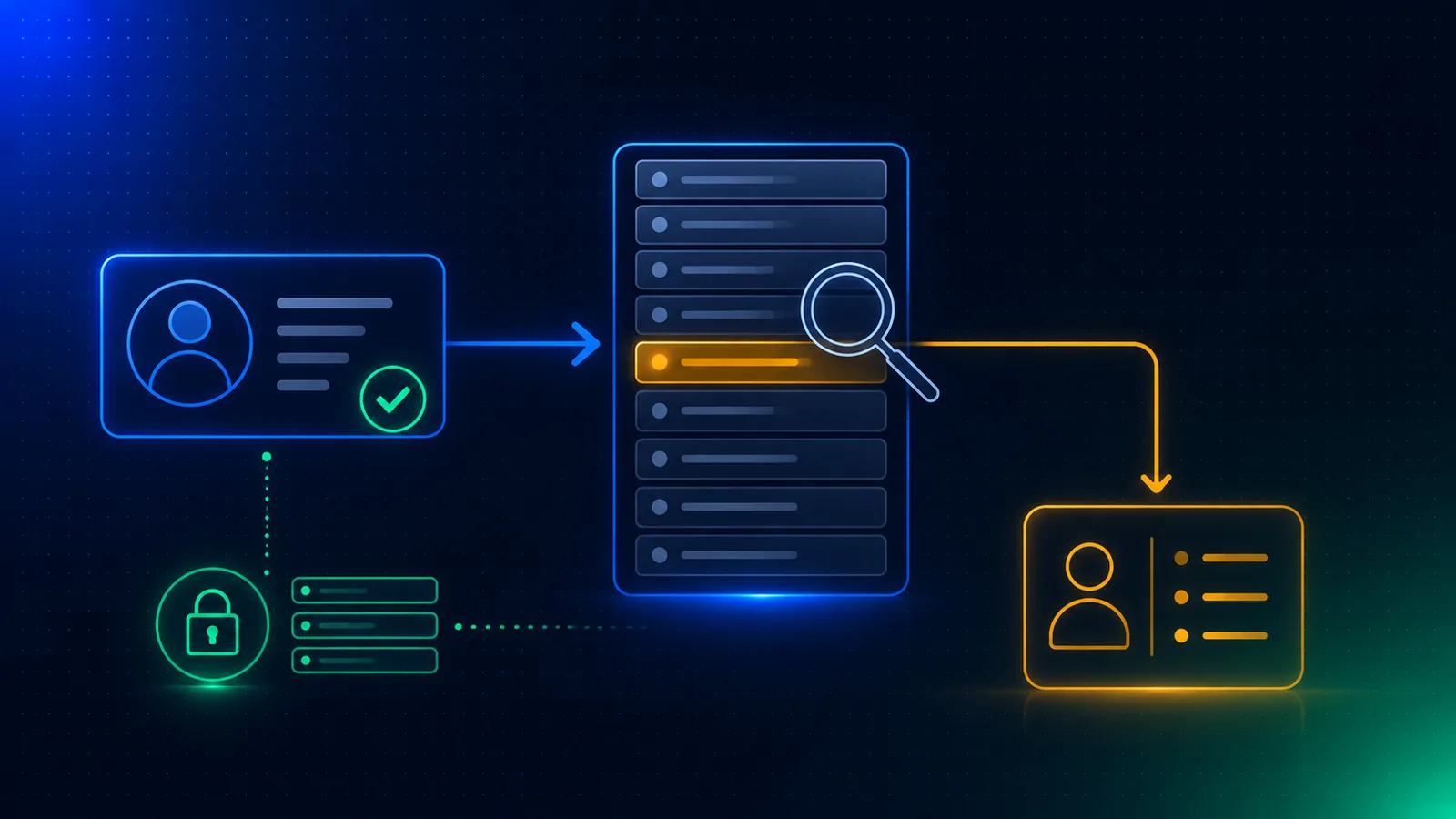
Google is the clearest example. Its US age-assurance system uses an age-estimation model that reads signals already on the account — the kinds of things you have searched for, the categories of videos you have watched — to decide whether you are over or under 18. If it decides you are under 18 and it is wrong, Google’s own remedy is that you “correct” your age by uploading a photo of a government ID or a selfie. Read that again: the privacy-preserving system whose entire pitch is “we don’t make you show ID” resolves its own mistakes by making you show ID. The estimation is free; the false positive costs the user a document upload.
Google is not alone, and that is the point. Over the first half of 2026, consumer AI apps switched estimation on across their user bases and adults with young-looking faces started landing in view-only lockouts. Platforms as different as X and Grindr published age-assurance help pages describing estimate-then-appeal flows. Apple pushed device-level age signals into iOS. The common thread is that age classification became ambient — applied by default to the whole population rather than requested from a few — and at that scale the arithmetic is unforgiving. A false-positive rate that looks trivial in a vendor deck becomes a mass event: 1% of a hundred-million-user base is a million wrongly-flagged adults, each one now holding a support ticket and a grievance. This is the same category error we flagged when platforms treated behavioral profiling as if it were verification — except now the cost lands on adults instead of the minors it was meant to protect.
Why Estimation Locks Out Adults — the Math, Not the Vibes
The adult-lockout rate is not a bug you can patch away with a better model this quarter. It falls directly out of how estimation works near a threshold.
Facial age estimation does not output “17” or “19.” It outputs a distribution with a mean absolute error measured in years. On NIST’s Face Analysis Technology Evaluation, the strongest algorithms have improved markedly, but NIST still colors a mean absolute error above 3.5 years as a caution — and that is for the leaders, on good images, for well-represented demographics. Now put an 18-or-21 hard line through a model with a few years of error. The people who cluster right at that line — the eighteen-to-twenty-two-year-olds — are precisely the population where a three-year error is the difference between “pass” and “prove it.” You cannot draw a crisp legal boundary through a fuzzy statistical estimate without slicing a large number of real adults onto the wrong side.
Then stack the conditions that widen the error, none of which are exotic. A younger-looking face. A hat, glasses, a beard shadow, a bad selfie in bad light. And, unavoidably, demographic skew: NIST’s own results still show mean-error gaps across sex, age cohort, and regional groups, which means the adult-lockout tax is not distributed evenly — it falls hardest on the same users who already carry the most friction, the ones we wrote about in the accessible age verification piece. “The model will get better” is true and irrelevant. Even a very good estimator, applied at population scale against a hard threshold, produces a steady stream of locked-out adults, because that is what a boundary through a distribution does. The NIST accuracy record tells you which vendors are best; it does not repeal the statistics.
The Appeal Path Is the Product
Here is the part teams get wrong even after they accept the math: they treat the appeal as an error-handling branch instead of a core product surface. It is the most important flow you will ship, and it is usually the least designed.
Walk the standard path. The model flags an adult as a minor. The product drops her into “view-only” or blocks the action. To recover, she is asked to retake a selfie; if that fails, upload a government ID; if that fails, open a support ticket and wait — days on the fast end, a week or two on the slow end. Every step of that is a tax on a person who did nothing wrong and who is, by definition, one of your real customers. A meaningful fraction never finishes it. They do not file feedback; they leave, exactly the way they leave any high-friction verification wall, except this cohort was already inside and already trusted you.
And notice what the appeal actually does to your privacy posture. Estimation is sold as the low-data option — no documents, no identity, just a yes/no. The appeal quietly inverts that. Every false positive converts a privacy-preserving check into a government-ID collection event, and at population scale you have built, by accident, a large pile of adult identity documents you never intended to hold. Critics have been blunt about where this leads: CNBC documented that age-verification tooling is spreading in the US while adults are the ones being surveilled, and Lawfare’s “To Read This, Please Upload Photo ID” captured the reversal in a headline. The EFF’s 2026 resource guide makes the same case at length. The appeal flow is where the political and reputational risk of your whole age program actually lives, and most teams ship it as a stub.
The Knob Nobody Tunes: Challenge Age and the Gray Zone
The good news is that the adult-lockout rate is not fixed. It is a dial, and the reason so many deployments get it wrong is that they never realized there was a dial to turn.
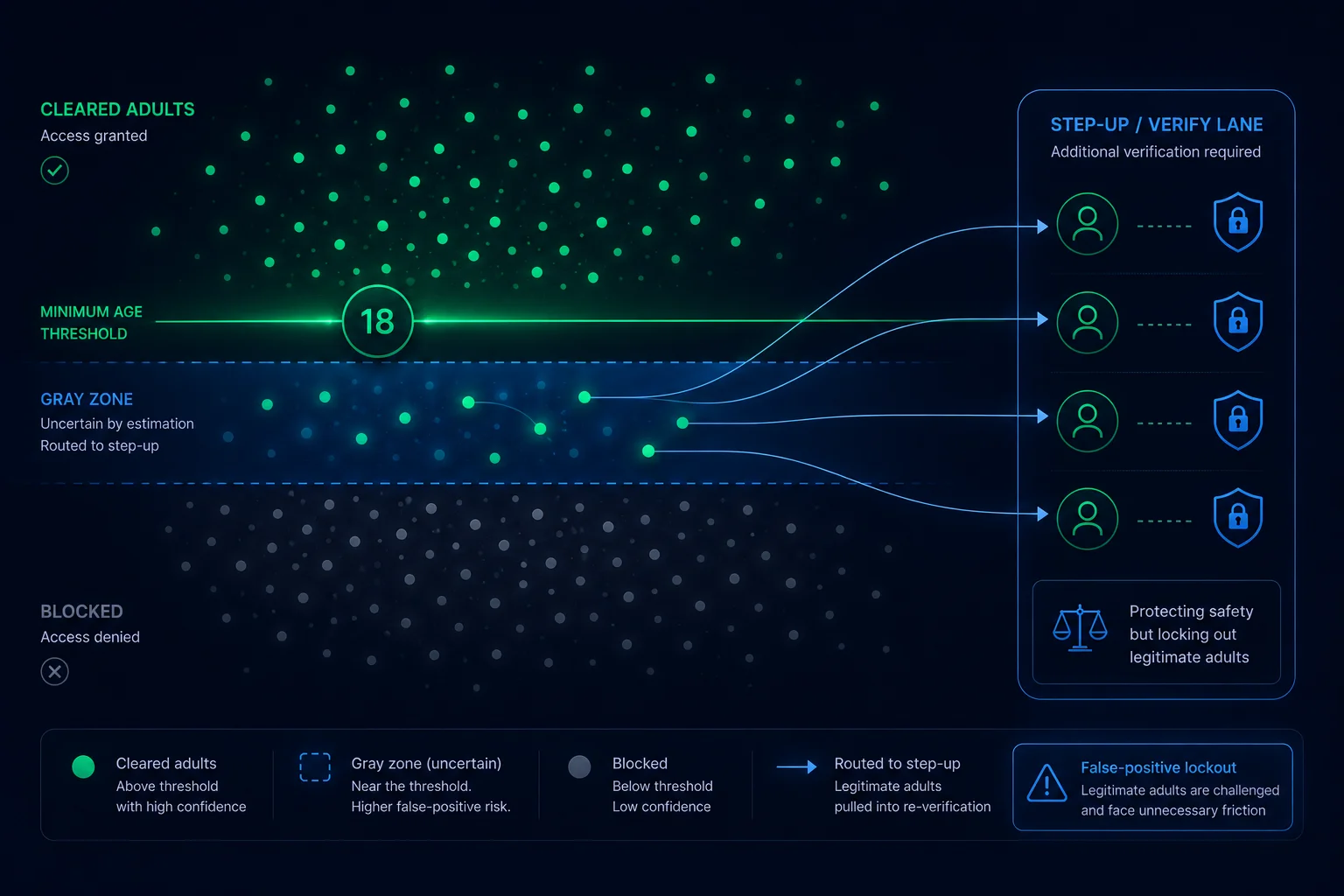
The naive design estimates the user’s age and compares it to the legal threshold: “model says 17, threshold is 18, block.” That maximizes false positives, because it puts the decision boundary exactly where the model’s error is most likely to flip an adult. The method that actually works is the one NIST tests against — the “challenge age”. Instead of asking “is this person 18,” you ask “is this person comfortably above 18” by setting a higher challenge age — Challenge-25 is the canonical example. Anyone the model places well above the challenge age clears instantly with almost no risk of being a minor. Anyone well below is blocked. Only the band in between — the gray zone near the boundary — gets escalated to a stronger check.
That single reframe is what lets you trade the two error rates against each other deliberately instead of accepting whatever the threshold hands you — and it pays to be precise about which error is which, because the word “false positive” points in opposite directions depending on who is speaking. NIST’s headline false-positive rate measures the error regulators fixate on: a minor who gets estimated at or above the challenge age and passes. Raise the challenge age and that number collapses — on NIST’s May 2026 update, Dermalog posted a false-positive rate of 0.017 in the Challenge-25 scenario. But the same move pushes more genuine adults into the gray zone, where they inherit the other error — the lockout this article is about. Lower the challenge age and the trade flips: fewer adults inconvenienced, more minors slipping through. There is no setting that makes both vanish; there is only an explicit, measured choice about where to sit on that curve for your risk profile. A gambling operator and a comment section should not pick the same point, and the failure of most 2026 deployments is that they never picked at all — they estimated at the bare threshold and shipped the resulting adult-lockout rate as if it were a law of nature. The academic literature is now explicit that these side effects and user acceptance are first-class evaluation criteria, not footnotes.
Designing the Failure Mode: Five Moves
Once you accept that false positives are a design choice rather than an accident, the build gets concrete.
Calibrate the challenge age to your actual risk, not to the statute. The legal threshold is 18 or 21; the age you estimate against should sit above it by a margin you chose on purpose. Size the gray zone to the stakes: wide where a wrong “pass” is catastrophic, narrow where the real cost is annoying adults.
Make the gray-zone step-up instant and privacy-preserving — this is the whole game. The step-up should be a fast, on-device escalation, not a multi-day support queue that terminates in an ID lake. When the estimate is ambiguous, offer an immediate second factor the user controls, and reserve document or chip checks for the genuine edge. The difference between a good and a catastrophic age program is almost entirely the latency and data cost of this one path.
Budget demographic equity explicitly, and measure it. A single headline accuracy number hides the fact that your gray zone falls harder on some cohorts than others. Track the false-flag rate by demographic, not just in aggregate, and treat a skewed lockout rate as a defect you own — the same discipline behind proving your assurance works rather than asserting it. This is also where you keep the retry path honest: a legitimate adult retrying after a bad selfie is not the attempt abuse a minor grinding for a pass is, and collapsing the two punishes the wrong person.
Remember the decision so an adult clears the gate once. A false positive that recurs on every session is a subscription to your own worst flow. Once a user has cleared a stronger check, issue a reusable credential or token so the estimate never re-litigates a settled question.
Keep the decision, not the data. The appeal is exactly where privacy programs go to die, because it is the moment you are tempted to retain documents “just in case.” Store the age-band outcome and discard the inputs, the way a privacy-first architecture is supposed to. If your false-positive handling quietly builds a biometric or document archive, you have converted a safety feature into a breach waiting to happen.
How Xident Fits
Xident was built around the boundary problem rather than the average-accuracy problem, because the boundary is where users actually get hurt. Instead of returning a single guessed age to compare against a bare threshold, Xident’s on-device facial age estimation returns an age band — +12, +15, +18, +21, +25 — which is the challenge-age model expressed as a product primitive. You pick the band that matches your risk, everyone comfortably inside it clears with no friction, and only the gray zone near your chosen line is escalated. The adult-lockout rate stops being an accident of the threshold and becomes a number you set.
The escalation is the part that decides whether your appeal flow is humane. When the band is ambiguous, the same SDK steps up on-device — to a document check for the genuine edge cases — in the same session, in seconds, rather than dumping the user into a days-long support ticket. Because the face is classified on the device and never reaches your servers, resolving a false positive does not build an identity archive; what you retain is the age-band decision, not a biometric. And token-based returning users never re-run the check, so a settled adult is settled for good. It is the opposite of the estimate-at-18-then-demand-a-passport pattern that is generating this year’s complaints — and it treats the wrongly-flagged adult as the customer she is, not as an exception to be processed.
The Real Takeaway
Age estimation is good technology and it is not going away; the population-scale rollout is, on balance, less friction and less collected data than the document-upload world it is replacing. But 2026 is teaching the whole industry a lesson it should have anticipated: when you run a classifier against everyone, the errors you have to answer for are the ones that hit your own users, and the false positive — the adult locked out — is now the failure that costs you trust, conversion, and headlines.
The teams that come out ahead are the ones that stop treating adult lockout as an edge case and start treating it as a first-class metric with a dial attached. Pick your challenge age on purpose. Make the step-up fast and forgettable. Measure the lockout rate by cohort. Keep the decision, not the documents. The false positive is not an act of god handed down by the model — it is a design choice, and in 2026 it is the most important one you will make. If you want to see what it looks like to build the boundary deliberately instead of inheriting it, start here.